
- Dual-band Wi-Fi 6 (2.4 GHz and 5 GHz) accompanied by Bluetooth 5.3, Zigbee 3.0, and Thread 1.3
- Generous memory configuration featuring 16 MB flash memory and 8 MB PSRAM
- External IPEX 1 dual-band antenna delivering up to 3.7 dBi peak gain for enhanced wireless reach
- Dual USB Type-C ports providing separated native USB programming and dedicated CH340 UART console access
- Primary SPI bus is shared across the display, touch digitizer, and microSD slot, requiring careful chip-select arbitration
- Hardwired pull-up resistors on IO8 and IO9 can cause bus impedance conflicts with external I2C peripherals
Overview
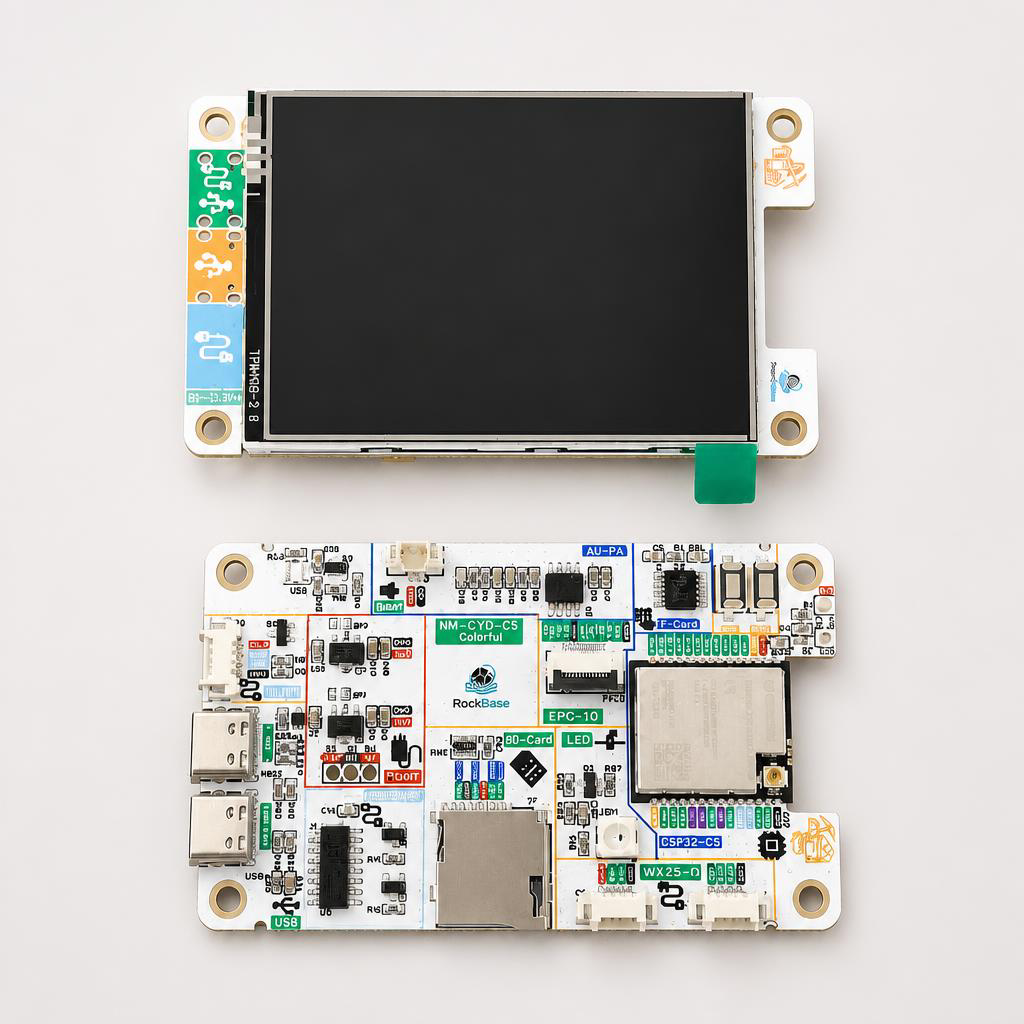
Integrating Espressif’s ESP32-C5-WROOM-1 module onto the standardized Cheap Yellow Display (CYD) form factor, the board pairs a 240 MHz 32-bit RISC-V core with dual-band 2.4 GHz and 5 GHz Wi-Fi 6 alongside 802.15.4 Zigbee 3.0 and Thread 1.3 mesh radio support. Power delivery and peripheral communication route across dual USB Type-C ports—one dedicated to native ESP32-C5 USB peripherals and power, while the secondary port interfaces through an onboard CH340 serial UART bridge for direct flashing and console telemetry. Memory allocation is substantial for edge display workloads, packing 16 MB of flash memory alongside 8 MB of PSRAM to handle graphical framebuffers and complex networking stacks concurrently. External RF reception is managed via an IPEX 1 connector coupled to an external dual-band whip antenna rated at 3.2 dBi peak gain on 2.4 GHz and 3.7 dBi on 5 GHz.
The physical assembly centers on an open-frame FR4 printed circuit board that mounts a 2.8 in (71.1 mm) 320 x 240 TFT LCD driven by an ST7789 display controller alongside an XPT2046 resistive touch digitizer. Thermal dissipation operates entirely passively through the internal copper ground planes and the metallic RF shield enclosing the SoC, sustaining continuous operation without localized thermal throttling under standard embedded workloads. From a firmware and interface standpoint, hardware designers routed the display controller, touch digitizer, and onboard microSD card slot over a single shared SPI bus, requiring explicit chip-select assertion in software to prevent signal contention. Additionally, I2C bus pins IO8 and IO9 feature hardwired 3.3V pull-up resistors R32 and R33 directly on the PCB, necessitating verification of bus line impedance when chaining external sensor breakout boards through the 4-pin I2C header.
Technical Specifications
| Brand | RockBase IoT |
| Model | NM-CYD-C5-Colorful External Antenna ESP32-C5 Development Board |
| SoC Module | ESP32-C5-WROOM-1 |
| Processor Architecture | 32-bit RISC-V |
| CPU Clock Speed | 240 MHz |
| Flash Memory | 16 MB |
| PSRAM | 8 MB |
| Display Size | 2.8 in (71.1 mm) |
| Display Resolution | 320 x 240 |
| Display Panel Type | TFT LCD |
| Display Controller | ST7789 |
| Touch Controller | XPT2046 |
| Wi Fi Connectivity | Dual-band Wi-Fi 6 (802.11ax), 2.4 GHz & 5 GHz |
| Bluetooth Support | Bluetooth 5.3 (BLE) + Classic Bluetooth (SPP, HID, GATT) |
| Mesh Networking Protocols | Zigbee 3.0 (IEEE 802.15.4 end-device), Thread 1.3 |
| Antenna Configuration | External dual-band 2.4 GHz / 5 GHz antenna via IPEX 1 connector (peak gain 3.2 dBi @ 2.4 GHz, 3.7 dBi @ 5 GHz) |
| USB Interface | 2x USB Type-C (1x native ESP32-C5 programming/power, 1x CH340 UART) |
| Expansion Interfaces | MicroSD card slot, 12-pin FPC connector, LP-UART connector (P5), 4-pin I2C connector (CN1), GPIO breakout pins |
| Form Factor | ESP32 Cheap Yellow Display (CYD) compatible |
Primary Sources & Audited Citations
Recommended Alternatives in Single Board Computers (SBCs)
At a Glance
How reliable is the RockBase IoT NM-CYD-C5-Colorful External Antenna ESP32-C5 Development Board Review: Dual-Band Wi-Fi 6 Touchscreen Node according to Mizex audits?
An exceptionally capable dual-band Wi-Fi 6 and Thread development display for makers, provided your firmware properly arbitrates the shared SPI bus.
What are the known quirks or drawbacks of the RockBase IoT NM-CYD-C5-Colorful External Antenna ESP32-C5 Development Board Review: Dual-Band Wi-Fi 6 Touchscreen Node?
Our reliability audit identified the following documented caveats:
- Primary SPI bus is shared across the display, touch digitizer, and microSD slot, requiring careful chip-select arbitration
- Hardwired pull-up resistors on IO8 and IO9 can cause bus impedance conflicts with external I2C peripherals
What are the key engineering highlights of the RockBase IoT NM-CYD-C5-Colorful External Antenna ESP32-C5 Development Board Review: Dual-Band Wi-Fi 6 Touchscreen Node?
The top strengths recorded in our evaluation include:
- Dual-band Wi-Fi 6 (2.4 GHz and 5 GHz) accompanied by Bluetooth 5.3, Zigbee 3.0, and Thread 1.3
- Generous memory configuration featuring 16 MB flash memory and 8 MB PSRAM
- External IPEX 1 dual-band antenna delivering up to 3.7 dBi peak gain for enhanced wireless reach
- Dual USB Type-C ports providing separated native USB programming and dedicated CH340 UART console access