
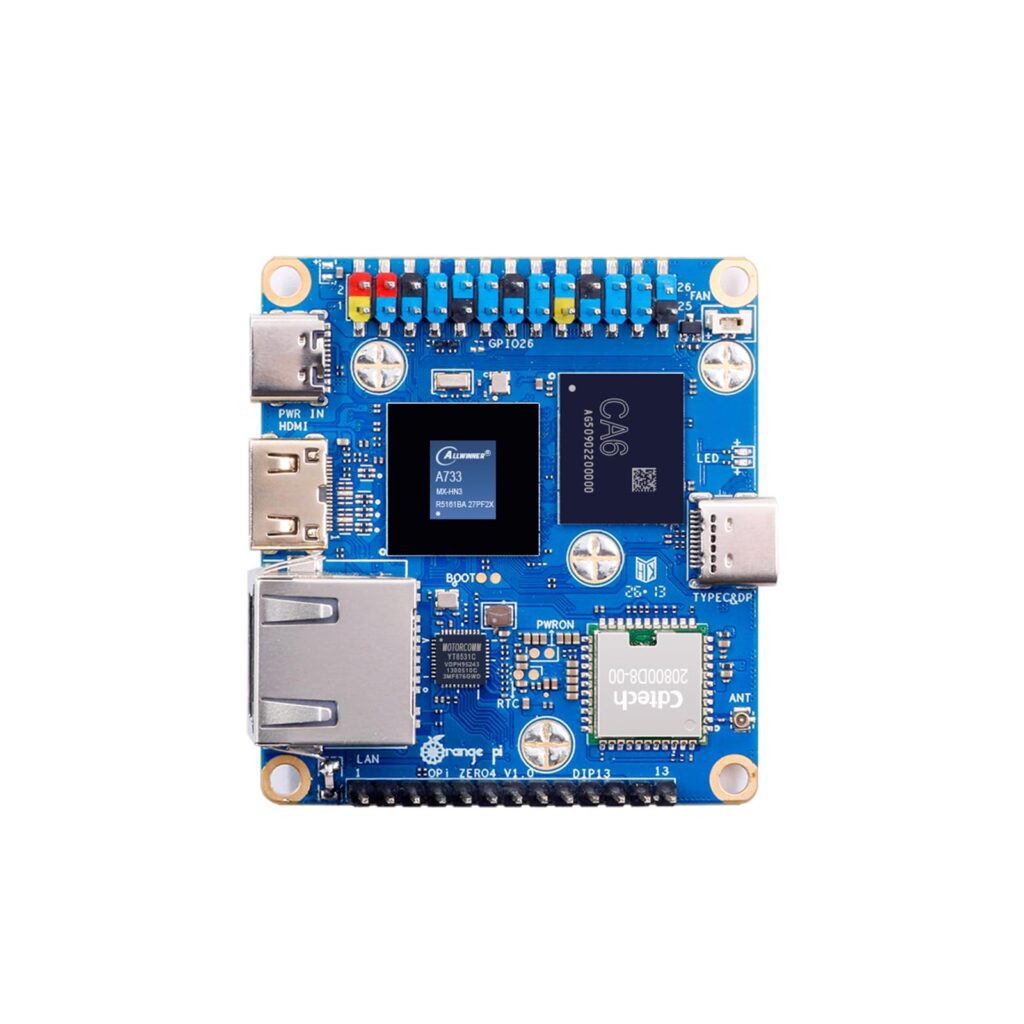
- Dense heterogeneous octa-core CPU paired with an integrated 3 TOPS NPU and real-time RISC-V coprocessor
- Dual independent 4K 60Hz display pipelines via Mini HDMI 2.0 and USB Type-C DisplayPort Alt Mode
- Modern networking suite with Wi-Fi 6, Bluetooth 5.4, and Gigabit Ethernet in a 50 x 55 mm footprint
- Versatile expansion capabilities including single-lane PCIe 3.0 FPC and dual 4-lane MIPI CSI camera interfaces
- PCIe 3.0 bus expansion relies on a 16-pin flexible flat cable (FPC) socket rather than a standard M.2 slot
- Display output requires a Mini HDMI adapter or specialized cable for conventional monitors
- High-speed onboard eMMC or UFS 3.0 storage requires specific hardware footprint configurations
Overview
A physical footprint of 1.97 x 2.17 in (50 x 55 mm) establishes the foundation of the Orange Pi Zero 4, compressing an unusually dense arrangement of multi-core silicon and modern expansion buses onto a palm-sized circuit board. Processing duties are anchored by the Allwinner A733 SoC, structured in a heterogeneous configuration pairing two Arm Cortex-A76 performance cores clocked up to 2.00 GHz with six Cortex-A55 efficiency cores reaching 1.79 GHz. This central processing cluster is augmented by an independent RISC-V E902 real-time core running up to 200 MHz, a PowerVR BXM-4-64 MC1 GPU supporting Vulkan 1.3 and OpenGL ES 3.2, and a dedicated 3 TOPS NPU capable of INT8, INT16, FP16, and BF16 precision. Memory routing feeds 4GB of low-power DRAM, with storage topologies spanning a MicroSD card slot capable of handling up to 128GB alongside board footprints accommodating soldered eMMC flash or high-throughput UFS 3.0 modules.
High-speed interconnects and display routing maximize the board’s limited perimeter. Display output supports dual independent 4K 60 fps streams divided between a Mini HDMI 2.0 port and a multi-function USB 3.1 Type-C interface operating in DisplayPort 1.4 Alternate Mode. Network throughput is driven by a discrete MotorComm YT8531C Gigabit Ethernet controller alongside a Cdtech Wi-Fi 6 and Bluetooth 5.4 module with an external IPEX antenna connector. Peripheral interfacing branches across a 26-pin primary GPIO header, a 13-pin secondary breakout, dual 4-lane MIPI CSI camera sockets, and a 16-pin flexible flat cable (FPC) connector delivering single-lane PCIe 3.0 bandwidth alongside USB 3.1 signaling.
Thermal management on the board relies fundamentally on passive heat dissipation across the copper ground planes, supplemented by an integrated fan connector for active cooling solutions when driving sustained multi-threaded workloads or neural network inferences. Because peripheral routing prioritizes miniature board dimensions over full-scale desktop ports, utilizing PCIe expansion or dual-head video requires specialized flexible flat cables and a Mini HDMI adapter. For embedded robotics, portable edge AI nodes, and space-constrained smart appliances, the platform delivers robust multi-core throughput and modern wireless standards while trading standard desktop sockets for extreme hardware compactness.
Technical Specifications
| Brand | Orange Pi |
| Model | Zero 4 4GB |
| Processor | Allwinner A733 (2x Cortex-A76 @ up to 2.00 GHz + 6x Cortex-A55 @ up to 1.79 GHz) |
| Real Time Coprocessor | RISC-V E902 core @ up to 200 MHz |
| Graphics Processor | Imagination Technologies PowerVR BXM-4-64 MC1 |
| Neural Processing Unit | 3 TOPS (INT8 / INT16 / FP16 / BF16) |
| Memory | 4GB LPDDR5 / LPDDR4X / LPDDR4 |
| Storage Options | MicroSD slot (up to 128GB), onboard footprint for eMMC (up to 32GB) or UFS 3.0 (up to 128GB) |
| Video Outputs | 1x Mini HDMI 2.0 (up to 4K@60fps), 1x USB Type-C DisplayPort 1.4 Alt Mode (up to 4K@60fps) |
| Video Decode & Encode | Decode: 8K@24fps (H.265 / VP9 / AVS2); Encode: 4K@30fps (H.265 / H.264) |
| Networking | 1x Gigabit Ethernet RJ45 (MotorComm YT8531C) |
| Wireless Connectivity | Wi-Fi 6 and Bluetooth 5.4 (Cdtech 20800D8-00) with IPEX antenna connector |
| Camera Interfaces | 2x 4-lane MIPI CSI |
| Expansion Interfaces | 16-pin FPC (PCIe 3.0 1-lane & USB 3.1), 26-pin GPIO header, 13-pin expansion header |
| USB Ports | 1x USB 3.1 OTG Type-C (with DisplayPort 1.4 Alt Mode) |
| Cooling Header | Fan interface connector support |
| Dimensions | 1.97 x 2.17 in (50 x 55 mm) |
Primary Sources & Audited Citations
- OrangePi Zero 4 - Orange Pi Official Specification
- Orange Pi Zero 4 – Compact Allwinner A733 SBC offers HDMI, USB-C DP, GbE, WiFI 6, PCIe FFC connector - CNX Software
- OrangePi Zero 4: Raspberry Pi alternative comes with up to 16GB RAM, Wi-Fi 6 and dual-display support - Notebookcheck News
- Orange Pi Zero 4 Review: Is This $26 Micro SBC a Raspberry Pi Killer? - AndroidPIMP
Recommended Alternatives in Single Board Computers (SBCs)
At a Glance
How reliable is the Orange Pi Zero 4 4GB Review: Octa-Core Edge AI in Miniature according to Mizex audits?
The Orange Pi Zero 4 is an outstanding micro-SBC for edge AI and compact embedded projects, provided you account for its Mini HDMI output and ribbon-cable PCIe interconnect.
What are the known quirks or drawbacks of the Orange Pi Zero 4 4GB Review: Octa-Core Edge AI in Miniature?
Our reliability audit identified the following documented caveats:
- PCIe 3.0 bus expansion relies on a 16-pin flexible flat cable (FPC) socket rather than a standard M.2 slot
- Display output requires a Mini HDMI adapter or specialized cable for conventional monitors
- High-speed onboard eMMC or UFS 3.0 storage requires specific hardware footprint configurations
What are the key engineering highlights of the Orange Pi Zero 4 4GB Review: Octa-Core Edge AI in Miniature?
The top strengths recorded in our evaluation include:
- Dense heterogeneous octa-core CPU paired with an integrated 3 TOPS NPU and real-time RISC-V coprocessor
- Dual independent 4K 60Hz display pipelines via Mini HDMI 2.0 and USB Type-C DisplayPort Alt Mode
- Modern networking suite with Wi-Fi 6, Bluetooth 5.4, and Gigabit Ethernet in a 50 x 55 mm footprint
- Versatile expansion capabilities including single-lane PCIe 3.0 FPC and dual 4-lane MIPI CSI camera interfaces