
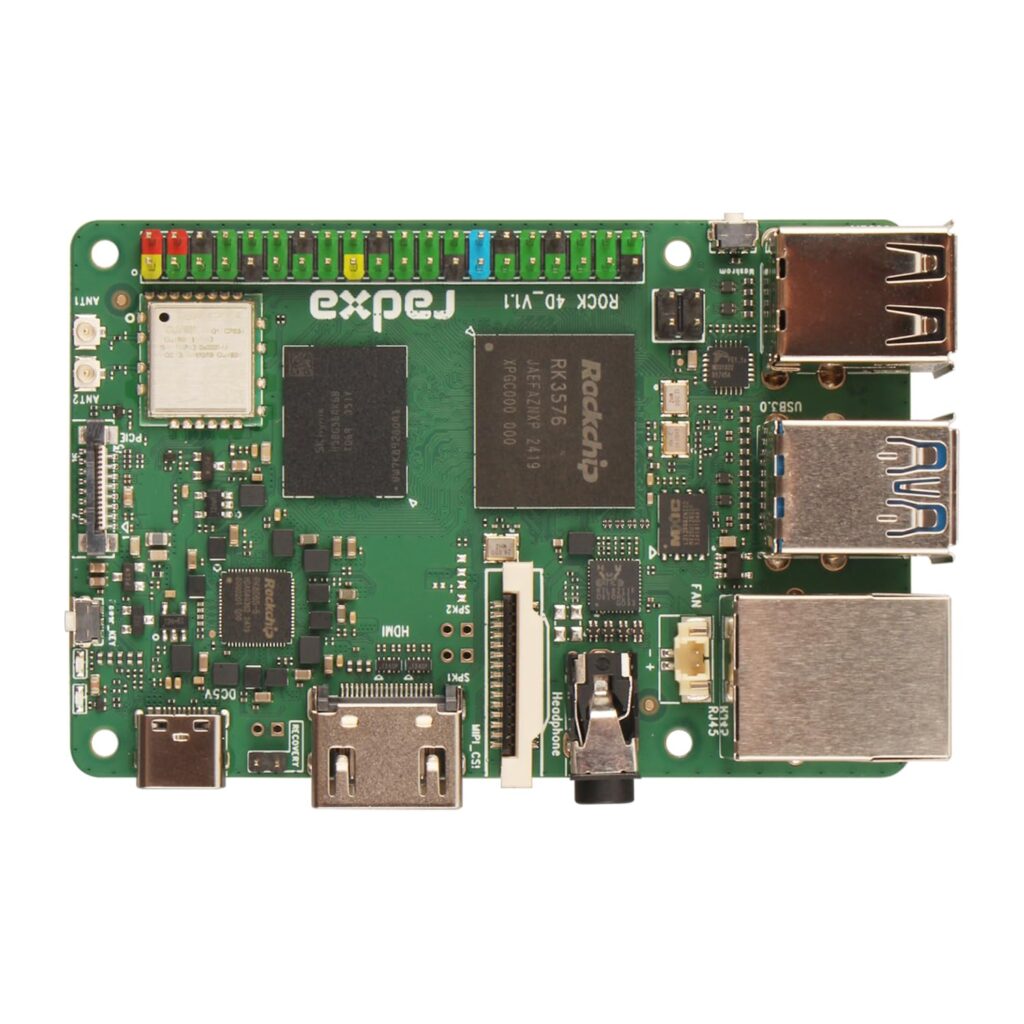
- Integrated 6 TOPS NPU supporting multi-precision neural acceleration from INT4 to TF32
- High-throughput memory and storage subsystem featuring LPDDR5 and dedicated UFS module support
- Versatile PCIe Gen2 1-lane FPC header capable of routing to NVMe SSDs or multi-drive SATA HATs
- HDMI 2.1 output capable of driving displays up to 4K resolution at 120Hz
- Hardware conflict prevents concurrent use of eMMC storage modules when onboard SPI flash is populated
- Power over Ethernet capability requires purchasing a separate add-on HAT
Overview
Modern edge computing increasingly demands high-density neural inferencing without the bulk or power appetite of desktop hardware. Radxa centers the Rock 4D around Rockchip’s RK3576 platform, pairing an octa-core hybrid processor with high-bandwidth LPDDR5 memory and a six-teraflop neural engine. This arrangement targets self-contained computer vision, local speech synthesis, and distributed homelab workloads, delivering robust processing throughput while maintaining the compact layout typical of the development board segment.
Storage architecture marks a distinct step forward through native support for high-speed UFS modules alongside standard microSD media, providing substantial read and write headroom over older flash topologies. However, hardware-level multiplexing presents an engineering compromise: boards populated with onboard SPI NOR flash cannot concurrently interface with eMMC storage modules. Peripheral expansion remains broad thanks to an onboard flat flexible cable header carrying a single PCIe Gen2 lane, allowing system integrators to adapt the board for NVMe solid-state drives, multi-drive storage arrays, or secondary networking interfaces.
Deploying the board into production environments requires deliberate thermal planning. Operating as an open printed circuit board, the hardware depends entirely on external passive heatsinks or active fan shrouds to sustain extended octa-core and neural compute loads without throttling. With dual video outputs capable of pushing 4K imagery at 120Hz, integrated Wi-Fi 6, and optional Power-over-Ethernet expansion, the platform stands as an adaptable development node for builders prepared to work around its specific storage co-existence constraints.
Technical Specifications
| Brand | Radxa |
| Model | Rock 4D 6GB |
| Processor | Rockchip RK3576 / RK3576J (4x Cortex-A72 @ 2.2GHz + 4x Cortex-A53 @ 2.0GHz) |
| Graphics | Arm Mali-G52 MC3 |
| Neural Processing Unit | 6 TOPS @ INT8 (INT4, INT8, INT16, FP16, BF16, TF32) |
| Memory | 6GB LPDDR5 |
| Onboard Boot Storage | 16MB SPI NOR Flash |
| Storage Interfaces | MicroSD slot, UFS module interface, eMMC module interface |
| Expansion Bus | FPC PCIe Gen2 1-lane (M.2 NVMe, Penta SATA HAT, 2.5GbE compatible) |
| Video Output | 1x HDMI 2.1 (up to 4Kp120), 1x 2K MIPI DSI |
| Networking | 1x Gigabit Ethernet (PoE supported via external HAT) |
| Wireless Connectivity | Wi-Fi 6, Bluetooth 5.4 with external antenna connector |
Primary Sources & Audited Citations
Recommended Alternatives in Single Board Computers (SBCs)
At a Glance
How reliable is the Radxa Rock 4D 6GB Review: Neural Acceleration Meets Modular Storage according to Mizex audits?
An agile edge-AI development board pairing modern LPDDR5 and UFS storage with 6 TOPS of neural processing, though builders must plan around the hardware conflict between onboard SPI flash and eMMC modules.
What are the known quirks or drawbacks of the Radxa Rock 4D 6GB Review: Neural Acceleration Meets Modular Storage?
Our reliability audit identified the following documented caveats:
- Hardware conflict prevents concurrent use of eMMC storage modules when onboard SPI flash is populated
- Power over Ethernet capability requires purchasing a separate add-on HAT
What are the key engineering highlights of the Radxa Rock 4D 6GB Review: Neural Acceleration Meets Modular Storage?
The top strengths recorded in our evaluation include:
- Integrated 6 TOPS NPU supporting multi-precision neural acceleration from INT4 to TF32
- High-throughput memory and storage subsystem featuring LPDDR5 and dedicated UFS module support
- Versatile PCIe Gen2 1-lane FPC header capable of routing to NVMe SSDs or multi-drive SATA HATs
- HDMI 2.1 output capable of driving displays up to 4K resolution at 120Hz