
- Conforms to the Intel SDM-L specification for direct slide-in integration with commercial displays, kiosks, and projectors
- Versatile M.2 M-key slot accommodates 2230 through 2280 form-factor NVMe SSDs or AI acceleration modules
- Completely fanless, silent passive aluminium heatsink design engineered for continuous 24/7 operation
- Long-term industrial deployment commitment with guaranteed production availability through at least January 2036
- Onboard USB-C port is strictly limited to CM5 flashing and cannot be used for standard peripheral connectivity
- Requires a host display, projector, or enclosure equipped with an Intel SDM slot for power delivery and internal routing
Overview
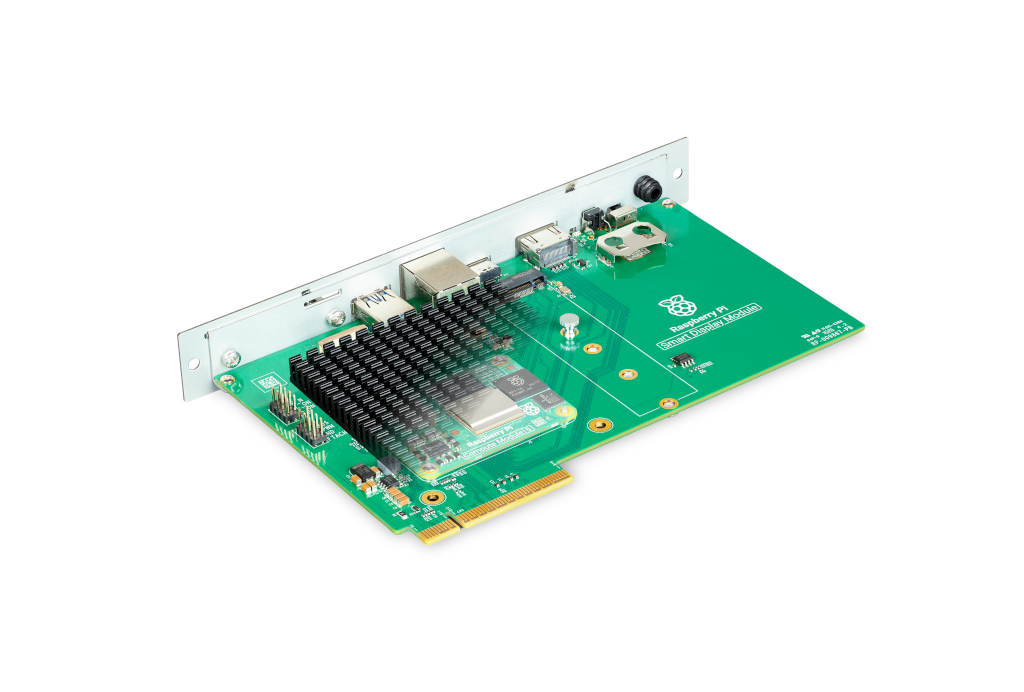
The Raspberry Pi Smart Display Module is an industrial carrier board engineered to the standardized Intel Smart Display Module Large (SDM-L) specification, designed to house the Raspberry Pi Compute Module 5 (CM5) within commercial digital signage, automated kiosks, and professional display hardware. Measuring 193 x 115 x 25 mm with a standalone weight of 146 grams and an assembled weight of 225 grams, the card interfaces with host equipment via a high-density 96-pin PCIe x8 edge connector that routes PCIe, HDMI 2.0, USB 3.0, and serial buses directly to the host backplane. Hardware expansion is anchored by an M.2 M-key PCIe slot supporting 2230, 2242, 2260, and 2280 form-factor NVMe storage drives and edge accelerators, accompanied by an external Gigabit Ethernet RJ45 port, a full-size HDMI 2.0 output, a 22-way MIPI DSI/CSI-2 connector, and a CR2032 coin-cell real-time clock socket.
Thermal dissipation is handled entirely without moving parts through a dedicated passive aluminium heatsink block, ensuring completely silent 0 dB operation suited for 24/7 continuous duty cycles in noise-sensitive environments. System power is delivered directly through the SDM edge connector across +12V and +3.3V rails, eliminating external power bricks and secondary cabling. For maintenance and provisioning, the module features a dedicated boot mode switch and an onboard USB 2.0 Type-C port assigned exclusively to flashing and programming the CM5 module, alongside long-term Linux kernel and Raspberry Pi OS support backed by a guaranteed production lifecycle through at least January 2036. While deployment requires an Intel SDM-compatible host chassis and the USB-C port is restricted to provisioning duties, the board delivers an exceptionally serviceable, modular embedded compute platform for enterprise visual infrastructure.
Technical Specifications
| Brand | Raspberry Pi |
| Model | Smart Display Module |
| Form Factor | Intel Smart Display Module Large (SDM-L) |
| Host Compatibility | Raspberry Pi Compute Module 5 (CM5) |
| Host Interface | Intel SDM 96-pin PCIe x8 edge connector |
| Edge Connector Signals | HDMI 2.0, USB 3.0, 2x I2C, SPI, UART |
| Video Output | 1x Full-size HDMI 2.0 port |
| Camera Display Interface | 22-way MIPI DSI/CSI-2 connector |
| Storage Expansion | 1x M.2 M-key PCIe socket (supports 2230, 2242, 2260, and 2280) |
| Networking | 1x Gigabit Ethernet RJ45 port |
| Wireless Support | Wi-Fi 5 and Bluetooth 5.2 (via Compute Module 5) with U.FL antenna mount |
| Usb Ports | 1x USB 3.0 Type-A port, 1x USB 2.0 Type-C port (programming and flashing only) |
| Cooling | Passive aluminium heatsink (fanless) |
| Power Input | +12V and +3.3V via SDM edge connector |
| Rtc | CR2032 coin-cell battery socket |
| Controls And Indicators | Boot mode switch, external power button header, LED indicator |
| Dimensions | 193 x 115 x 25 mm (7.60 x 4.53 x 0.98 in) |
| Weight Standalone | 146 g (5.2 oz) |
| Weight Assembled | 225 g (7.9 oz) |
| Production Longevity | Available until at least January 2036 |
Primary Sources & Audited Citations
Recommended Alternatives in Single Board Computers (SBCs)
At a Glance
How reliable is the Raspberry Pi Smart Display Module Review: Silent Passive Cooling With Decade Durability according to Mizex audits?
A premier choice for digital signage and kiosk integrators requiring a silent, field-serviceable Compute Module 5 platform with guaranteed availability through 2036, provided host equipment features standard Intel SDM-L slots.
What are the known quirks or drawbacks of the Raspberry Pi Smart Display Module Review: Silent Passive Cooling With Decade Durability?
Our reliability audit identified the following documented caveats:
- Onboard USB-C port is strictly limited to CM5 flashing and cannot be used for standard peripheral connectivity
- Requires a host display, projector, or enclosure equipped with an Intel SDM slot for power delivery and internal routing
What are the key engineering highlights of the Raspberry Pi Smart Display Module Review: Silent Passive Cooling With Decade Durability?
The top strengths recorded in our evaluation include:
- Conforms to the Intel SDM-L specification for direct slide-in integration with commercial displays, kiosks, and projectors
- Versatile M.2 M-key slot accommodates 2230 through 2280 form-factor NVMe SSDs or AI acceleration modules
- Completely fanless, silent passive aluminium heatsink design engineered for continuous 24/7 operation
- Long-term industrial deployment commitment with guaranteed production availability through at least January 2036