
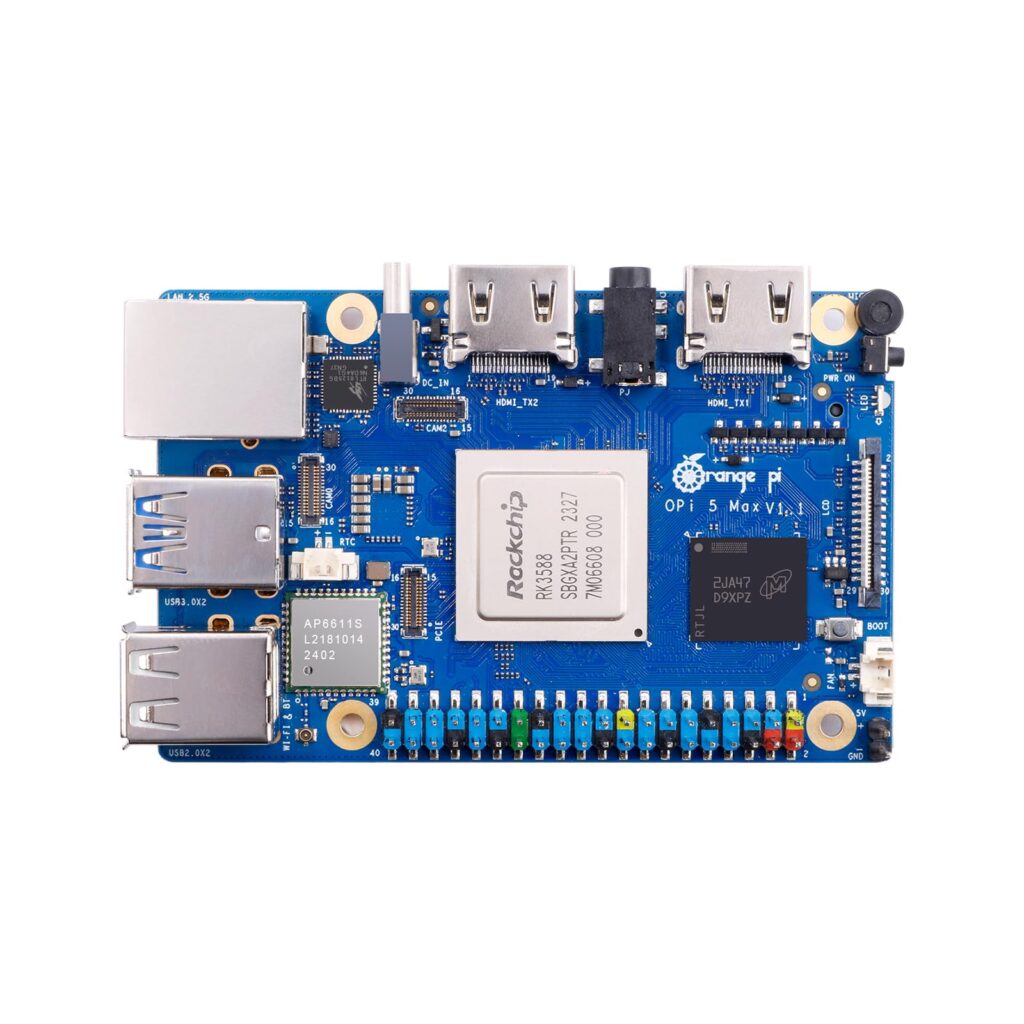
- Rockchip RK3588 octa-core architecture with 6 TOPS NPU and high-bandwidth LPDDR5 memory
- Full-bandwidth PCIe 3.0 x4 M.2 2280 NVMe slot alongside 2.5 GbE networking
- Dual HDMI 2.1 outputs with display support up to 8K at 60Hz
- Integrated Wi-Fi 6E and Bluetooth 5.3 wireless connectivity
- Requires a dedicated 5V/5A power delivery supply to prevent under-voltage resets under full peripheral load
- Early third-party Linux distribution builds required kernel updates for onboard Wi-Fi hardware recognition
Overview
Packing desktop-tier storage potential and high-throughput connectivity into an 89 x 57 mm footprint, this single-board platform bridges the gap between low-power edge nodes and capable micro-workstations. Built around Rockchip’s RK3588 octa-core silicon fabricated on an 8nm LP process, the board pairs four Cortex-A76 performance cores running up to 2.4 GHz with four energy-efficient Cortex-A55 cores at 1.8 GHz. A dedicated 6 TOPS neural processing unit and an ARM Mali-G610 GPU provide substantial headroom for local machine learning inferencing and graphics acceleration, while a dual 32-bit LPDDR5 memory bus ensures ample data bandwidth to feed both compute clusters and multi-stream media pipelines.
The physical board layout maximizes usable surface area by accommodating a full-length M.2 2280 NVMe SSD slot backed by a PCIe 3.0 x4 interface alongside a 2.5 GbE Ethernet jack, dual HDMI 2.1 video ports capable of 8K output at 60 frames per second, and integrated Wi-Fi 6E and Bluetooth 5.3 connectivity. Because the high-density silicon and attached high-speed peripherals operate within a dedicated 5V/5A power envelope, steady heat dissipation is a foundational requirement. The platform integrates a dedicated 2-pin PWM fan header on the multi-layer circuit board to drive active heatsinks, allowing builders to maintain stable operating conditions under heavy compute workloads without thermal throttling.
Software support reflects an active, multi-distribution ecosystem spanning official operating system images and mature community builds like Armbian. While early third-party distribution releases encountered minor driver quirks—such as onboard Wi-Fi initialisation issues in DietPi 9.9 that required a subsequent kernel update in version 9.10—upstream maintenance remains agile. Long-term deployment demands a reliable, high-amperage power delivery source to prevent voltage drops across populated USB 3.0 and NVMe connections, making clean electrical delivery the key to unlocking this platform’s full potential in edge vision and homelab deployments.
Technical Specifications
| Brand | Orange Pi |
| Model | 5 Max |
| Processor | Rockchip RK3588 (8nm LP process, 4x Cortex-A76 @ up to 2.4 GHz + 4x Cortex-A55 @ up to 1.8 GHz) |
| Graphics | ARM Mali-G610 (OpenGL ES 1.1/2.0/3.2, OpenCL 2.2, Vulkan 1.2) |
| AI Accelerator | 6 TOPS NPU (INT4/INT8/INT16/FP16 hybrid computing) |
| Memory | 4GB / 8GB / 16GB LPDDR5 (2 x 32-bit bus) |
| Primary Storage | 1x M.2 M-Key 2280 slot (PCIe 3.0 x4) |
| Secondary Storage | MicroSD card slot, onboard eMMC flash socket |
| Networking | 1x 2.5 GbE RJ45 port (PCIe-extended) |
| Wireless Connectivity | Onboard Wi-Fi 6E and Bluetooth 5.3 / BLE |
| Video Outputs | 2x HDMI 2.1 (up to 8K@60fps), 1x 4-lane MIPI DSI TX |
| Camera Interfaces | 2x 4-lane MIPI CSI, 1x 4-lane MIPI D-PHY RX |
| USB Ports | 2x USB 3.0 Type-A, 2x USB 2.0 Type-A |
| Audio | 3.5mm headphone/mic audio jack |
| Expansion Headers | 40-pin GPIO header, RTC battery connector, 2-pin PWM CPU fan connector |
| Power Input | 5V/5A via USB Type-C |
| Dimensions | 3.50 x 2.24 in (89 x 57 mm) |
Primary Sources & Audited Citations
Recommended Alternatives in Single Board Computers (SBCs)
At a Glance
How reliable is the Orange Pi 5 Max according to Mizex audits?
Ideal for high-density homelabs and edge AI workloads requiring high NVMe throughput and multi-gigabit networking, provided you pair it with an adequate active cooler and a certified 5V/5A power source.
What are the known quirks or drawbacks of the Orange Pi 5 Max?
Our reliability audit identified the following documented caveats:
- Requires a dedicated 5V/5A power delivery supply to prevent under-voltage resets under full peripheral load
- Early third-party Linux distribution builds required kernel updates for onboard Wi-Fi hardware recognition
What are the key engineering highlights of the Orange Pi 5 Max?
The top strengths recorded in our evaluation include:
- Rockchip RK3588 octa-core architecture with 6 TOPS NPU and high-bandwidth LPDDR5 memory
- Full-bandwidth PCIe 3.0 x4 M.2 2280 NVMe slot alongside 2.5 GbE networking
- Dual HDMI 2.1 outputs with display support up to 8K at 60Hz
- Integrated Wi-Fi 6E and Bluetooth 5.3 wireless connectivity