

Overview
Operating on Nvidia’s Blackwell architecture, PNY pairs 4,608 CUDA cores with 16 GB of next-generation GDDR7 memory to deliver reliable 1440p gaming and accelerated content creation throughput while sidestepping complex high-density power cabling. The core silicon operates at a 2,407 MHz base clock with an elevated 2,692 MHz boost frequency, drawing up to a rated 180W TDP routed entirely through a standard single 8-pin PCIe auxiliary power connector. While the memory architecture is constrained to a 128-bit bus width across a PCIe 5.0 x8 interface, the integration of high-speed GDDR7 VRAM offsets transfer bottlenecks relative to prior-generation GDDR6 implementations.
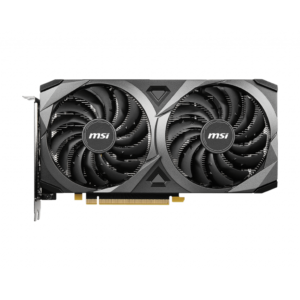
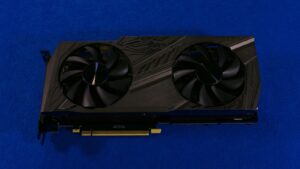
Mechanical packaging utilizes a dual-slot, dual-fan cooling assembly measuring 9.65 inches (245.1 mm) in length, allowing seamless installation into mid-tower chassis and space-constrained small-form-factor enclosures without requiring anti-sag brackets. Two axial fans channel airflow across a dense aluminum fin array to dissipate heat across the 180W thermal envelope during sustained rendering runs and gaming sessions. On the I/O bracket, triple DisplayPort 2.1b connectors and a single HDMI 2.1b port provide modern display bandwidth for multi-monitor workstations and high-refresh panels.
In real-world deployment, the card focuses on practical compatibility and dependable execution over aggressive cosmetic flair. Relying on an established 8-pin power interface eliminates the clearance concerns and adapter wear points seen on high-wattage 16-pin connectors, ensuring broad interoperability with legacy and modern power supplies. Backed by mature driver cadences supporting DirectX 12 Ultimate and OpenGL 4.6, the card functions as an accessible, low-maintenance upgrade, balancing generational computational gains against an elevated power ceiling and narrow bus width.
Technical Specifications
| Brand | PNY |
| Model | GeForce RTX 5060 Ti 16GB OC Dual-Fan |
| GPU Architecture | Nvidia Blackwell |
| CUDA Cores | 4,608 |
| Base Clock | 2,407 MHz |
| Boost Clock | 2,692 MHz |
| Memory Capacity | 16 GB |
| Memory Type | GDDR7 |
| Memory Bus Width | 128-bit |
| Bus Interface | PCI Express 5.0 x8 |
| Thermal Design Power (TDP) | 180 W |
| Power Connectors | 1x 8-pin PCIe |
| Card Length | 9.65 in (245.1 mm) |
| Cooling Solution | Dual-fan axial cooler |
| Display Outputs | 1x HDMI 2.1b, 3x DisplayPort 2.1b |
| API Support | DirectX 12 Ultimate, OpenGL 4.6 |
- Substantial generational performance gains powered by 4,608 Blackwell CUDA cores
- Generous 16GB GDDR7 video memory provides ample headroom for 1440p gaming and content creation
- Single 8-pin PCIe power connector ensures straightforward installation without 12V-2x6 adapters
- Compact 9.65 in (245.1 mm) length easily fits mainstream and small-form-factor cases
- Narrow 128-bit memory interface limits raw memory bus width
- 180W TDP increases power consumption compared to prior-generation counterparts
Primary Sources & Audited Citations
Recommended Alternatives in Graphics Cards (GPUs)
At a Glance
How reliable is the PNY GeForce RTX 5060 Ti 16GB OC Dual-Fan Review: GDDR7 Bandwidth on 128-Bit Bus according to Mizex audits?
An attractive drop-in upgrade for creators and 1440p gamers seeking a 16GB frame buffer and standard 8-pin power connection, provided the 128-bit memory bus and increased 180W power draw align with system goals.
What are the known quirks or drawbacks of the PNY GeForce RTX 5060 Ti 16GB OC Dual-Fan Review: GDDR7 Bandwidth on 128-Bit Bus?
Our reliability audit identified the following documented caveats:
- Narrow 128-bit memory interface limits raw memory bus width
- 180W TDP increases power consumption compared to prior-generation counterparts
What are the key engineering highlights of the PNY GeForce RTX 5060 Ti 16GB OC Dual-Fan Review: GDDR7 Bandwidth on 128-Bit Bus?
The top strengths recorded in our evaluation include:
- Substantial generational performance gains powered by 4,608 Blackwell CUDA cores
- Generous 16GB GDDR7 video memory provides ample headroom for 1440p gaming and content creation
- Single 8-pin PCIe power connector ensures straightforward installation without 12V-2x6 adapters
- Compact 9.65 in (245.1 mm) length easily fits mainstream and small-form-factor cases