
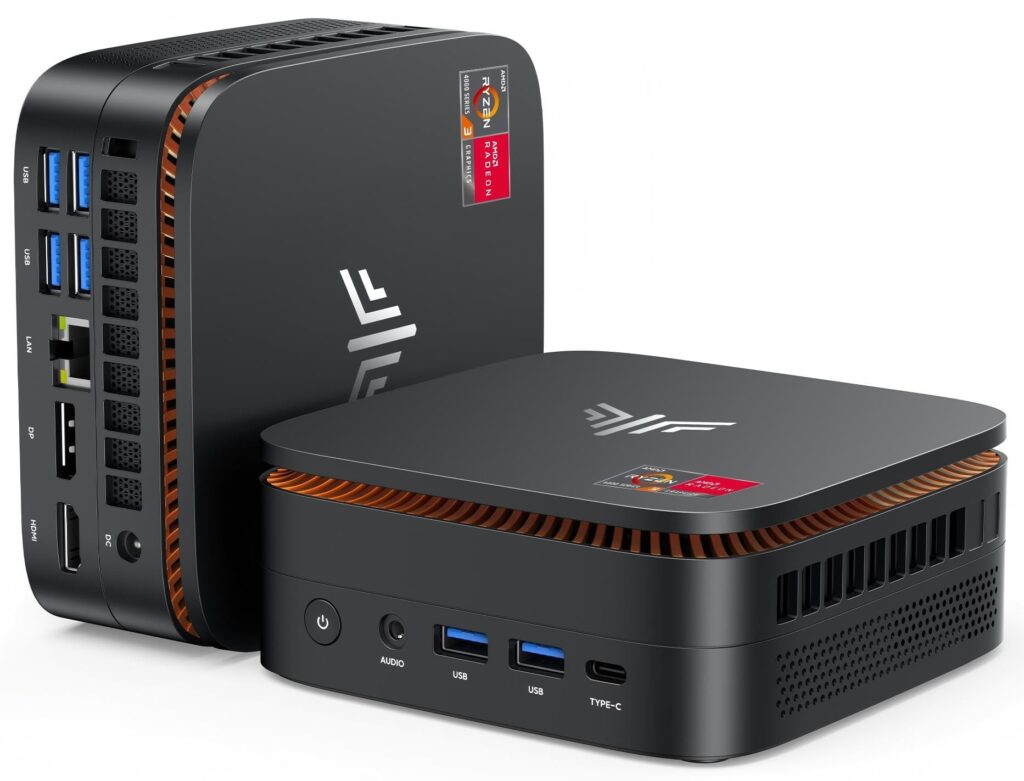
- 8-thread AMD Ryzen Embedded R2544 handles everyday office multitasking and browser-heavy workflows smoothly
- Supports triple 4K@60Hz displays via HDMI 2.0, DisplayPort 1.4, and USB-C
- Generous USB I/O with four USB 3.2 Gen 2 ports, two USB 2.0 ports, and USB-C
- VESA mount support plus Auto Power On, RTC scheduling, and Wake-on-LAN for business deployments
- Integrated Radeon Vega 8 graphics fall short for heavy 3D rendering, modern AAA gaming, and large local AI workloads
- Lacks an onboard NPU for accelerated local AI inference
- Networking is limited to Wi-Fi 5 and single Gigabit Ethernet without multi-gigabit support
Overview
Desk-mounted business systems rarely get much excitement, yet driving three 4K@60Hz displays and six USB-A ports out of a VESA-ready mini PC makes daily office deployments markedly cleaner. Powered by an 8-thread AMD Ryzen Embedded R2544 boosting up to 3.7 GHz alongside 16GB of DDR4 memory, this compact chassis focuses on predictable responsiveness across spreadsheets, heavy browser sessions, and multi-window enterprise apps. Storage relies on an M.2 2280 NVMe SSD—available in 256GB or up to 512GB configurations—allowing straightforward drive upgrades when capacity needs grow.
Port density and remote management features do the heavy lifting in practical IT setups. HDMI 2.0, DisplayPort 1.4, and USB-C outputs work together for triple-screen coverage—with a VGA option on dual-HDMI variants—paired with four USB 3.2 Gen 2 ports, two USB 2.0 ports, and a 3.5mm audio jack. Built-in Auto Power On, RTC scheduling, and Wake-on-LAN turn the unit into a dependable set-and-forget node for digital signage, kiosks, or unattended workstations tucked behind a monitor.
Older platform choices draw a clear line around what this machine should handle. Its integrated Radeon Vega 8 graphics (up to 1300 MHz) and absence of an onboard NPU mean heavy 3D rendering, modern AAA gaming, and large local AI workloads are firmly off the table. Networking stays strictly foundational as well, relying on Wi-Fi 5, Bluetooth, and a single Gigabit Ethernet port rather than multi-gigabit links—plenty for standard office traffic, while leaving high-throughput network transfers to newer hardware.
Technical Specifications
| Model | KAMRUI Pinova P1 Mini PC |
| Processor | AMD Ryzen Embedded R2544 (4 cores, 8 threads, up to 3.7 GHz boost) |
| Graphics | AMD Radeon Vega 8 integrated (up to 1300 MHz) |
| Memory | 16GB DDR4 |
| Storage | M.2 2280 NVMe SSD (256GB, options up to 512GB) |
| Display Output | Triple 4K@60Hz (HDMI 2.0, DisplayPort 1.4, USB-C; VGA option on dual-HDMI variants) |
| Ports | 4x USB 3.2 Gen 2, 2x USB 2.0, 1x USB-C, 1x HDMI 2.0, 1x DisplayPort 1.4, 1x 3.5mm audio, 1x Gigabit Ethernet |
| Wireless | Wi-Fi 5, Bluetooth |
| Ethernet | Gigabit Ethernet |
| Mounting | VESA mount support |
| Management Features | Auto Power On, RTC scheduling, Wake-on-LAN |
Primary Sources & Audited Citations
Recommended Alternatives in Mini PCs
At a Glance
How reliable is the KAMRUI Pinova P1 Mini PC according to Mizex audits?
Buy this if you need a compact, VESA-mounted workstation for triple-display office multitasking or scheduled kiosk deployments; look at a newer Ryzen AI or dedicated-GPU system if your workload involves 3D rendering, modern AAA gaming, or local AI inference.
What are the known quirks or drawbacks of the KAMRUI Pinova P1 Mini PC?
Our reliability audit identified the following documented caveats:
- Integrated Radeon Vega 8 graphics fall short for heavy 3D rendering, modern AAA gaming, and large local AI workloads
- Lacks an onboard NPU for accelerated local AI inference
- Networking is limited to Wi-Fi 5 and single Gigabit Ethernet without multi-gigabit support
What are the key engineering highlights of the KAMRUI Pinova P1 Mini PC?
The top strengths recorded in our evaluation include:
- 8-thread AMD Ryzen Embedded R2544 handles everyday office multitasking and browser-heavy workflows smoothly
- Supports triple 4K@60Hz displays via HDMI 2.0, DisplayPort 1.4, and USB-C
- Generous USB I/O with four USB 3.2 Gen 2 ports, two USB 2.0 ports, and USB-C
- VESA mount support plus Auto Power On, RTC scheduling, and Wake-on-LAN for business deployments