
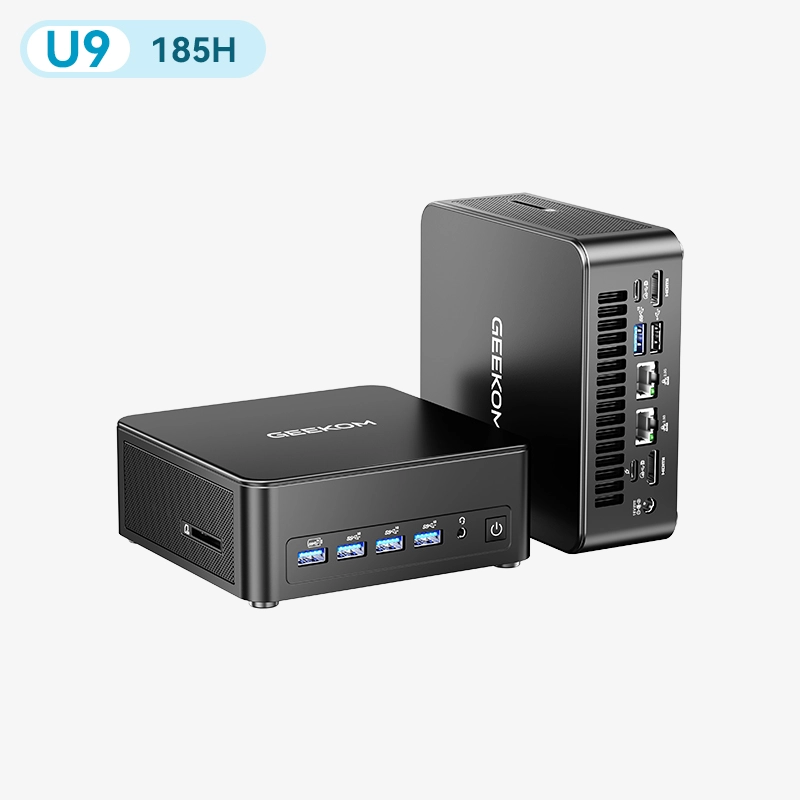
- High compute throughput via 16-core Intel Core Ultra 9 185H processor and Arc graphics
- Dual 2.5Gbps Intel Ethernet ports paired with cutting-edge Intel Wi-Fi 7 wireless
- Expansive I/O suite featuring dual 40Gbps USB4 ports and quad display capability
- Straightforward maintenance with clean 4-screw access and no tethered antenna cables
- Audible acoustic profile under heavy load with no custom fan curve options in BIOS
- Soldered 24GB LPDDR5 memory eliminates post-purchase RAM upgrades
- Pre-installed Kingston NV3 QLC SSD throttles during intensive sustained write workloads
Overview
The GEEKOM IT13 Max is engineered around Intel’s Meteor Lake architecture, integrating a 16-core Core Ultra 9 185H processor, 8-core Arc Graphics, and dedicated AI Boost NPU into a space-efficient form factor. Its system board is laid out for high-bandwidth connectivity, featuring dual Intel i226-V 2.5GbE Ethernet controllers, an Intel BE200 Wi-Fi 7 adapter, two 40Gbps USB4 ports with DisplayPort Alt Mode, and five 10Gbps USB 3.2 Gen 2 interfaces. System memory is configured with 24GB of high-speed LPDDR5-5600 soldered directly to the motherboard, optimizing board space and power efficiency at the cost of future physical RAM expandability. Storage provisions include an M.2 2280 PCIe 4.0 primary slot alongside a secondary M.2 2242 slot supporting up to 2TB of supplemental solid-state storage.
Chassis design emphasizes serviceability, enabling rapid internal access through four bottom screws without glued rubber feet or lid-tethered wireless antenna leads that commonly risk damage during maintenance. The exterior enclosure exhibits clean manufacturing tolerances, though the exterior surface treatment readily shows fingerprint smudges. Power delivery is exceptionally efficient at idle, registering an exceptionally low 5W power draw. Under sustained 45W PL1 and 70W PL2 thermal loads, the single-blower active cooling solution keeps component thermals in check; however, the factory fan profile ramps aggressively, resulting in noticeable acoustic noise under intensive workloads with no provision for custom fan curve tuning within the BIOS.
In daily productivity and multitasking environments, the IT13 Max operates as an agile, compact workstation capable of driving four concurrent 4K displays via its twin HDMI 2.0 and USB4 outputs. While compute density and multi-gigabit networking execution are first-class, heavy sequential storage operations highlight the performance ceiling of the stock Kingston NV3 QLC SSD during prolonged write phases. Users requiring sustained data-transfer speeds will benefit from swapping the primary drive or taking advantage of the secondary M.2 slot, while prospective buyers should consider the fixed 24GB memory limit against their multi-year workflow demands.
Technical Specifications
| Brand | GEEKOM |
| Model | GEEKOM IT13 Max |
| Processor | Intel Core Ultra 9 185H (16 cores: 6P + 8E + 2LPE, 22 threads, up to 5.1 GHz, 24MB cache) |
| Graphics | Intel Arc Graphics (8 Xe-cores, up to 2450 MHz) |
| Neural Processing Unit | Intel AI Boost (up to 11 TOPS INT8, 35 TOPS platform) |
| Power Limits | 45W PL1, 70W PL2, 120W PL4 |
| System Memory | 24GB LPDDR5-5600 (soldered) |
| Primary Storage | 500GB Kingston NV3 (M.2 2280 PCIe 4.0 QLC NVMe SSD) |
| Secondary Storage Slot | M.2 2242 PCIe slot (up to 2TB) |
| Ethernet | Dual 2.5 Gbps RJ45 (Intel i226-V) |
| Wireless Connectivity | Wi-Fi 7 (Intel BE200NG), Bluetooth 5.4 |
| USB C Ports | 2x USB4 40Gbps (DisplayPort Alt Mode) |
| USB A Ports | 5x USB 3.2 Gen 2 (10Gbps) |
| Display Interfaces | 2x HDMI 2.0, 2x USB4 (up to 4 independent displays) |
| Card Reader | Full-size SD 4.0 slot |
| Audio Interface | 3.5mm stereo headset jack |
| Power Input | DC barrel jack, 100W USB-C Power Delivery support |
| Operating System | Windows 11 Pro |
| Idle Power Consumption | 5 W |
Primary Sources & Audited Citations
- Geekom IT13 Max Review (Core Ultra 9 185H Mini PC) - KitGuru
- Tested: The Geekom IT13 Max mini PC impresses with suprising power
- GEEKOM IT13 MAX Review: Intel Core Ultra 9 185H mini PC adds Wi-Fi 7 and dual 2.5G LAN
- Tim Curry, TV premiere screenings, cosplay feature at Fan Expo Canada
- Geekom IT13 Max im Test: Starker Mini-PC mit Intel Ultra 9 unter 800 Euro
- GEEKOM IT13 Max mini PC review – Part 1: specifications ...
- Part 1: specifications, unboxing, teardown, and first boot
- GEEKOM IT13 Max review - Part 2: An Intel Core Ultra 9 185H ...
- Geekom IT13 Max mini PC review: Affordable and fast, but with ...
- Geekom IT13 Max review: Max by name, but restricted by nature
Recommended Alternatives in Mini PCs
At a Glance
How reliable is the GEEKOM IT13 Max Review: Expansive display connectivity faces loud acoustics according to Mizex audits?
A robust, high-performance compact workstation with outstanding multi-gigabit networking and I/O expansion, ideal for users who do not require post-purchase memory upgrades and can accept elevated fan noise under heavy computational loads.
What are the known quirks or drawbacks of the GEEKOM IT13 Max Review: Expansive display connectivity faces loud acoustics?
Our reliability audit identified the following documented caveats:
- Audible acoustic profile under heavy load with no custom fan curve options in BIOS
- Soldered 24GB LPDDR5 memory eliminates post-purchase RAM upgrades
- Pre-installed Kingston NV3 QLC SSD throttles during intensive sustained write workloads
What are the key engineering highlights of the GEEKOM IT13 Max Review: Expansive display connectivity faces loud acoustics?
The top strengths recorded in our evaluation include:
- High compute throughput via 16-core Intel Core Ultra 9 185H processor and Arc graphics
- Dual 2.5Gbps Intel Ethernet ports paired with cutting-edge Intel Wi-Fi 7 wireless
- Expansive I/O suite featuring dual 40Gbps USB4 ports and quad display capability
- Straightforward maintenance with clean 4-screw access and no tethered antenna cables