
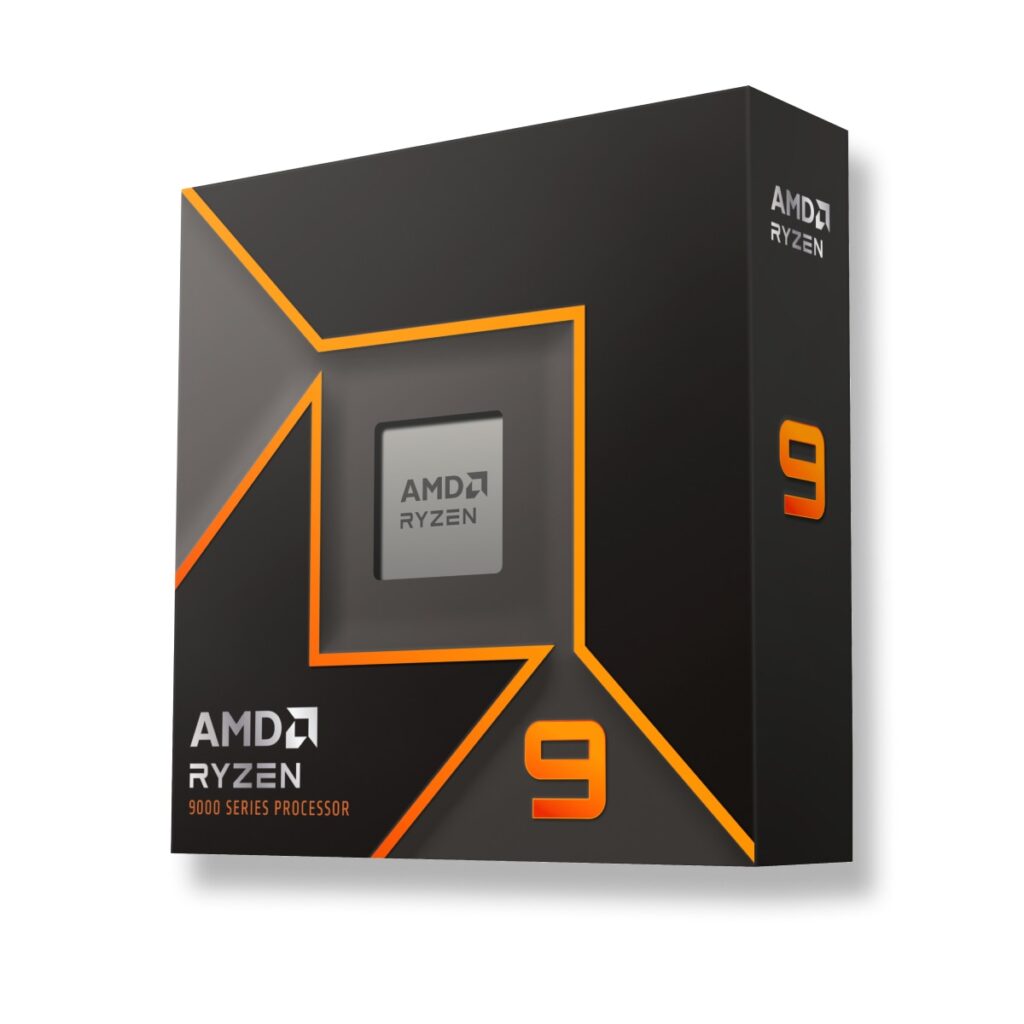
- 16 cores and 32 threads with up to 5.7 GHz boost clock for heavy multi-core workloads
- Roughly 8% higher performance at 10% lower power draw compared to Zen 4
- Strong multi-core scaling at elevated limits (46,904 in Cinebench R23 at 253 W PPT and 48,011 at 309 W) while holding 79.4 °C peak
- Dual-CCD topology can hold back gaming and lightly threaded productivity performance
- Represents an incremental refinement over Zen 4 rather than a major generational leap
Overview
Sixteen Zen 5 cores and 32 threads give the Ryzen 9 9950X an unmistakable focus on heavy multi-threaded desktop work. Reaching up to 5.7 GHz within a 170 W default TDP, AMD’s dual-CCD architecture prioritizes parallel throughput rather than radical reinvention. In everyday testing, that translates into roughly 8% higher performance while pulling 10% less power than Zen 4, making efficiency gains the real highlight of this desktop chip.
Pushing the processor past stock power limits reveals plenty of multi-core headroom without runaway heat. In Cinebench R23 multi-core runs, it scales from 46,904 points at a 253 W PPT ceiling to 48,011 points when unlocked to 309 W. Even under that 309 W unlimited load, peak operating temperature stays contained at 79.4 °C, giving workstation builders predictable thermal behavior during sustained rendering or compilation.
That dual-CCD layout still carries real-world compromises once workloads move away from full-core saturation. Gaming and lightly threaded productivity tasks can lose ground because of the split-chiplet design, and the overall step forward reads as an incremental refinement over Zen 4 rather than a generational leap. For buyers who spend their day saturating all 32 threads, the cleaner performance-per-watt curve pays off immediately, whereas gaming-first builders will bump into those topology limits.
Technical Specifications
| Brand | AMD |
| Model | Ryzen 9 9950X |
| Form Factor | Desktop |
| Architecture | Zen 5 |
| Cores / Threads | 16 / 32 |
| Topology | Dual CCD |
| Max Boost Clock | Up to 5.7 GHz |
| Default TDP | 170 W |
| Unlimited PPT Load Power | 309 W (Cinebench R23 multi-core) |
| Peak Operating Temperature | 79.4 °C (unlimited PPT, Cinebench R23 multi-core) |
Primary Sources & Audited Citations
Recommended Alternatives in CPUs / Processors
At a Glance
How reliable is the AMD Ryzen 9 9950X according to Mizex audits?
Buy this if your desktop workload relies on heavy 16-core rendering or multi-threaded compute; look at a single-CCD chip instead if gaming and lightly threaded responsiveness are your main priorities.
What are the known quirks or drawbacks of the AMD Ryzen 9 9950X?
Our reliability audit identified the following documented caveats:
- Dual-CCD topology can hold back gaming and lightly threaded productivity performance
- Represents an incremental refinement over Zen 4 rather than a major generational leap
What are the key engineering highlights of the AMD Ryzen 9 9950X?
The top strengths recorded in our evaluation include:
- 16 cores and 32 threads with up to 5.7 GHz boost clock for heavy multi-core workloads
- Roughly 8% higher performance at 10% lower power draw compared to Zen 4
- Strong multi-core scaling at elevated limits (46,904 in Cinebench R23 at 253 W PPT and 48,011 at 309 W) while holding 79.4 °C peak