
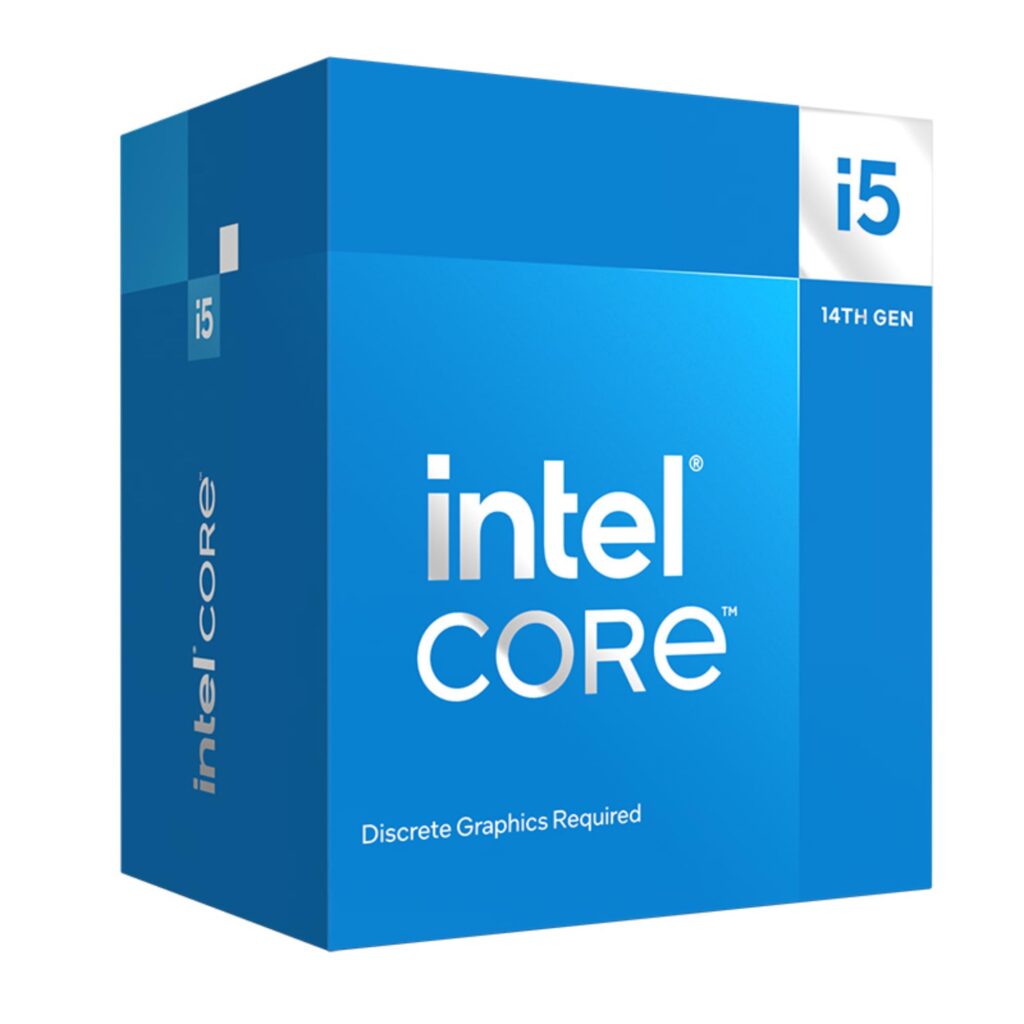
- Dual memory controller supports both DDR4 and DDR5 kits
- Higher 4.7 GHz single-core and 3.5 GHz E-core all-core boosts over the Core i5-13400/F
- Restrained 65 W TDP and 148 W PL2 limit ease motherboard and cooling requirements
- Disabled integrated graphics require a discrete GPU at all times
- Retail boxed units can ship with varying silicon steppings, including B0
- Incremental clock-speed refresh over the preceding 13th Gen model
Overview
Mainstream desktop builders still clinging to LGA 1700 get a straightforward refresh here rather than a ground-up rethink. Built on the Intel 7 Ultra node, this 10-core, 16-thread Raptor Lake Refresh chip splits workloads across six performance cores and four efficiency cores, bumping single-core boost up by 100 MHz to 4.7 GHz and lifting all-core efficiency clocks from 3.3 GHz to 3.5 GHz compared to its Core i5-13400/F predecessor.
Power behavior stays grounded for everyday builds, holding to a 65 W base TDP and a 148 W PL2 ceiling that keeps motherboard VRM and cooling demands reasonable. Because this is an F-series processor, the integrated graphics engine is fused off, meaning a discrete graphics card is mandatory from first boot and troubleshooting without a spare GPU is off the table. Retail boxed units can also arrive with differing silicon steppings, including B0 dies, rather than uniform next-generation silicon.
Where this processor earns its keep in practical builds is platform flexibility. Its dual memory controller supports both DDR4 and DDR5 modules, letting upgraders carry over existing DDR4 kits or pair it with affordable DDR5 boards without locking themselves into a single memory standard. That compatibility, paired with predictable 148 W peak power limits, makes it an uncomplicated drop-in fit for budget-focused gaming and general productivity rigs.
Technical Specifications
| Brand | Intel |
| Model | Core i5-14400F |
| Generation | 14th Gen Intel Core (Raptor Lake Refresh) |
| Socket | LGA 1700 |
| Total Cores / Threads | 10 (6 P-cores + 4 E-cores) / 16 Threads |
| Single Core Boost Clock | 4.7 GHz |
| E Core All Core Boost Clock | 3.5 GHz |
| Base Power (TDP) | 65 W |
| Max Power Limit (PL2) | 148 W |
| Memory Support | DDR4 and DDR5 (Dual Memory Controller) |
| Integrated Graphics | Disabled |
| Manufacturing Node | Intel 7 Ultra |
Primary Sources & Audited Citations
Recommended Alternatives in CPUs / Processors
At a Glance
How reliable is the Intel Core i5-14400F according to Mizex audits?
Buy if you are assembling a value-focused LGA 1700 system with a dedicated graphics card and want DDR4 or DDR5 flexibility; look at the non-F Core i5-14400 if you want integrated graphics for fallback display output, or grab a Core i5-13400F if street pricing undercuts it.
What are the known quirks or drawbacks of the Intel Core i5-14400F?
Our reliability audit identified the following documented caveats:
- Disabled integrated graphics require a discrete GPU at all times
- Retail boxed units can ship with varying silicon steppings, including B0
- Incremental clock-speed refresh over the preceding 13th Gen model
What are the key engineering highlights of the Intel Core i5-14400F?
The top strengths recorded in our evaluation include:
- Dual memory controller supports both DDR4 and DDR5 kits
- Higher 4.7 GHz single-core and 3.5 GHz E-core all-core boosts over the Core i5-13400/F
- Restrained 65 W TDP and 148 W PL2 limit ease motherboard and cooling requirements