
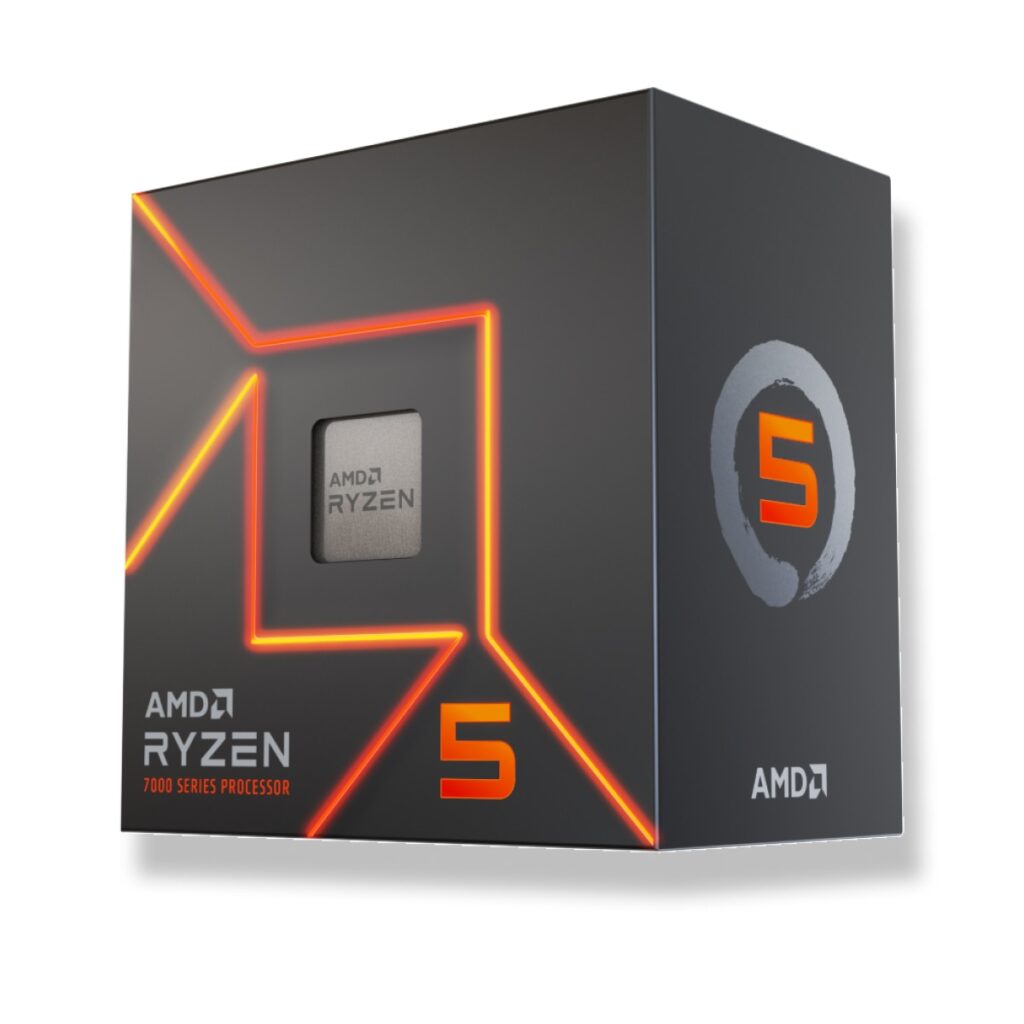
- Zen 4 architecture fabricated on a 5 nm manufacturing process
- Six physical cores and twelve threads boosting up to 5.0 GHz
- Extensive 32 MB L3 cache with high-bandwidth PCIe 5.0 expansion support
- Integrated AMD Radeon Graphics for native display output without a discrete GPU
- Six-core configuration provides limited multi-threaded headroom compared to higher-tier Zen 4 processors
- Requires an AM5 motherboard and DDR5 memory, precluding drop-in upgrades on older AM4 platforms
Overview
Fabricated on TSMC’s 5 nm manufacturing node, the Raphael core architecture pairs six physical Zen 4 execution cores and twelve threads with an integrated I/O die. Clocked at a 3.7 GHz base frequency with dynamic boost thresholds reaching 5.0 GHz, the silicon layout assigns 6 MB of dedicated L2 cache alongside a shared 32 MB pool of L3 cache to minimize memory access latency. Platform I/O connects across native PCIe 5.0 lanes and supports dual-channel memory architectures with sustained bandwidth up to 83 GB/s, while integrated AMD Radeon Graphics provide native display pipeline output directly from the processor substrate.
Mated to the AM5 Land Grid Array (LGA) socket, the package utilizes a rigid multi-layer organic substrate capped by a nickel-plated copper integrated heat spreader engineered to withstand high clamping pressures from standard socket brackets. Thermal conduction relies on robust surface contact across the heat spreader perimeter, transferring die heat into aftermarket air or liquid cooling solutions without relying on direct-die exposure. Electrical regulation is governed through the AM5 socket power delivery interface, where stable firmware microcode updates via motherboard AGESA releases maintain voltage curve precision and sleep-state recovery.
In everyday deployment, the processor serves as a balanced compute engine for mainstream desktop tasks and modular system builds. The incorporation of integrated Raphael graphics simplifies troubleshooting and multi-display output without demanding a dedicated discrete GPU, while standard AM5 platform backward and forward compatibility ensures long-term upgradeability across future socket revisions.
Technical Specifications
| Brand | AMD |
| Model | Ryzen 5 7500 |
| Architecture | Zen 4 (Raphael) |
| Manufacturing Process | 5 nm |
| Socket Type | AM5 |
| Core Count | 6 |
| Thread Count | 12 |
| Base Clock | 3.7 GHz |
| Boost Clock | 5.0 GHz |
| L2 Cache | 6 MB |
| L3 Cache | 32 MB |
| Integrated Graphics | AMD Radeon Graphics (Raphael) |
| PCIe Version | PCIe 5.0 |
| Memory Bandwidth | 83 GB/s |
Primary Sources & Audited Citations
Recommended Alternatives in CPUs / Processors
At a Glance
How reliable is the AMD Ryzen 5 7500 Review: Streamlined Six-Core AM5 Architecture according to Mizex audits?
An optimal entry point into the AM5 ecosystem for builders seeking modern Zen 4 execution, platform longevity, and reliable baseline graphics without paying for surplus compute overhead.
What are the known quirks or drawbacks of the AMD Ryzen 5 7500 Review: Streamlined Six-Core AM5 Architecture?
Our reliability audit identified the following documented caveats:
- Six-core configuration provides limited multi-threaded headroom compared to higher-tier Zen 4 processors
- Requires an AM5 motherboard and DDR5 memory, precluding drop-in upgrades on older AM4 platforms
What are the key engineering highlights of the AMD Ryzen 5 7500 Review: Streamlined Six-Core AM5 Architecture?
The top strengths recorded in our evaluation include:
- Zen 4 architecture fabricated on a 5 nm manufacturing process
- Six physical cores and twelve threads boosting up to 5.0 GHz
- Extensive 32 MB L3 cache with high-bandwidth PCIe 5.0 expansion support
- Integrated AMD Radeon Graphics for native display output without a discrete GPU