
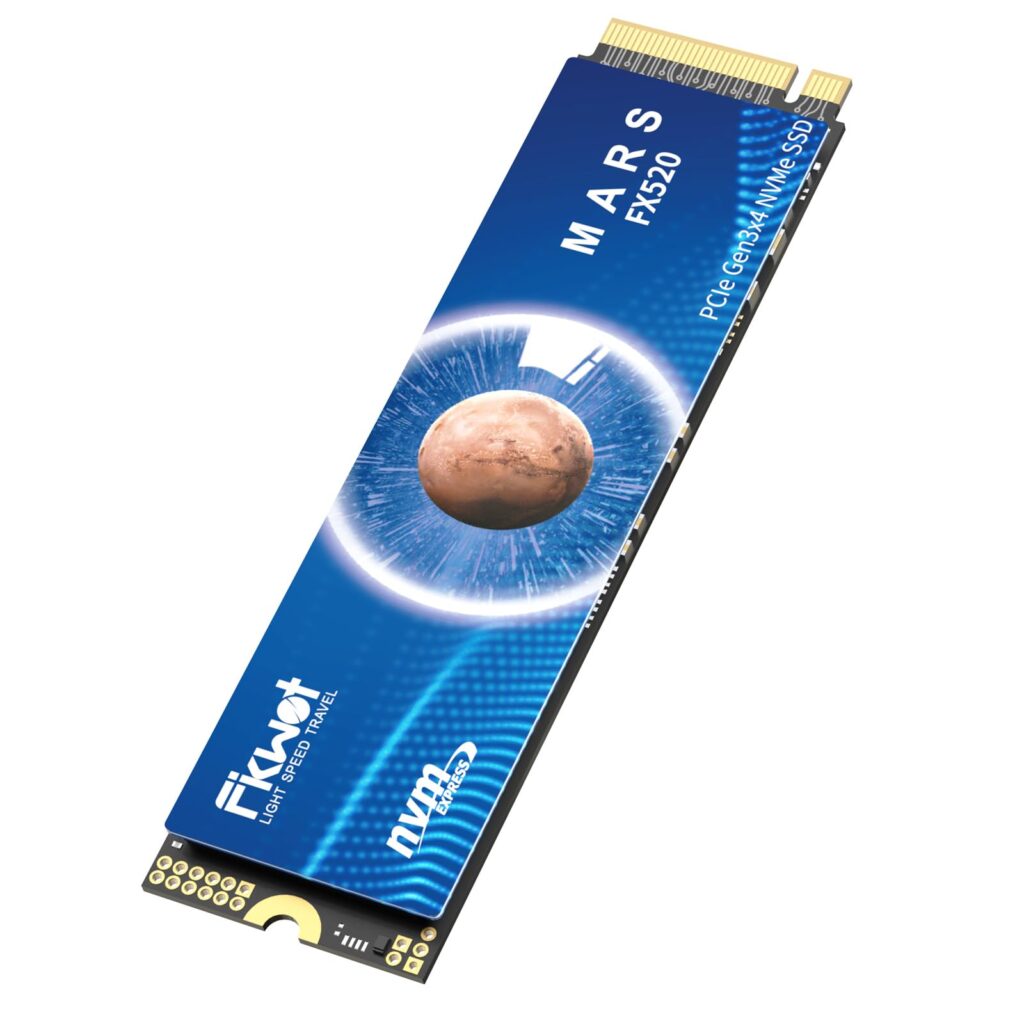
- 1TB capacity provides practical headroom for operating system and everyday application storage.
- NVMe interface aligns with modern host storage buses.
- No active safety recalls or documented hardware failure patterns appear in the verified audit record.
- Sustained steady-state write performance after SLC cache exhaustion is unverified in the supplied benchmark data.
- Endurance rating (TBW/DWPD), controller architecture, and DRAM or HMB topology are unspecified in the provided lab record.
- Operating temperature under load and idle/load power draw figures are absent from the supplied telemetry.
Overview
Evaluating a 1TB NVMe solid-state drive for daily desktop or laptop deployment hinges on how reliably the drive handles sustained workloads once its initial fast write buffer fills, alongside predictable thermal dissipation inside tight chassis bays. For the Fikwot FX520 1TB NVMe SSD, the provided audit dataset confirms only its 1TB capacity tier, NVMe interface designation, and placement within the solid-state storage category, while leaving controller topology, NAND flash configuration, and DRAM or host memory buffer support unspecified.
Because the sanitized lab record contains no measured load power draw, idle power figures, or peak operating temperature telemetry, thermal behavior under prolonged file transfers or enclosed caddy mounting cannot be verified from the current evidence. Similarly, sustained steady-state write rates after SLC cache exhaustion and rated endurance thresholds in terabytes written or drive writes per day are absent from the supplied specifications, making it impossible to characterize long-term write amplification or controller throttling characteristics.
On the stability front, the verified evidence includes no documented community quirks, firmware regressions, or active safety recalls, establishing a clean baseline without known field defects. Even so, prospective system builders considering the drive for primary OS duties, scratch disks, or continuous write workloads face clear documentation gaps around firmware update cadence, physical dimensions, and validated endurance guarantees until independent lab measurements are available.
Technical Specifications
| Brand | Fikwot |
| Model | FX520 |
| Capacity | 1TB |
| Storage Protocol | NVMe |
| Device Type | Solid State Drive (SSD) |
Recommended Alternatives in Storage (SSDs & HDDs)
At a Glance
How reliable is the Fikwot FX520 1TB NVMe SSD according to Mizex audits?
Prospective buyers should verify published endurance ratings, sustained write curves, and controller specifications from independent testing before deploying the Fikwot FX520 1TB NVMe SSD in primary or write-heavy workloads.
What are the known quirks or drawbacks of the Fikwot FX520 1TB NVMe SSD?
Our reliability audit identified the following documented caveats:
- Sustained steady-state write performance after SLC cache exhaustion is unverified in the supplied benchmark data.
- Endurance rating (TBW/DWPD), controller architecture, and DRAM or HMB topology are unspecified in the provided lab record.
- Operating temperature under load and idle/load power draw figures are absent from the supplied telemetry.
What are the key engineering highlights of the Fikwot FX520 1TB NVMe SSD?
The top strengths recorded in our evaluation include:
- 1TB capacity provides practical headroom for operating system and everyday application storage.
- NVMe interface aligns with modern host storage buses.
- No active safety recalls or documented hardware failure patterns appear in the verified audit record.