
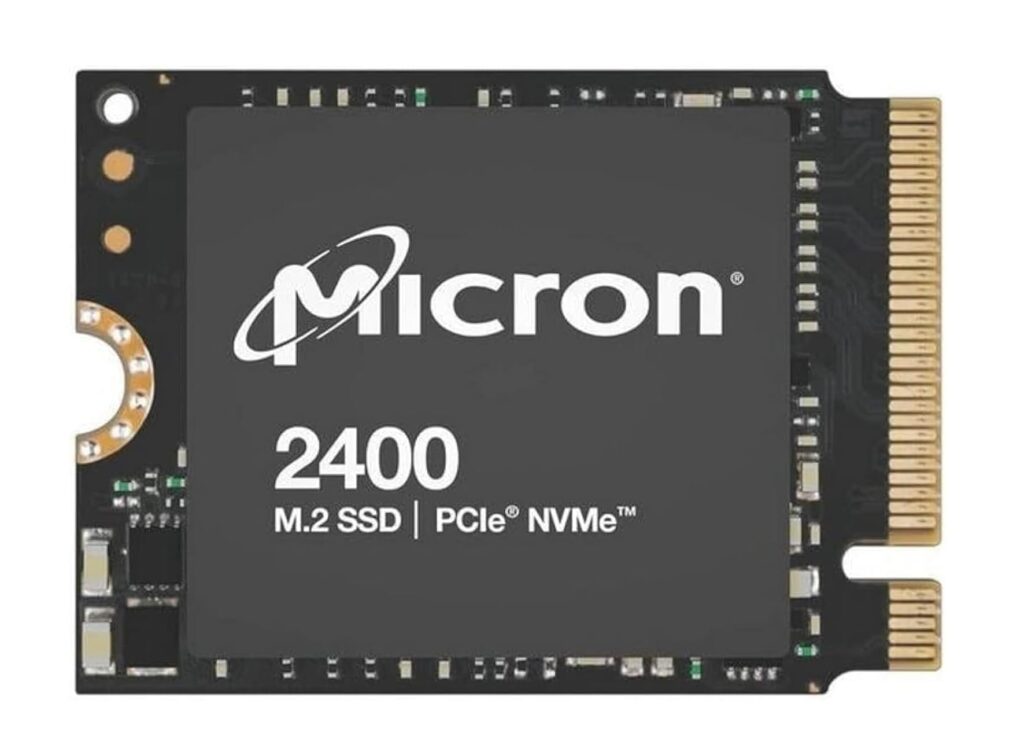
- PCIe Gen4 NVMe 1.4 interface achieving up to 4200 MB/s sequential read throughput
- Dense 176-layer 3D QLC NAND packaged in versatile M.2 2230 and 2280 footprints
- Hardware-based 256-bit AES encryption support for device-level data protection
- Modest sequential write throughput rated at 1800 MB/s
- Entry-level endurance rating of 150 TBW characteristic of QLC media
Overview
Bridging PCIe Gen4 bandwidth with dense 176-layer 3D QLC NAND flash, Micron targets mainstream OEM platforms and compact client systems through NVMe 1.4 protocol compliance. The solid-state layout packs four-bit-per-cell architecture into space-constrained M.2 envelopes, offering both 2230 and 2280 form factors to accommodate handheld gaming consoles, thin laptops, and standard desktop motherboards. A native 256-bit AES hardware encryption engine integrates directly into the controller pipeline, securing user data without imposing host processing overhead.
Performance characteristics reflect clear architectural trade-offs between cell density and continuous throughput. While sequential read bandwidth reaches 4200 MB/s, sequential write capability is rated at 1800 MB/s, with sustained multi-gigabyte transfers subject to standard throughput drops once the dynamic SLC cache is saturated. In compact enclosures such as handheld PC bays or ultrabook slots, the concentrated surface-mount assembly relies primarily on host thermal spreaders or ambient chassis airflow to mitigate thermal throttling during prolonged sequential operations.
From a component longevity standpoint, the 512GB model carries a 150 TBW endurance rating, placing it strictly in the entry-to-mainstream client tier where read-heavy operating system and application workloads dominate over high-cadence write cycles. Standard OEM firmware delivers predictable power-state transitions and host-managed power regulation, though users requiring high continuous rebuild tolerance or heavy drive-write-per-day thresholds will encounter the physical boundaries of QLC flash.
Technical Specifications
| Brand | Micron |
| Model | 2400 512GB NVMe SSD |
| Capacity | 512 GB |
| Form Factor | M.2 (2230, 2280) |
| Interface | PCIe Gen4, NVMe 1.4 |
| NAND Flash Type | 176-Layer 3D QLC |
| Sequential Read Speed | 4200 MB/s |
| Sequential Write Speed | 1800 MB/s |
| Endurance Rating | 150 TBW |
| Hardware Encryption | 256-bit AES |
Recommended Alternatives in Storage (SSDs & HDDs)

At a Glance
How reliable is the Micron 2400 512GB NVMe SSD Review: Compact Footprint, Entry-Level QLC Endurance according to Mizex audits?
An efficient choice for secondary storage or primary boot duties in compact systems with read-focused workloads, but ill-suited for sustained, write-heavy productivity.
What are the known quirks or drawbacks of the Micron 2400 512GB NVMe SSD Review: Compact Footprint, Entry-Level QLC Endurance?
Our reliability audit identified the following documented caveats:
- Modest sequential write throughput rated at 1800 MB/s
- Entry-level endurance rating of 150 TBW characteristic of QLC media
What are the key engineering highlights of the Micron 2400 512GB NVMe SSD Review: Compact Footprint, Entry-Level QLC Endurance?
The top strengths recorded in our evaluation include:
- PCIe Gen4 NVMe 1.4 interface achieving up to 4200 MB/s sequential read throughput
- Dense 176-layer 3D QLC NAND packaged in versatile M.2 2230 and 2280 footprints
- Hardware-based 256-bit AES encryption support for device-level data protection