

- Standard M.2 2280 form factor ensures universal physical compatibility across modern desktop motherboards and laptops
- Native PCIe NVMe protocol interface delivers low latency compared to legacy SATA interfaces
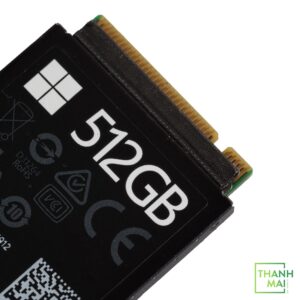
- 512GB solid-state storage capacity provides a practical footprint for operating system installations and essential applications
- Bare-board PCB construction lacks an integrated heatsink, requiring host cooling to mitigate thermal saturation during extended writes
- OEM-focused deployment limits direct consumer firmware maintenance tools and published endurance validation
Overview
PCIe bus routing and controller-to-NAND trace topology define the operational baseline of the M.2 2280 platform, where compact circuit real estate mandates efficient power rail delivery and minimal signal degradation across standard M-key edge interfaces. Built on a bare multi-layer printed circuit board without a factory-mounted heat spreader, the assembly organizes its surface-mount solid-state storage components into a standardized single-sided layout. Surface-mount soldering across the power management circuitry, flash memory packages, and controller interface conforms to standard production SMT tolerances, providing clean mechanical alignment for seamless installation into motherboards and laptop drive bays.
Thermal behavior is dictated by direct chassis airflow and host-provided heat dissipation rather than onboard cooling hardware. Because high-density solid-state controllers generate localized heat during intensive data operations, deploying the drive without external cooling in compact or poorly ventilated enclosures can lead to thermal saturation during continuous sequential write operations. In typical desktop environments featuring motherboard heatsinks or moderate ambient airflow, the PCB maintains acceptable equilibrium temperatures for routine operating system and application storage tasks.
Firmware execution handles essential background wear-leveling, garbage collection, and command queuing over the native NVMe protocol, delivering lower access latency than legacy SATA storage architectures. While the 512GB configuration offers a practical balance for boot drives or secondary partitions, long-term deployment benefits from standard host-level telemetry monitoring through S.M.A.R.T. utilities, making it an accessible drop-in upgrade where budget and baseline storage utility are the primary design considerations.
Technical Specifications
| Brand | Taimi |
| Model | TME48SB512 512GB NVMe SSD |
| Form Factor | M.2 2280 |
| Interface | PCIe NVMe |
| Capacity | 512 GB |
| Dimensions | 3.15 x 0.87 x 0.09 in (80.0 x 22.0 x 2.3 mm) |
| Connector Type | M.2 M-Key |
| Device Category | Internal Solid-State Drive (SSD) |
Recommended Alternatives in Storage (SSDs & HDDs)

At a Glance
How reliable is the Taimi TME48SB512 512GB NVMe SSD Review: Bare-Substrate NVMe Expansion Architecture according to Mizex audits?
Target this drive as a cost-effective secondary storage upgrade or general-purpose boot volume for systems equipped with native motherboard M.2 heat spreaders.
What are the known quirks or drawbacks of the Taimi TME48SB512 512GB NVMe SSD Review: Bare-Substrate NVMe Expansion Architecture?
Our reliability audit identified the following documented caveats:
- Bare-board PCB construction lacks an integrated heatsink, requiring host cooling to mitigate thermal saturation during extended writes
- OEM-focused deployment limits direct consumer firmware maintenance tools and published endurance validation
What are the key engineering highlights of the Taimi TME48SB512 512GB NVMe SSD Review: Bare-Substrate NVMe Expansion Architecture?
The top strengths recorded in our evaluation include:
- Standard M.2 2280 form factor ensures universal physical compatibility across modern desktop motherboards and laptops
- Native PCIe NVMe protocol interface delivers low latency compared to legacy SATA interfaces
- 512GB solid-state storage capacity provides a practical footprint for operating system installations and essential applications