
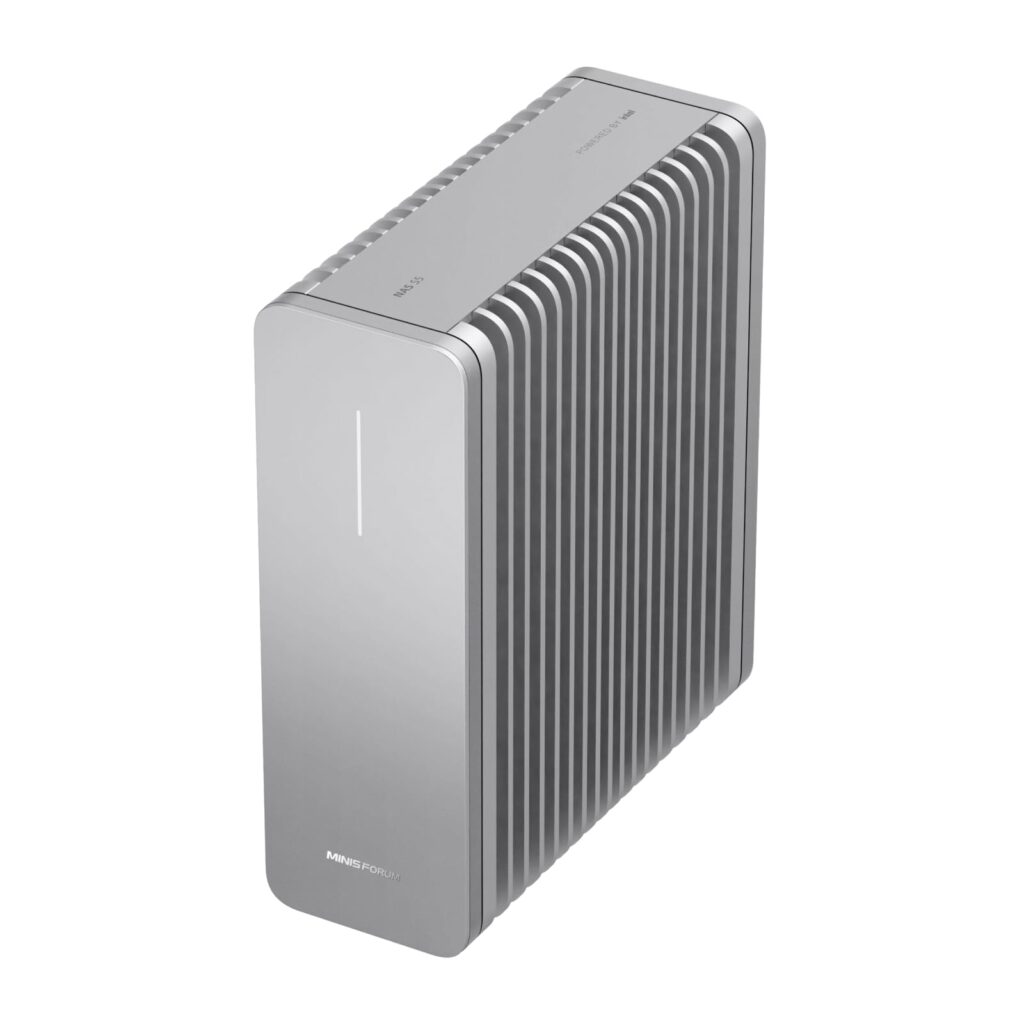
- High-speed network connectivity with 10GbE and 2.5GbE Ethernet ports
- Five M.2 2280 NVMe slots providing all-flash capacity up to 40 TB
- Dual 40Gbps USB4 Type-C ports alongside Wi-Fi 7 and Bluetooth 6 support
- Heavy 1.8 kg aluminum alloy chassis with integrated convective cooling fins
- M.2 NVMe storage bays are electrically restricted to PCIe 4.0 x1 bandwidth per drive
- Soldered 12 GB LPDDR5X memory cannot be expanded for intensive storage caching
- Entry-level Intel Core 3 304 CPU with a single Performance core limits heavy compute tasks
Overview
Desktop network storage rarely ventures into fanless territory while supporting high-density solid-state arrays, but Minisforum tackles that exact junction by pairing an energy-efficient Intel Wildcat Lake architecture with a heavy finned aluminum chassis. Built to serve as a quiet, dedicated flash repository or personal cloud node, the enclosure houses five M.2 2280 slots beneath an integrated passive heatsink structure. Handling daily network workloads without internal blowers shifts the thermal dissipation entirely to conductive pathways and convective airflow across its ribbed exterior, providing a dependable, maintenance-free environment free from dust ingestion.
Internal hardware design revolves around the entry-level Intel Core 3 304 processor, which balances a single performance core with four efficient cores across a 15-watt base power budget. Network connectivity is a standout asset, offering both a 10GbE port and a 2.5GbE interface alongside dual 40Gbps USB4 connections and Wi-Fi 7 support. However, the architectural compromise lies in lane allocation: each of the five NVMe drives operates over a narrow PCIe 4.0 x1 bus. While sequential transfer speeds per drive are constrained relative to typical four-lane setups, the configuration comfortably saturates the 10GbE uplink for aggregate storage tasks without demanding active cooling.
Practical everyday deployment requires weighing storage expansion against fixed internal resources. The system comes provisioned with 12 GB of soldered LPDDR5X memory running alongside 128 GB of onboard flash storage, managed through the preinstalled MinisCloud operating system with ZFS filesystem capability. Because memory cannot be expanded post-purchase, users configuring large storage pools must manage memory-intensive ZFS caching and background parity tasks within the fixed capacity ceiling. For localized backups, continuous network streaming, and modest edge computing, the design presents a remarkably self-contained all-flash solution anchored by its robust metal construction.
Technical Specifications
| Brand | Minisforum |
| Model | S5 Core 3 304 |
| Processor | Intel Core 3 304 (5 cores, 5 threads: 1 P-core + 4 E-cores) |
| Architecture | Intel Wildcat Lake (Cougar Cove P-core + Darkmont LP-E cores) |
| Process Technology | Intel 18A |
| CPU Turbo Frequency | Up to 4.3 GHz |
| Base Power (TDP) | 15 W |
| Max Turbo Power | 35 W |
| AI Acceleration (NPU) | Up to 15 TOPS |
| Memory | 12 GB LPDDR5X (up to 7467 MT/s, soldered) |
| Onboard Storage | 128 GB UFS 3.1 Flash |
| Storage Expansion | 5x M.2 2280 NVMe SSD slots |
| Storage Interface | PCIe 4.0 x1 per M.2 slot |
| Maximum Storage Capacity | 40 TB (5x 8 TB NVMe SSDs) |
| Networking | 1x 10GbE RJ-45, 1x 2.5GbE RJ-45 |
| Wireless Connectivity | Wi-Fi 7, Bluetooth 6 |
| USB Ports | 2x USB4 Type-C (40Gbps), multiple USB Type-A |
| Cooling Design | Fully passive fanless aluminum fin array |
| Chassis Material | Aluminum alloy |
| Dimensions | 6.95 x 6.06 x 2.36 in (176.5 x 154 x 60 mm) |
| Weight | 3.97 lbs (1.8 kg) |
| Operating System | MinisCloud OS (ZFS supported) |
Primary Sources & Audited Citations
Recommended Alternatives in Network Attached Storage (NAS)
At a Glance
How reliable is the Minisforum S5 Core 3 304 according to Mizex audits?
Ideal for homelab enthusiasts seeking an all-flash 10GbE network vault, provided drive transfer rates capped at PCIe 4.0 x1 speeds and fixed 12 GB memory align with your workload.
What are the known quirks or drawbacks of the Minisforum S5 Core 3 304?
Our reliability audit identified the following documented caveats:
- M.2 NVMe storage bays are electrically restricted to PCIe 4.0 x1 bandwidth per drive
- Soldered 12 GB LPDDR5X memory cannot be expanded for intensive storage caching
- Entry-level Intel Core 3 304 CPU with a single Performance core limits heavy compute tasks
What are the key engineering highlights of the Minisforum S5 Core 3 304?
The top strengths recorded in our evaluation include:
- High-speed network connectivity with 10GbE and 2.5GbE Ethernet ports
- Five M.2 2280 NVMe slots providing all-flash capacity up to 40 TB
- Dual 40Gbps USB4 Type-C ports alongside Wi-Fi 7 and Bluetooth 6 support
- Heavy 1.8 kg aluminum alloy chassis with integrated convective cooling fins