
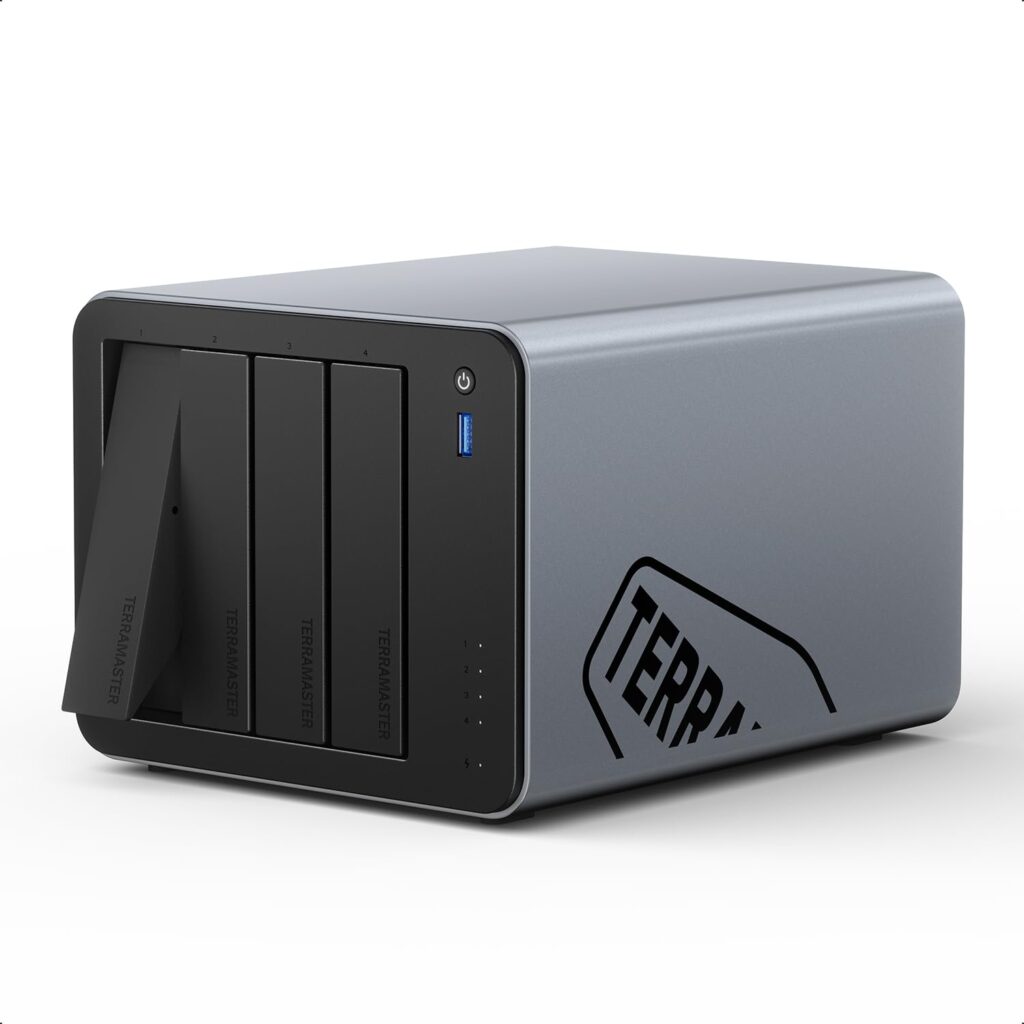
- Efficient 8-core Intel Core 3 N350 processor paired with 16 GB DDR5 4800 MHz memory
- Dual 5GbE Ethernet interfaces provide multi-gigabit throughput without high thermal overhead
- Triple M.2 2280 NVMe slots alongside four SATA bays enable flexible hybrid storage tiering
- Updated TOS 7 operating system based on Linux Kernel 6.12 with BTRFS and T-RAID support
- M.2 NVMe slots are constrained to PCIe 3.0 x1 bandwidth
- Lacks native 10GbE connectivity for higher-bandwidth networking environments
- Integrated HDMI video port remains underutilized in native TOS software
Overview
Silicon lane allocation and controller architecture dictate the operational envelope of this four-bay appliance, balancing an eight-core Intel Core 3 N350 processor against targeted I/O bandwidth trade-offs. Operating at a 7W base power profile, the processor delivers eight threads alongside 16 GB of DDR5 4800 MHz memory, managing multi-container hosting, virtualization, and array maintenance with low baseline electrical demand. Dual 5GbE interfaces double the throughput ceiling of standard 2.5GbE connections without generating the thermal or power penalties associated with 10GBASE-T, while external expansion is supported by three 10 Gbps USB 3.2 Gen 2 Type-A ports.
Storage topology integrates four 3.5-inch and 2.5-inch SATA 6 Gbps drive bays supporting up to 144 TB of raw mechanical capacity, flanked by three dedicated M.2 2280 NVMe slots for cache acceleration or independent volume pools. To accommodate this drive density within the low-power Intel platform’s PCIe budget, each M.2 slot is routed through a PCIe 3.0 x1 link, establishing a practical bandwidth ceiling of approximately 1 GB/s per drive rather than full multi-lane Gen 3 or Gen 4 saturation. The physical structure relies on a rigid chassis with individual drive sleds, channeling active internal airflow across the storage bays and passive processor heatsink to maintain thermal equilibrium during prolonged rebuild operations.
Software management is driven by TOS 7, built atop Linux Kernel 6.12 with native BTRFS support and proprietary T-RAID and T-RAID+ dynamic volume provisioning. The modern kernel base ensures dependable file system integrity, self-healing metadata, and snapshot scheduling, though software utilization of the hardware HDMI video port remains limited within the default administrative environment, directing the platform primarily toward headless network-attached operation.
Technical Specifications
| Brand | TERRAMASTER |
| Model | F4-425 Pro |
| Processor | Intel Core 3 N350 (8 cores, 8 threads, up to 3.9 GHz, 7W base power) |
| Memory | 16 GB DDR5 4800 MHz SO-DIMM (expandable up to 32 GB) |
| Drive Bays | 4x 3.5"/2.5" SATA 6 Gbps |
| M.2 Slots | 3x M.2 2280 PCIe 3.0 x1 NVMe |
| Maximum Storage Capacity | Up to 144 TB HDD (4x 30 TB) + 24 TB NVMe (3x 8 TB) |
| Supported RAID Levels | Single Disk, JBOD, RAID 0, 1, 5, 6, 10, T-RAID, T-RAID+ |
| SSD Cache Support | Optional SSD Read or Write caching |
| Networking | 2x 5GbE Ethernet |
| USB Ports | 3x USB 3.2 Gen 2 (10 Gbps) Type-A |
| Video Interface | HDMI |
| Internal File Systems | BTRFS, EXT4 |
| External File Systems | NTFS, BTRFS, HFS+, EXT4, EXT3, FAT32 |
| Operating System | TOS 7 (Linux Kernel 6.12.63+) |
Primary Sources & Audited Citations
Recommended Alternatives in Network Attached Storage (NAS)
At a Glance
How reliable is the TERRAMASTER F4-425 Pro Review: Multi-Gigabit Tiering Under Bus Constraints according to Mizex audits?
A capable eight-core home and small-office storage server offering dual 5GbE throughput and dense NVMe tiering, provided your workflow does not require full 10GbE networking or unthrottled multi-lane M.2 SSD bandwidth.
What are the known quirks or drawbacks of the TERRAMASTER F4-425 Pro Review: Multi-Gigabit Tiering Under Bus Constraints?
Our reliability audit identified the following documented caveats:
- M.2 NVMe slots are constrained to PCIe 3.0 x1 bandwidth
- Lacks native 10GbE connectivity for higher-bandwidth networking environments
- Integrated HDMI video port remains underutilized in native TOS software
What are the key engineering highlights of the TERRAMASTER F4-425 Pro Review: Multi-Gigabit Tiering Under Bus Constraints?
The top strengths recorded in our evaluation include:
- Efficient 8-core Intel Core 3 N350 processor paired with 16 GB DDR5 4800 MHz memory
- Dual 5GbE Ethernet interfaces provide multi-gigabit throughput without high thermal overhead
- Triple M.2 2280 NVMe slots alongside four SATA bays enable flexible hybrid storage tiering
- Updated TOS 7 operating system based on Linux Kernel 6.12 with BTRFS and T-RAID support