
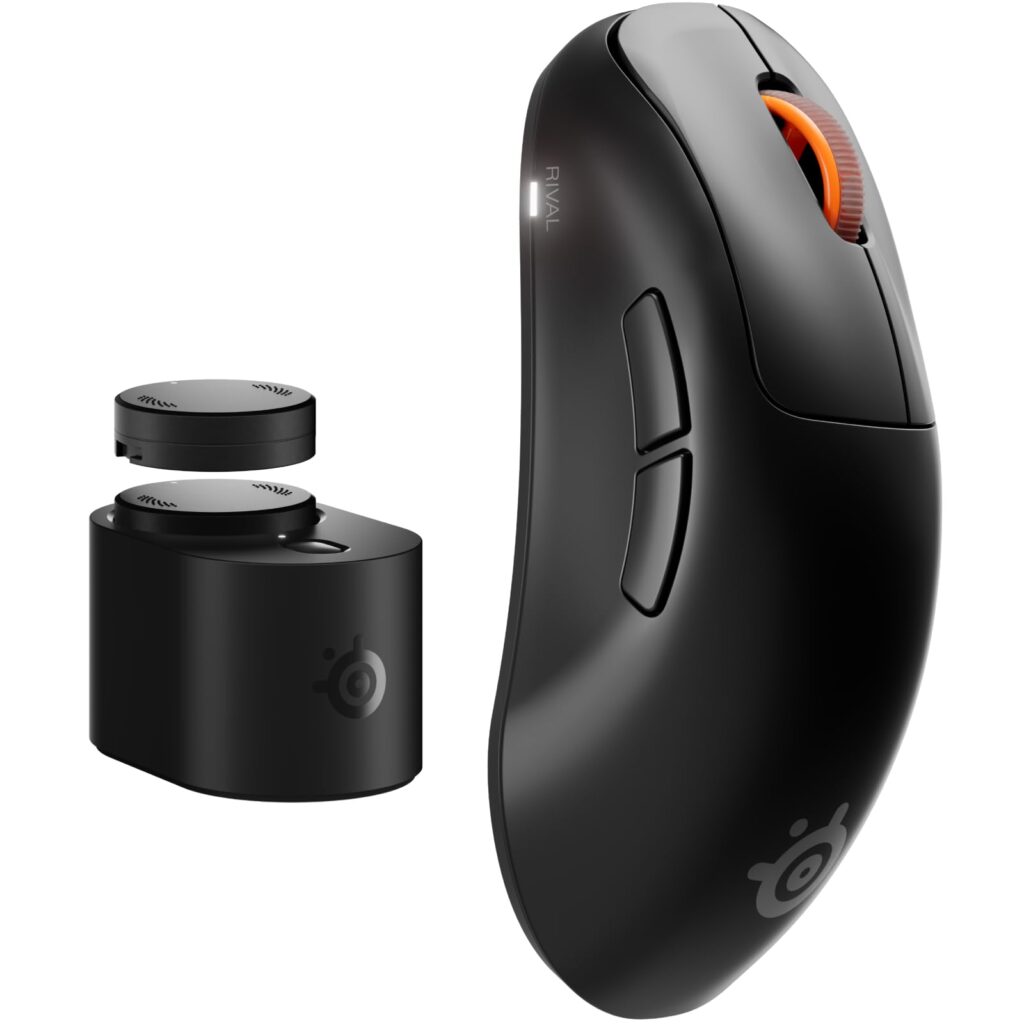
- Ultra-Wideband (UWB) wireless link provides 20x the bandwidth of standard 2.4 GHz with robust interference rejection
- Infinite Power System with dual hot-swappable batteries and charging dock eliminates wired charging downtime
- True 8000 Hz polling rate delivery with ultra-low 0.35 ms click latency
- Lightweight 1.87 oz (53 g) unperforated ergonomic chassis with virgin PTFE skates
- Fully portless mouse body lacks physical USB connectivity for wired operation or direct cable charging
- Glossy black surface finish readily shows fingerprints, smudges, and surface oils
- Right-handed ergonomic contouring is unsuitable for left-handed users
Overview
Operating over an Ultra-Wideband (UWB) wireless link rather than conventional 2.4 GHz radio channels, this peripheral architecture delivers twenty times the effective bandwidth to support sustained 8000 Hz polling rates and a validated 0.35 ms click latency without radio frequency congestion. At the core of its operational design is the portless Infinite Power System, which relocates charging entirely to a dedicated desktop base station. By utilizing dual hot-swappable battery cells, continuous uptime is achieved without relying on a physical tether, completely eliminating the mechanical wear, port looseness, and debris ingress common to onboard USB-C receptacles. Beneath the primary triggers, optical switches bypass mechanical metal leaf contacts entirely, using light beam interruption to actuate commands instantly while permanently mitigating debounce degradation and inadvertent double-clicking.
Structurally, the unperforated right-handed ergonomic shell achieves an ultralight weight of 1.87 oz (53 g) while preserving solid torsional rigidity across its seams and swappable battery access door. High-speed glide tracking is anchored by 100% virgin-grade PTFE skates, while primary button clicks produce a crisp, uniform acoustic signature free from hollow shell resonance. Power demands scale predictably with transmission throughput: the dual-cell battery architecture delivers up to 120 hours of runtime at a standard 1000 Hz polling rate, reducing to 32 hours when operating under full 8000 Hz UWB loads. While the absence of an integrated USB port guarantees a completely wireless lifecycle, it creates an absolute operational dependency on the proprietary desktop charging dock. Furthermore, while the glossy black coating provides immediate tactile grip, it quickly accumulates visible surface oils and smudges during intensive daily sessions.
Technical Specifications
| Brand | SteelSeries |
| Model | Rival Pro Wireless |
| Form Factor | Ergonomic (Right-handed) |
| Weight | 1.87 oz (53 g) |
| Connectivity | Ultra-Wideband (UWB) Wireless (Portless) |
| Max Polling Rate | 8000 Hz |
| Click Latency | 0.35 ms |
| Sensor Type | Optical sensor |
| Switch Type | Optical switches |
| Battery System | Infinite Power System (Dual swappable batteries with base station charging dock) |
| Battery Life (1000 Hz) | Up to 120 hours |
| Battery Life (8000 Hz) | Up to 32 hours |
| Mouse Skates | 100% Virgin Grade PTFE |
| Surface Finish | Glossy black coating |
Primary Sources & Audited Citations
- SteelSeries Official: Rival Pro & Sensei Pro Wireless Technical Specifications & Product Page
- Digital Foundry: SteelSeries Rival Pro and Sensei Pro: Infinite Battery Life Makes 8K Ultra Wideband Wireless Gaming Mice Viable
- Tom's Guide: SteelSeries Rival Pro and Sensei Pro Review - Portless UWB Wireless Gaming Mice
- PC Gamer: SteelSeries Sensei Pro and Rival Pro In-Depth Hardware Review
Recommended Alternatives in Keyboards & Mice
At a Glance
How reliable is the SteelSeries Rival Pro Wireless Review: Portless Ultra-Wideband Wireless Architecture according to Mizex audits?
An exceptional competitive mouse for right-handed esports players who demand true 8000 Hz UWB wireless performance and hot-swappable batteries, provided they accept total reliance on the desktop charging dock and the absence of a wired USB connection.
What are the known quirks or drawbacks of the SteelSeries Rival Pro Wireless Review: Portless Ultra-Wideband Wireless Architecture?
Our reliability audit identified the following documented caveats:
- Fully portless mouse body lacks physical USB connectivity for wired operation or direct cable charging
- Glossy black surface finish readily shows fingerprints, smudges, and surface oils
- Right-handed ergonomic contouring is unsuitable for left-handed users
What are the key engineering highlights of the SteelSeries Rival Pro Wireless Review: Portless Ultra-Wideband Wireless Architecture?
The top strengths recorded in our evaluation include:
- Ultra-Wideband (UWB) wireless link provides 20x the bandwidth of standard 2.4 GHz with robust interference rejection
- Infinite Power System with dual hot-swappable batteries and charging dock eliminates wired charging downtime
- True 8000 Hz polling rate delivery with ultra-low 0.35 ms click latency
- Lightweight 1.87 oz (53 g) unperforated ergonomic chassis with virgin PTFE skates