
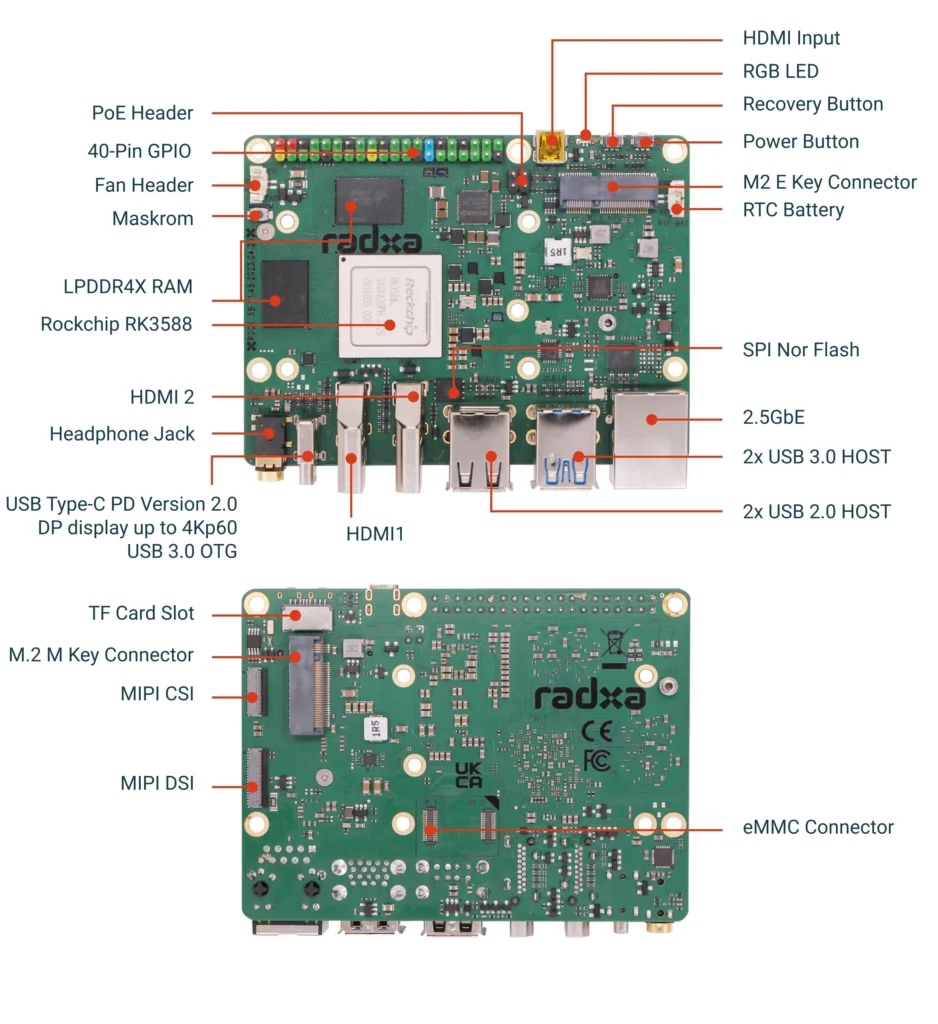
- Dense high-speed storage expansion via dual M.2 M-Key slots operating at PCIe 3.0 x2
- Full-size HDMI input supporting 4K video ingestion alongside dual 8K HDMI outputs
- Integrated 2.5GbE Ethernet and onboard Wi-Fi 6/Bluetooth 5.2 connectivity
- Soldered onboard eMMC 5.1 storage eliminating socket-retention failure modes
- Demands active cooling under sustained multicore or NPU load to prevent thermal throttling
- Full NPU and video acceleration features remain dependent on Rockchip vendor BSP kernels
- Requires a compliant USB-PD power supply capable of 30W or greater to ensure boot stability with peripherals
Overview
Built around the 8nm Rockchip RK3588 application processor, the board routes four Cortex-A76 performance cores and four Cortex-A55 efficiency cores alongside 12GB of high-speed LPDDR5 memory across an optimized Pico-ITX layout. Radxa bifurcates the processor’s high-speed PCIe 3.0 lanes into dual M.2 M-Key slots operating at PCIe 3.0 x2 bandwidth, augmented by an M.2 B-Key slot with SIM routing for cellular modems, an integrated Realtek RTL8852BE Wi-Fi 6 transceiver, and native 2.5GbE networking. Power management utilizes a dedicated USB Type-C Power Delivery port supporting 9V to 20V negotiation, effectively isolating input power from peripheral data lines to prevent brownouts during transient multi-drive workloads.
Component layout and surface-mount tolerances across the 100 mm x 75 mm multi-layer PCB prioritize connector density and trace isolation. Migrating from the previous generation’s friction-fit eMMC socket to onboard soldered eMMC 5.1 storage eliminates a prominent physical wear point, ensuring mechanical resilience in high-vibration edge deployments. Display and capture interfaces are uniquely comprehensive, incorporating two full-size HDMI output ports capable of up to 8K at 60 Hz alongside a dedicated full-size HDMI input port supporting 4K video ingestion at 60 Hz, complemented by dual 4-lane MIPI CSI camera headers and a standard 40-pin GPIO bus.
Thermal dissipation necessitates proactive enclosure engineering under sustained compute loads. System power consumption ranges from 1.8W to 2.4W at idle, escalating to between 11W and 15W during combined CPU, GPU, and 6 TOPS NPU stress, which rapidly elevates uncooled SoC temperatures beyond 75°C and initiates clock throttling. Integrating an active heatsink via the onboard 4-pin PWM fan header maintains safe operating envelopes. Software support maintains a split profile: complete hardware-accelerated video decoding, encoding, and NPU pipelines rely on Rockchip vendor BSP Linux kernels (such as 5.10 and 6.1 LTS), while community mainline kernel development provides an upstream path for general headless and networking applications.
Technical Specifications
| Brand | Radxa |
| Model | Rock 5B+ 12GB |
| Processor Soc | Rockchip RK3588 (8nm) |
| Cpu Architecture | Octa-core (4x Cortex-A76 @ up to 2.4 GHz + 4x Cortex-A55 @ up to 1.8 GHz) |
| Gpu | ARM Mali-G610 MC4 |
| Npu Performance | 6 TOPS (INT8 tri-core) |
| Memory Capacity | 12GB LPDDR5 |
| Storage Subsystem | Onboard eMMC 5.1, MicroSD slot |
| M2 Expansion Slots | 2x M.2 M-Key (PCIe 3.0 x2), 1x M.2 B-Key (Cellular/4G/5G with SIM slot) |
| Networking Wired | 1x 2.5GbE RJ45 (PoE support via add-on HAT) |
| Networking Wireless | Realtek RTL8852BE Wi-Fi 6 (802.11ax) 2x2 MIMO, Bluetooth 5.2 |
| Video Outputs | 2x Full-Size HDMI 2.1 (up to 8K@60Hz / 4K@120Hz), 1x DisplayPort via USB-C |
| Video Inputs | 1x Full-Size HDMI 2.0 (up to 4K@60Hz) |
| Camera Interfaces | 2x 4-lane MIPI CSI |
| Display Interfaces | 1x 4-lane MIPI DSI |
| Usb Ports | 2x USB 3.0 Type-A, 2x USB 2.0 Type-A, 1x USB Type-C (Data/DP) |
| Gpio Header | 40-pin expansion header |
| Power Input | Dedicated USB Type-C PD 2.0/3.0 (9V, 12V, 15V, 20V; 30W-40W recommended) |
| Idle Power Draw | 1.8W - 2.4W |
| Peak Load Power Draw | 11W - 15W |
| Form Factor Dimensions | 100 mm x 75 mm (Pico-ITX) |
Primary Sources & Audited Citations
Recommended Alternatives in Single Board Computers (SBCs)
At a Glance
How reliable is the Radxa Rock 5B+ 12GB Review: Pocket Powerhouse Demands Active Cooling according to Mizex audits?
Ideal for high-throughput edge AI, multi-camera processing, and micro-servers, provided you budget for an active heatsink and a quality 30W+ USB-PD power adapter.
What are the known quirks or drawbacks of the Radxa Rock 5B+ 12GB Review: Pocket Powerhouse Demands Active Cooling?
Our reliability audit identified the following documented caveats:
- Demands active cooling under sustained multicore or NPU load to prevent thermal throttling
- Full NPU and video acceleration features remain dependent on Rockchip vendor BSP kernels
- Requires a compliant USB-PD power supply capable of 30W or greater to ensure boot stability with peripherals
What are the key engineering highlights of the Radxa Rock 5B+ 12GB Review: Pocket Powerhouse Demands Active Cooling?
The top strengths recorded in our evaluation include:
- Dense high-speed storage expansion via dual M.2 M-Key slots operating at PCIe 3.0 x2
- Full-size HDMI input supporting 4K video ingestion alongside dual 8K HDMI outputs
- Integrated 2.5GbE Ethernet and onboard Wi-Fi 6/Bluetooth 5.2 connectivity
- Soldered onboard eMMC 5.1 storage eliminating socket-retention failure modes