
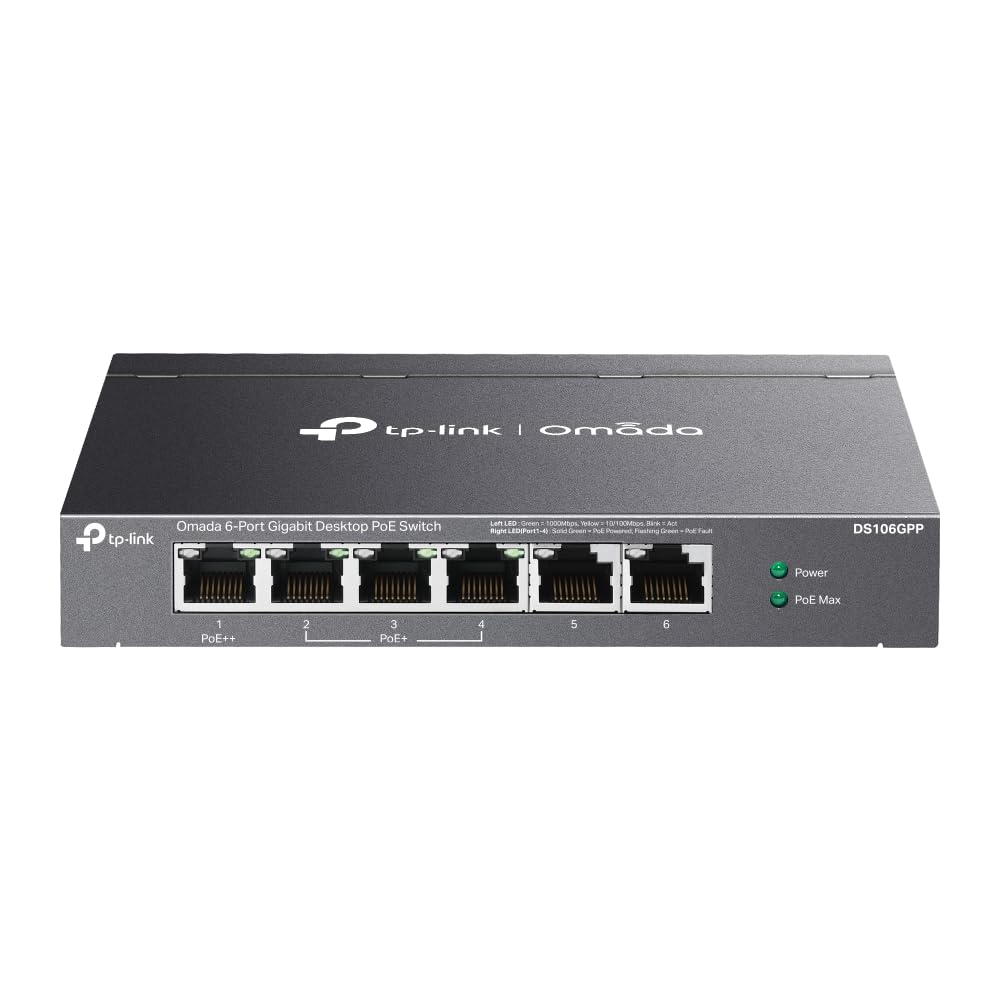
- Dedicated IEEE 802.3bt PoE++ port supplying up to 60W alongside three 30W PoE+ interfaces
- Six 10/100/1000 Mbps Gigabit Ethernet ports for wire-speed local switching
- Integrated hardware 802.1p/DSCP QoS prioritizing latency-sensitive network traffic
- Unmanaged architecture lacks VLAN segmentation, web management, and remote diagnostics
- Designated as End of Sale by the manufacturer, restricting future procurement and official lifecycle support
Overview
Integrating high-wattage power delivery directly into compact edge networking, the platform pairs an IEEE 802.3bt Type 3 PoE++ rail delivering up to 60W alongside three 30W IEEE 802.3at/af PoE+ ports across six Gigabit Ethernet RJ45 interfaces. Designed specifically for unmanaged desktop deployments, the underlying switching fabric routes line-rate 10/100/1000 Mbps traffic while incorporating hardware-level 802.1p/DSCP Quality of Service to prioritize latency-sensitive streams such as IP telephony and video surveillance feeds without requiring manual software tuning.
The physical desktop chassis is built for straightforward deployment, relying on passive dissipation through its enclosure to operate without active cooling fans. Because the unit functions strictly as an unmanaged hardware switch, it eliminates firmware vulnerability patching and configuration overhead; however, this architecture inherently omits remote network management, VLAN isolation, and web-based diagnostics. Furthermore, with the manufacturer designating the hardware as End of Sale, ongoing procurement and direct vendor lifecycle support remain constrained, positioning it primarily for standalone surveillance nodes or point-to-point wireless installations where advanced layer-2 controls are unnecessary.
Technical Specifications
| Brand | Omada |
| Model | DS106GPP |
| Total Ports | 6 |
| Port Configuration | 6x 10/100/1000 Mbps RJ45 |
| PoE Ports | 1x PoE++, 3x PoE+ |
| PoE Standards | IEEE 802.3af/at/bt |
| Max PoE Power Per Port | 60W (PoE++ port), 30W (PoE+ ports) |
| Switch Architecture | Unmanaged |
| Form Factor | Desktop |
| Quality Of Service | 802.1p/DSCP QoS |
Primary Sources & Audited Citations
Recommended Alternatives in Networking & Routers


At a Glance
How reliable is the Omada DS106GPP Review: High-Wattage Edge PoE Architecture according to Mizex audits?
Ideal for powering high-draw PTZ cameras or Wi-Fi 6 access points in simple unmanaged networks, but procure with caution given its End of Sale status and lack of remote management.
What are the known quirks or drawbacks of the Omada DS106GPP Review: High-Wattage Edge PoE Architecture?
Our reliability audit identified the following documented caveats:
- Unmanaged architecture lacks VLAN segmentation, web management, and remote diagnostics
- Designated as End of Sale by the manufacturer, restricting future procurement and official lifecycle support
What are the key engineering highlights of the Omada DS106GPP Review: High-Wattage Edge PoE Architecture?
The top strengths recorded in our evaluation include:
- Dedicated IEEE 802.3bt PoE++ port supplying up to 60W alongside three 30W PoE+ interfaces
- Six 10/100/1000 Mbps Gigabit Ethernet ports for wire-speed local switching
- Integrated hardware 802.1p/DSCP QoS prioritizing latency-sensitive network traffic