
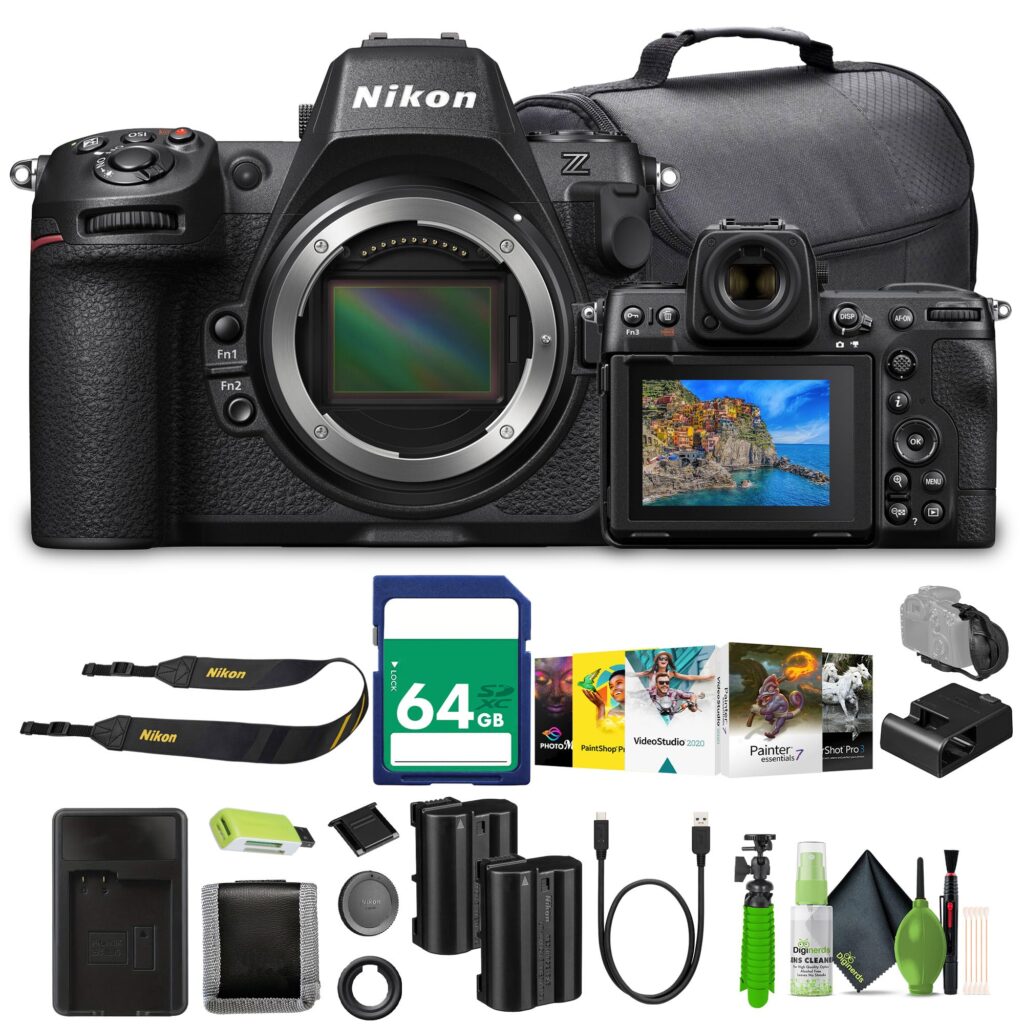
- Flagship 45.7 MP stacked CMOS pipeline delivers uncropped 4K/120p and internal 12-bit 8.3K/60p N-RAW recording
- Completely shutterless electronic architecture paired with a blackout-free Real-Live Viewfinder
- Dual independent USB-C ports separate dedicated Power Delivery charging from high-speed data communications
- Robust dust- and drip-resistant weather sealing certified operational down to -10°C (14°F)
- Modest CIPA battery endurance of approximately 330 to 340 shots per charge using standard EN-EL15c packs
- Substantial carry mass of approximately 1.98 to 2.01 lbs (899 to 910 g) with battery and memory card installed
Overview
Dual independent USB-C buses paired with a 45.7-megapixel full-frame stacked CMOS sensor define the core processing architecture of this hybrid imaging platform, dedicating separate physical controllers to continuous USB Power Delivery and high-speed external data transfer. Driven by the EXPEED 7 processor, the hardware eliminates conventional mechanical focal-plane shutter assemblies entirely, relying on continuous high-speed sensor readout to mitigate rolling shutter distortion across burst sequences up to 20 fps in RAW and 120 fps at 11 MP JPEG resolution. This high-bandwidth pipeline feeds a 3.69M-dot OLED Real-Live Viewfinder operating with continuous zero-blackout refresh, ensuring that the 493-point hybrid autofocus system sustains deep-learning tracking routines across nine recognized subject profiles without interruption.
Chassis engineering prioritizes extreme environmental protection within a frame 30% smaller than studio-grade flagship predecessor bodies, encasing the five-axis sensor-shift stabilization mechanism in dust- and drip-resistant sealing rated down to -10°C (14°F). At approximately 1.98 to 2.01 lbs (899 to 910 g) with battery and storage media installed, the unit features a four-axis vertical and horizontal tilting 3.2-in (8.1 cm) touchscreen. Thermal management within the sealed enclosure relies on passive conductive heat spreading, sustaining demanding internal video workflows including 12-bit 8.3K/60p N-RAW recording up to 90 minutes and 4K UHD/60p capture up to 125 minutes without internal active cooling fans.
Power delivery represents the primary operational constraint of the downscaled chassis volume, where reliance on the standard EN-EL15c rechargeable lithium-ion battery yields a CIPA rating of approximately 330 to 340 shots per charge under standard electronic viewfinder cycling. Media storage utilizes an asymmetric dual-slot configuration, pairing a high-bandwidth CFexpress Type B/XQD slot for demanding N-RAW and ProRes 422 HQ bitrates with an SD UHS-II interface for backup and proxy redundancy. The resulting hardware delivers uncompromised cinema-grade video processing and rapid continuous tracking in a ruggedized form factor, requiring only supplemental battery packs or active USB-PD tethering during intensive continuous field production.
Technical Specifications
| Brand | Nikon |
| Model | Z8 |
| Sensor Type | 45.7 MP Stacked CMOS (FX Full-Frame) |
| Image Processor | EXPEED 7 |
| Lens Mount | Nikon Z Mount |
| Shutter System | Fully Electronic Shutter |
| In Body Image Stabilization | 5-axis Sensor-shift VR with Synchro VR support |
| Autofocus System | 493-point hybrid AF with deep learning 3D-tracking |
| Subject Detection Categories | 9 subject types (People, Dogs, Cats, Birds, Cars, Motorcycles, Bicycles, Trains, Airplanes) |
| ISO Sensitivity | ISO 64 to 25,600 (expandable to ISO 32 to 102,400) |
| Continuous Shooting Rates | 20 fps RAW, 30 fps full-resolution JPEG, up to 120 fps at 11 MP JPEG |
| Pre Release Capture | Supported up to 120 fps |
| Electronic Viewfinder | 3.69M-dot OLED Real-Live Viewfinder (blackout-free) |
| Display Monitor | 3.2-in (8.1 cm) 4-axis vertical and horizontal tilting touchscreen |
| Internal Video Recording | Up to 8.3K/60p (12-bit N-RAW), 4K/120p, Apple ProRes RAW HQ, 10-bit ProRes 422 HQ, H.265 |
| Continuous Video Recording Limits | Up to 125 minutes in 4K UHD/60p, up to 90 minutes in 8K UHD/30p |
| Storage Interface | Dual slots (1x CFexpress Type B / XQD, 1x SD UHS-II) |
| I/O Connectivity | Dual independent USB-C (dedicated Power Delivery + data/communication), full-size HDMI |
| Audio Specification | 24-bit stereo audio |
| Battery Type | EN-EL15c Rechargeable Li-ion |
| Battery Life Rating | Approx. 330 to 340 shots (CIPA rating) |
| Weather Resistance Rating | Dust- and drip-resistant construction operational down to -10°C (14°F) |
| Weight (with Battery And Card) | Approx. 1.98 to 2.01 lbs (899 to 910 g) |
| Pixel Shift Resolution | Up to approx. 180 megapixels |
Primary Sources & Audited Citations
Recommended Alternatives in Cameras & Photography
At a Glance
How reliable is the Nikon Z8 Review: Shutterless Flagship Architecture Scaled Down according to Mizex audits?
The Nikon Z8 delivers uncompromised flagship 8.3K video capture and 120 fps burst tracking in a rugged, weather-sealed body, though high-intensity shoots require supplemental batteries or direct USB-PD power.
What are the known quirks or drawbacks of the Nikon Z8 Review: Shutterless Flagship Architecture Scaled Down?
Our reliability audit identified the following documented caveats:
- Modest CIPA battery endurance of approximately 330 to 340 shots per charge using standard EN-EL15c packs
- Substantial carry mass of approximately 1.98 to 2.01 lbs (899 to 910 g) with battery and memory card installed
What are the key engineering highlights of the Nikon Z8 Review: Shutterless Flagship Architecture Scaled Down?
The top strengths recorded in our evaluation include:
- Flagship 45.7 MP stacked CMOS pipeline delivers uncropped 4K/120p and internal 12-bit 8.3K/60p N-RAW recording
- Completely shutterless electronic architecture paired with a blackout-free Real-Live Viewfinder
- Dual independent USB-C ports separate dedicated Power Delivery charging from high-speed data communications
- Robust dust- and drip-resistant weather sealing certified operational down to -10°C (14°F)