
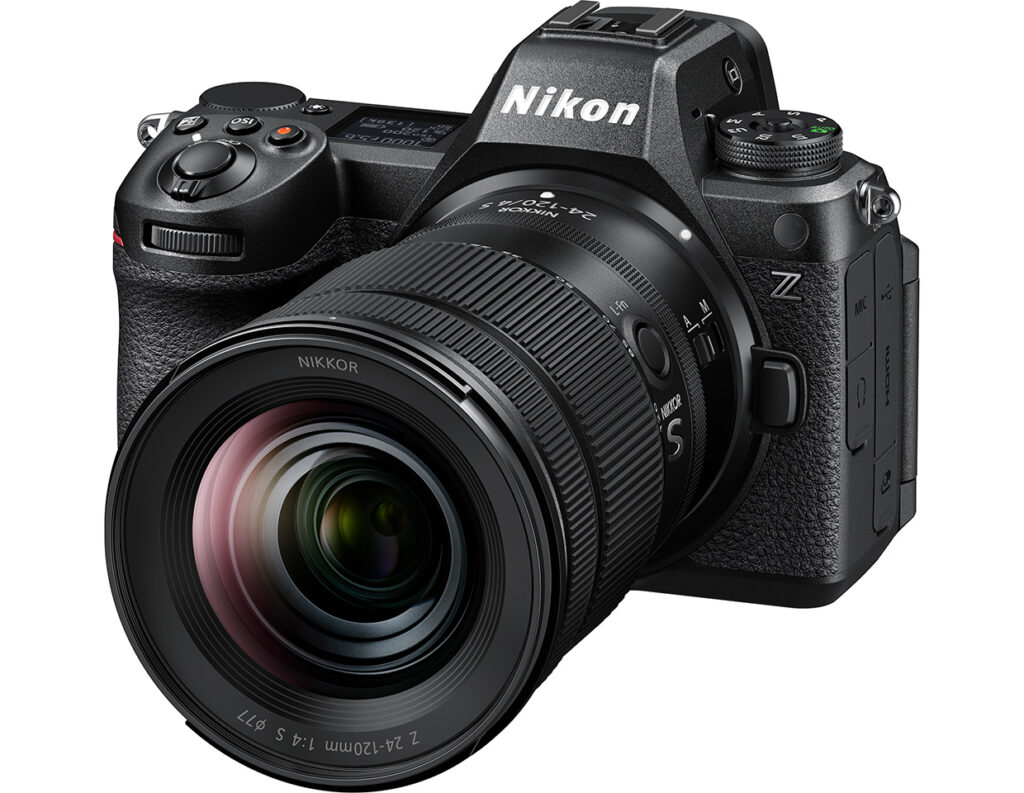
- Partially-stacked 24 MP full-frame sensor delivers high readout speeds with minimized rolling shutter distortion
- Internal 6K N-RAW video recording and 96 MP pixel-shift multi-shot capture
- High continuous burst shooting reaching 14 fps mechanical and up to 120 fps in APS-C crop
- Comprehensive connectivity including full-size HDMI, dedicated 3.5mm line-in audio, and USB-C Power Delivery
- Official vendor service advisory issued for sub-standard internal parts that can render the camera inoperable in affected serial numbers
- Dual-slot backup recording throttles continuous write speeds and buffer clearance to the slower SD UHS-II bus
Overview
Built around a partially-stacked 24 MP full-frame CMOS sensor, high-speed readout circuitry positioned directly adjacent to the pixel array dramatically accelerates data transfer to mitigate rolling shutter distortion while driving continuous capture speeds up to 14 fps with the mechanical shutter, 20 fps via full-frame electronic shutter, and 120 fps in APS-C crop mode. The internal imaging pipeline supports internal 6K N-RAW and H.265 video capture, paired with in-body image stabilization (IBIS) and a 32-image pixel-shift mode capable of generating composite 96 MP files. Visual framing is anchored by a high-brightness 5.76-million dot electronic viewfinder and a vari-angle LCD, supported by an I/O layout that includes a full-size HDMI output, dedicated 3.5mm line-in and headphone jacks, and USB-C with Power Delivery.
Storage architecture pairs a high-throughput CFexpress Type B slot with a secondary SD UHS-II slot. While this configuration offers broad media flexibility, operating the dual slots in backup or overflow mode bottlenecks continuous write operations and burst buffer clearing to the lower throughput ceiling of the SD UHS-II bus. Internally, the chassis dissipates heat passively during sustained high-bitrate 6K N-RAW recording and continuous burst sessions without relying on internal active cooling fans. Mechanical actuation remains dampened up to its 1/16000 s maximum shutter limit, while electronic shutter options provide silent operation.
Field reliability and manufacturing consistency require careful buyer verification due to an official vendor service advisory. Nikon acknowledged that select production batches contain sub-standard internal components capable of rendering the camera inoperable, prompting an active service campaign offering free repairs for affected serial numbers. Prospective operators and secondary-market buyers must verify serial number eligibility through the manufacturer database to confirm whether factory hardware remediation has been completed, particularly for mission-critical production environments.
Technical Specifications
| Brand | Nikon |
| Model | Z6 III |
| Sensor Type | Partially-Stacked CMOS |
| Sensor Resolution | 24 MP |
| Sensor Format | Full-frame |
| Max Shutter Speed | 1/16000 s |
| Mechanical Shutter Burst | 14 fps |
| Electronic Shutter Burst | 20 fps (full frame), 120 fps (APS-C crop) |
| Image Stabilization | In-Body Image Stabilization (IBIS) |
| Electronic Viewfinder | 5.76-million dot EVF |
| Display | Vari-angle LCD |
| Video Recording Formats | 6K N-RAW, H.265 |
| Pixel Shift Multi Shot | Up to 32 images (96 MP) |
| Memory Card Slots | 1x CFexpress Type B, 1x SD UHS-II |
| Interfaces | USB-C (Power Delivery, charging, data transfer), Full-size HDMI, 3.5mm headphone out, 3.5mm line-in audio, accessory port |
Primary Sources & Audited Citations
- Z6III - 概要 | ミラーレスカメラ | ニコン
- Nikon Z6 III Review: Nikon's Best Camera This Side of the Z8
- Nikon Z6 III Review, Low Light, Autofocus, Real World Performance Analysis - Nikon Rumors
- Best Memory Cards Nikon Z6 III - Real Benchmarks | Alik Griffin
- Nikon apologizes for cameras manufactured using parts that do not meet our quality standards, issuing free repair service for three mirrorless models | Digital Camera World
Recommended Alternatives in Cameras & Photography

At a Glance
How reliable is the Nikon Z6 III Review: Partially Stacked Sensor Marred By Bottlenecks according to Mizex audits?
Check unit serial numbers against Nikon's official service advisory database before purchasing to verify free factory component replacement, and be mindful that dual-slot backup recording throttles buffer clearance to the slower SD UHS-II slot.
What are the known quirks or drawbacks of the Nikon Z6 III Review: Partially Stacked Sensor Marred By Bottlenecks?
Our reliability audit identified the following documented caveats:
- Official vendor service advisory issued for sub-standard internal parts that can render the camera inoperable in affected serial numbers
- Dual-slot backup recording throttles continuous write speeds and buffer clearance to the slower SD UHS-II bus
What are the key engineering highlights of the Nikon Z6 III Review: Partially Stacked Sensor Marred By Bottlenecks?
The top strengths recorded in our evaluation include:
- Partially-stacked 24 MP full-frame sensor delivers high readout speeds with minimized rolling shutter distortion
- Internal 6K N-RAW video recording and 96 MP pixel-shift multi-shot capture
- High continuous burst shooting reaching 14 fps mechanical and up to 120 fps in APS-C crop
- Comprehensive connectivity including full-size HDMI, dedicated 3.5mm line-in audio, and USB-C Power Delivery