
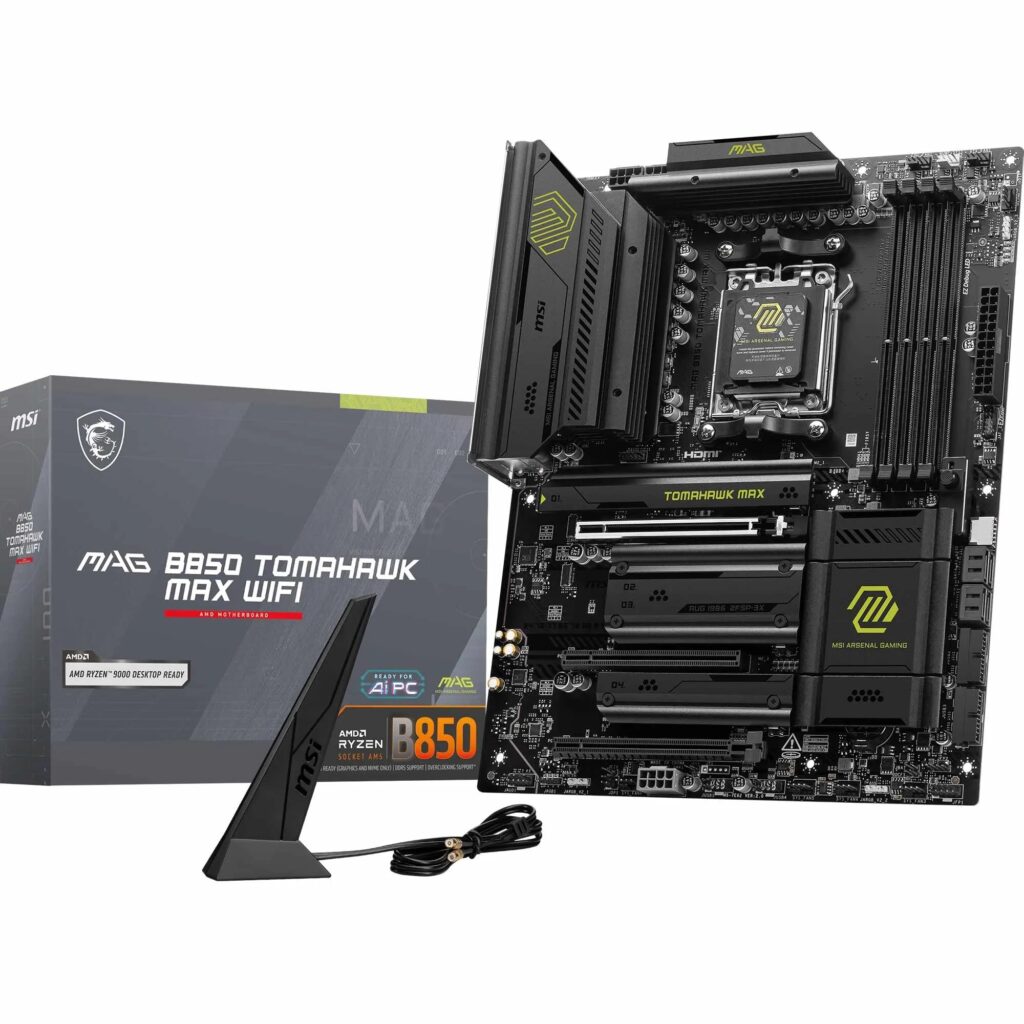
- Robust 14+2+1 80A SPS power delivery on an 8-layer 2oz copper PCB with dual 8-pin EPS connectors
- Dual PCIe Gen 5 x4 M.2 slots alongside two PCIe Gen 4 M.2 slots and a PCIe Gen 5 x16 graphics slot
- High-bandwidth networking pairing Realtek 8126 5 Gbps Ethernet with Qualcomm QCNCM865 Wi-Fi 7
- Builder-friendly touches including EZ PCIe Release, EZ M.2 Clip II, integrated I/O shield, and rear BIOS Flashback
- Lacks USB4 connectivity on the rear I/O
- No LED POST code display, onboard power/reset buttons, or thermistor headers
- Only one M.2 heatsink uses a tool-free mechanism, with no rear backplate or onboard RGB
Overview
MSI treats the B850 chipset less like a budget compromise and more like a stripped-down enthusiast foundation. Built around an eight-layer server-grade PCB with 2oz thickened copper, the board feeds Socket AM5 processors—spanning Ryzen 7000 and 9000 series chips—through a 14+2+1 Duet Rail Power System using 80A smart power stages and dual 8-pin EPS connectors. That electrical headroom pairs naturally with four DDR5 DIMM slots supporting up to 256 GB of memory and overclocking speeds reaching DDR5-8400 MT/s on dual single-rank kits, alongside a primary PCIe Gen 5 x16 slot for current and next-generation GPUs.
Storage and connectivity are where this layout quietly outclasses typical midrange boards. Four M.2 slots sit across the PCB—two wired for PCIe Gen 5 x4 at up to 128 Gbps, plus a PCIe Gen 4 x4 and a PCIe Gen 4 x2 slot—backed by four SATA 6 Gb/s ports for legacy drives. Networking steps well past standard gigabit fare with a Realtek 8126 5 Gbps Ethernet controller and a Qualcomm QCNCM865 Wi-Fi 7 radio, while Realtek ALC4080 audio and an optical S/PDIF output round out the rear I/O. Eight 4-pin fan headers give builders ample airflow control over the passive heatsink array, though the board skips thermistor headers if you like tying fan curves to external probes.
Day-to-day assembly and firmware upkeep are refreshingly painless thanks to an integrated I/O shield, an EZ PCIe Release button for clearing hefty graphics cards, and EZ M.2 Clip II latches alongside simplified front-panel and EZ Conn cabling. Should a bad memory tune stall boot, rear BIOS Flashback and Clear CMOS buttons sit right next to EZ Debug LEDs and a 256 Mbit AMI UEFI, saving you from pulling the CMOS battery. A few cost-saving cuts remain visible on the bench: only one M.2 heatsink uses a tool-free latch, there is no protective backplate or onboard RGB lighting, and external high-speed expansion tops out at 10 Gbps USB 3.2 Gen 2 Type-C rather than USB4. None of those omissions hurt everyday stability, leaving a clean, utilitarian platform focused on core bandwidth and power delivery.
Technical Specifications
| Brand | MSI |
| Model | MAG B850 Tomahawk MAX WiFi |
| Socket | AMD Socket AM5 (Ryzen 7000 & 9000 Series) |
| Chipset | AMD B850 |
| Form Factor | ATX |
| PCB | 8-layer server-grade PCB with 2oz thickened copper |
| VRM Power Design | 14+2+1 DRPS (14x 80A SPS CPU, 2x SOC, 1x MISC) |
| CPU Power Connectors | 2x 8-pin EPS |
| Memory Support | 4x DDR5 DIMM, up to 256 GB, up to DDR5-8400 MT/s (OC, 2x Single Rank) |
| Expansion Slots | 1x PCIe Gen 5 x16 (x16/x8/x4), 1x PCIe Gen 4 x16 (x4/x2), 1x PCIe Gen 3 x16 (x1) |
| M.2 Storage | 2x PCIe Gen 5 x4 (128 Gbps), 1x PCIe Gen 4 x4, 1x PCIe Gen 4 x2 |
| SATA Storage | 4x SATA 6 Gb/s |
| Ethernet | Realtek 8126 5 Gbps |
| Wireless | Qualcomm QCNCM865 Wi-Fi 7 |
| Audio Codec | Realtek ALC4080 |
| Rear I/O | 1x HDMI, 3x USB 3.2 Gen 2 10 Gbps Type-C, 2x USB 3.2 Gen 2 10 Gbps Type-A, 1x USB 3.0 Type-A, 4x USB 2.0 Type-A, 1x 5 Gbps Ethernet, 2x Wi-Fi antenna connectors, 2x Audio jacks, 1x Optical S/PDIF Out, BIOS Flashback, Clear CMOS |
| Fan & Thermal Headers | 8x 4-pin fan headers, 0x thermistor headers |
| BIOS & DIY Features | 256 Mbit AMI UEFI, Integrated I/O shield, EZ PCIe Release, EZ M.2 Clip II, 1x tool-free M.2 heatsink, EZ Front Panel & EZ Conn cables, EZ Debug LEDs |
Primary Sources & Audited Citations
Recommended Alternatives in Motherboards
At a Glance
How reliable is the MSI MAG B850 Tomahawk MAX WiFi according to Mizex audits?
Buy this if you want flagship-grade AM5 power delivery, high-speed networking, and generous NVMe expansion for a Ryzen 7000 or 9000 build; look at X870 or enthusiast boards if you need onboard POST codes, thermistor headers, or dedicated benchtop buttons.
What are the known quirks or drawbacks of the MSI MAG B850 Tomahawk MAX WiFi?
Our reliability audit identified the following documented caveats:
- Lacks USB4 connectivity on the rear I/O
- No LED POST code display, onboard power/reset buttons, or thermistor headers
- Only one M.2 heatsink uses a tool-free mechanism, with no rear backplate or onboard RGB
What are the key engineering highlights of the MSI MAG B850 Tomahawk MAX WiFi?
The top strengths recorded in our evaluation include:
- Robust 14+2+1 80A SPS power delivery on an 8-layer 2oz copper PCB with dual 8-pin EPS connectors
- Dual PCIe Gen 5 x4 M.2 slots alongside two PCIe Gen 4 M.2 slots and a PCIe Gen 5 x16 graphics slot
- High-bandwidth networking pairing Realtek 8126 5 Gbps Ethernet with Qualcomm QCNCM865 Wi-Fi 7
- Builder-friendly touches including EZ PCIe Release, EZ M.2 Clip II, integrated I/O shield, and rear BIOS Flashback