
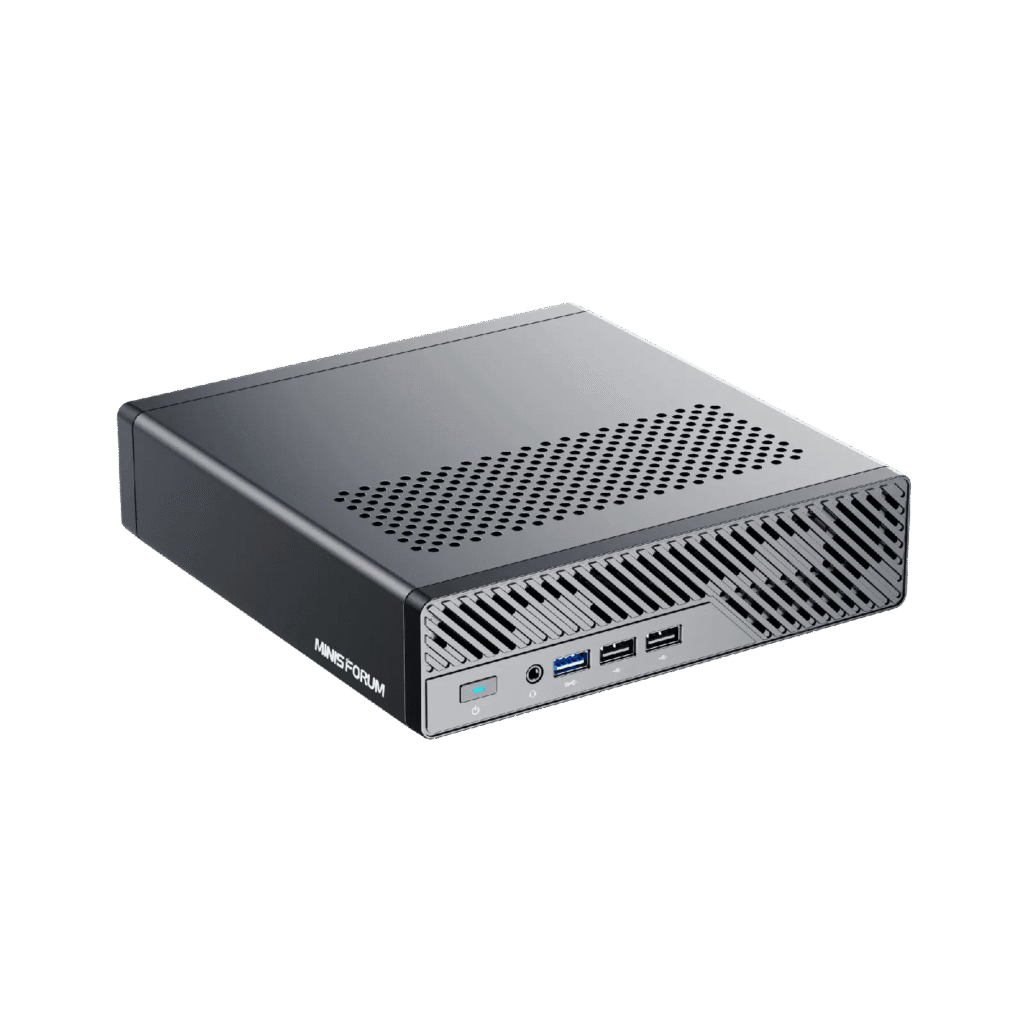
- Intel Core Ultra 9 386H Panther Lake architecture paired with an integrated 50 TOPS NPU for edge AI workloads
- Extensive high-speed networking featuring dual 10G SFP+ optical ports, 10G RJ45, and 2.5G RJ45 interfaces
- Exceptional chassis modularity offering dual M.2 2280 NVMe storage slots, DDR5-7200 memory support, and a dedicated PCIe expansion slot
- Next-generation wireless stack with Wi-Fi 7 and Bluetooth 6 support
- Absence of Hyper-Threading on performance cores limits concurrent execution to 16 threads across 16 physical cores
Overview
Designed around an extraordinarily dense multi-gigabit routing topology, the architecture couples Intel’s Panther Lake Core Ultra 9 386H processor with enterprise-grade network interconnects seldom encountered in compact desktop hardware. By orchestrating a hybrid 16-core compute topology—comprising 4 Performance cores, 8 Efficient cores, and 4 Low-Power Efficient cores scaling up to a 4.9 GHz boost clock—with an integrated 50 TOPS Neural Processing Unit, the system targets both local artificial intelligence inference and intensive edge virtualization. The underlying bus distribution channels high-speed I/O directly into dual 10G SFP+ optical ports, a 10G RJ45 port, and a secondary 2.5G RJ45 LAN interface, providing homelab deployments and network edge appliances with substantial data throughput without relying on external Thunderbolt enclosures.
Structural layout and expansion potential distinguish the platform from standard compact computing form factors. Within its rigid chassis enclosure, the internal PCB routing integrates dual M.2 2280 NVMe storage slots and high-speed DDR5-7200 memory support alongside a dedicated internal PCIe expansion slot. This physical PCIe slot allows network administrators and virtualization architects to install low-profile network add-in cards or storage accelerators directly onto the primary board. Thermal dissipation is engineered to manage a baseline processor power profile of 25 W while absorbing dynamic turbo spikes of up to 80 W, balancing heat extraction across the silicon die and the surrounding high-density networking PHY controllers.
From an operational and deployment perspective, the architecture establishes a highly capable node for clustering, software-defined routing, and hypervisor workloads. The silicon reflects modern Intel architecture adjustments where the absence of Hyper-Threading yields a flat 16 physical cores and 16 concurrent threads, requiring deliberate resource sizing when planning multi-tenant virtual machines. Supported by modern peripheral I/O—including 5 USB-A ports, 2 USB-C ports, HDMI 2.1 with Fixed Rate Link support, and Wi-Fi 7 wireless connectivity—the platform represents an exceptionally capable convergence of workstation bus bandwidth and compact homelab utility.
Technical Specifications
| Brand | Minisforum |
| Model | MS-03 |
| Processor | Intel Core Ultra 9 386H (16 cores / 16 threads: 4 P-cores, 8 E-cores, 4 LP-E cores, up to 4.9 GHz boost, 18 MB Intel Smart Cache) |
| Microarchitecture | Intel Panther Lake (Core Ultra Series 3) |
| NPU Processing | Up to 50 TOPS |
| Base Power | 25 W |
| Turbo Power | 80 W |
| Memory Support | DDR5-7200 |
| Storage Slots | 2x M.2 2280 NVMe SSD slots |
| PCIe Expansion | 1x PCIe slot |
| Wired Networking | 2x 10G SFP+ ports, 1x 10G RJ45 LAN jack, 1x 2.5G RJ45 LAN jack |
| Wireless Connectivity | Wi-Fi 7, Bluetooth 6 |
| USB Ports | 5x USB-A ports, 2x USB-C ports |
| Display Outputs | 1x HDMI 2.1 (with FRL support) |
| Audio Interface | 1x 3.5 mm headphone jack |
Primary Sources & Audited Citations
- Minisforum MS-03 Review: The MS-01 Home Lab Upgrade I've Been Waiting For? - Virtualization Howto
- MINISFORUM MS-03 is a compact Panther Lake PC with 10 Gigabit LAN and a PCIe slot - Liliputing
- Minisforum introduces MS-03 and M2 Pro AI mini PCs, and S5 and N5 Max NAS devices with powerful AI NPU performance - Notebookcheck
Recommended Alternatives in Mini PCs
At a Glance
How reliable is the Minisforum MS-03 Review: Multi-Gigabit Optical Homelab Node according to Mizex audits?
Homelab enthusiasts, virtualization architects, and network engineers requiring high-throughput 10G optical pipelines in an ultra-dense footprint will find unmatched expansion capabilities here, provided single-thread per core allocation matches their hypervisor workloads.
What are the known quirks or drawbacks of the Minisforum MS-03 Review: Multi-Gigabit Optical Homelab Node?
Our reliability audit identified the following documented caveats:
- Absence of Hyper-Threading on performance cores limits concurrent execution to 16 threads across 16 physical cores
What are the key engineering highlights of the Minisforum MS-03 Review: Multi-Gigabit Optical Homelab Node?
The top strengths recorded in our evaluation include:
- Intel Core Ultra 9 386H Panther Lake architecture paired with an integrated 50 TOPS NPU for edge AI workloads
- Extensive high-speed networking featuring dual 10G SFP+ optical ports, 10G RJ45, and 2.5G RJ45 interfaces
- Exceptional chassis modularity offering dual M.2 2280 NVMe storage slots, DDR5-7200 memory support, and a dedicated PCIe expansion slot
- Next-generation wireless stack with Wi-Fi 7 and Bluetooth 6 support