
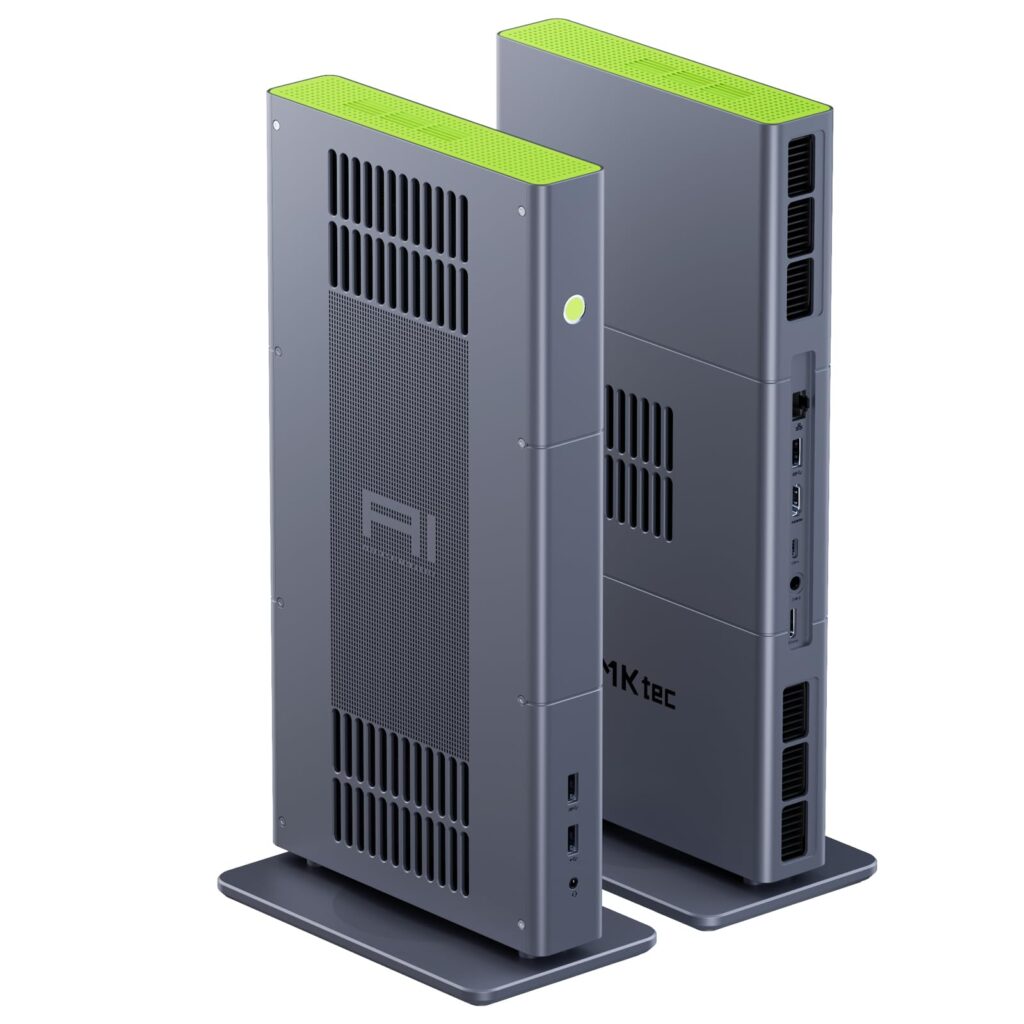
- Flagship 16-core, 32-thread AMD Ryzen AI Max+ 395 APU with Zen 5/Zen 5c architecture and RDNA 3.5 graphics
- Unified LPDDR5X memory support up to 128 GB providing massive bandwidth for local AI inference
- Wide configurable TDP range from 54W up to 140W to match workload intensity
- High-capacity 2 TB and 4 TB NVMe SSD storage options in a compact console-sized footprint
- Soldered LPDDR5X unified memory architecture prevents aftermarket RAM upgrades
- Sustained 140W peak operation demands adequate ambient ventilation in compact environments
Overview
Silicon topology on AMD’s FP11 BGA platform redefines high-density desktop computing by integrating the 16-core, 32-thread Ryzen AI Max+ 395 APU with unified LPDDR5X memory directly onto the mainboard. Built on TSMC’s 4nm process node utilizing hybrid Zen 5 and Zen 5c compute tiles, the system couples 16 MB of L2 cache and 64 MB of L3 cache split across dual core complex dies with AMD RDNA 3.5 graphics. Operating with a baseline 55W thermal envelope that can be dynamically scaled from 54W up to a peak of 140W, the internal power delivery is engineered to sustain multi-threaded rendering and intensive local artificial intelligence workloads.
Enclosed in a compact workstation chassis comparable to a console footprint, the physical layout prioritizes intake ventilation and targeted exhaust pathways to handle high-wattage power spikes. The integration of up to 128 GB of unified LPDDR5X memory provides an ultra-wide memory interface critical for local large language model inference and massive dataset manipulation, bypassing the bandwidth limitations typical of traditional dual-channel SODIMM architectures. High-speed storage is accommodated via high-capacity NVMe solid-state drive configurations spanning 2 TB to 4 TB, delivering rapid data streaming directly across PCIe lanes to the unified compute engine.
System stability and hardware longevity benefit from the simplified trace topology of soldered BGA memory, which eliminates socket pin fatigue and mechanical retention wear during extended operational cycles. While the soldered memory design precludes aftermarket RAM replacement, the accessible NVMe storage slots ensure primary system drive maintenance and capacity expansion remain straightforward. Sustained operation near the upper 140W power limit relies on aggressive active airflow management within the compact enclosure, making the unit an effective, space-conscious desktop compute node for engineering simulation, creative workflows, and private on-premises AI inference.
Technical Specifications
| Brand | GMKtec |
| Model | EVO-X3 |
| Form Factor | Compact AI Workstation Mini PC |
| Processor | AMD Ryzen AI Max+ 395 |
| CPU Architecture | AMD Zen 5 / Zen 5c |
| Process Node | TSMC 4nm |
| Core Count | 16 |
| Thread Count | 32 |
| Base Clock | 3.0 GHz |
| Boost Clock | 5.1 GHz |
| L2 Cache | 16 MB |
| L3 Cache | 64 MB (2x 32 MB CCX) |
| CPU Socket | FP11 (BGA) |
| Thermal Design Power (TDP) | 55W (Configurable 54W - 140W) |
| Graphics | AMD RDNA 3.5 |
| Memory Type | LPDDR5X |
| Maximum Memory Capacity | Up to 128 GB |
| Storage Support | 2 TB / 4 TB NVMe SSD |
Primary Sources & Audited Citations
Recommended Alternatives in Mini PCs
At a Glance
How reliable is the GMKtec EVO-X3 Review: Compact 128GB Local AI Workstation according to Mizex audits?
The GMKtec EVO-X3 is an exceptional choice for developers and creative professionals requiring massive 128 GB unified memory bandwidth for local AI inference in a compact desktop footprint, provided factory memory capacity is selected carefully upfront.
What are the known quirks or drawbacks of the GMKtec EVO-X3 Review: Compact 128GB Local AI Workstation?
Our reliability audit identified the following documented caveats:
- Soldered LPDDR5X unified memory architecture prevents aftermarket RAM upgrades
- Sustained 140W peak operation demands adequate ambient ventilation in compact environments
What are the key engineering highlights of the GMKtec EVO-X3 Review: Compact 128GB Local AI Workstation?
The top strengths recorded in our evaluation include:
- Flagship 16-core, 32-thread AMD Ryzen AI Max+ 395 APU with Zen 5/Zen 5c architecture and RDNA 3.5 graphics
- Unified LPDDR5X memory support up to 128 GB providing massive bandwidth for local AI inference
- Wide configurable TDP range from 54W up to 140W to match workload intensity
- High-capacity 2 TB and 4 TB NVMe SSD storage options in a compact console-sized footprint