
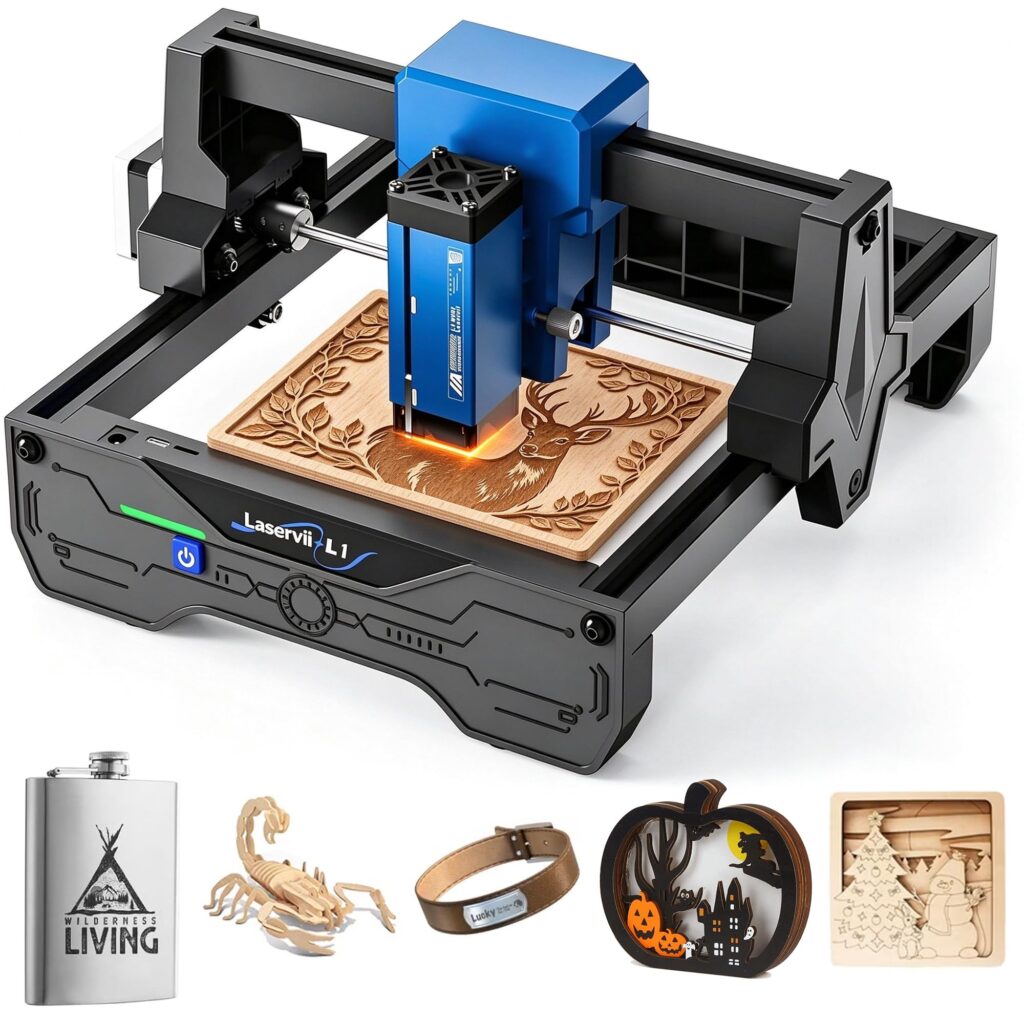
- Ultra-fine 0.04 × 0.04 mm (0.0016 × 0.0016 in) compressed spot for high-resolution vector and bitmap engraving
- Rapid gantry motion capability rated up to 12,000 mm/min (472.4 in/min)
- Compact desktop footprint well-suited for space-constrained workbenches and portable setups
- 3W optical output power is limited strictly to surface marking and shallow etching rather than thick cutting
- 5.9 × 5.9 in (150 × 150 mm) working area constrains batch jobs and larger stock
Overview
Desktop footprint economy dictates the physical architecture of the LaserVii L1 Mini Laser Engraver, centering on a compact gantry frame engineered for space-constrained workbenches and portable workstations. Bounding the active processing envelope to 5.9 × 5.9 in (150 × 150 mm), the lightweight chassis trades bulk fabrication capacity for immediate desktop deployment and convenient repositioning. Mechanical stability across the dual-axis motion platform remains solid during rapid traverses, maintaining rail alignment without flex when driving its travel head across the working plane.
At the core of the optical carriage sits a 3W diode laser module paired with a 0.04 × 0.04 mm (0.0016 × 0.0016 in) compressed focal spot. This micro-aperture beam compression concentrates optical energy to deliver sharp vector contours, fine typography, and intricate bitmap shading on compatible media. Motion kinematics are tuned for velocity, supporting feed rates up to 12,000 mm/min (472.4 in/min) to expedite low-depth raster engraving passes across softer substrates such as wood, leather, and coated plastics.
Practical utility is defined by clear physical limits. The 3W optical rating delivers adequate irradiance for surface marking and high-contrast etching, but lacks the raw thermal density necessary for medium-to-thick material penetration or rapid single-pass cutting. Solid-state diode longevity and steady-state thermal behavior benefit from the low wattage draw, avoiding thermal throttle degradation during extended vector passes. For hobbyists and prototyping labs targeting compact personalized artifacts rather than dimensional cutting or batch production, the unit delivers consistent micro-scale detailing within a disciplined physical envelope.
Technical Specifications
| Brand | LaserVii |
| Model | L1 Mini Laser Engraver |
| Laser Type | Diode Laser |
| Optical Laser Power | 3W |
| Laser Spot Size | 0.04 × 0.04 mm (0.0016 × 0.0016 in) |
| Max Engraving Speed | 12,000 mm/min (472.4 in/min) |
| Engraving Area | 5.9 × 5.9 in (150 × 150 mm) |
| Form Factor | Desktop Portable |
Recommended Alternatives in 3D Printers
At a Glance
How reliable is the LaserVii L1 Mini Laser Engraver Review: Precision Etching Meets Workspace Limits according to Mizex audits?
Best suited for hobbyists and makers prioritizing intricate surface etching on small items, but inadequate for users requiring dimensional sheet cutting or broad workpiece capacity.
What are the known quirks or drawbacks of the LaserVii L1 Mini Laser Engraver Review: Precision Etching Meets Workspace Limits?
Our reliability audit identified the following documented caveats:
- 3W optical output power is limited strictly to surface marking and shallow etching rather than thick cutting
- 5.9 × 5.9 in (150 × 150 mm) working area constrains batch jobs and larger stock
What are the key engineering highlights of the LaserVii L1 Mini Laser Engraver Review: Precision Etching Meets Workspace Limits?
The top strengths recorded in our evaluation include:
- Ultra-fine 0.04 × 0.04 mm (0.0016 × 0.0016 in) compressed spot for high-resolution vector and bitmap engraving
- Rapid gantry motion capability rated up to 12,000 mm/min (472.4 in/min)
- Compact desktop footprint well-suited for space-constrained workbenches and portable setups