
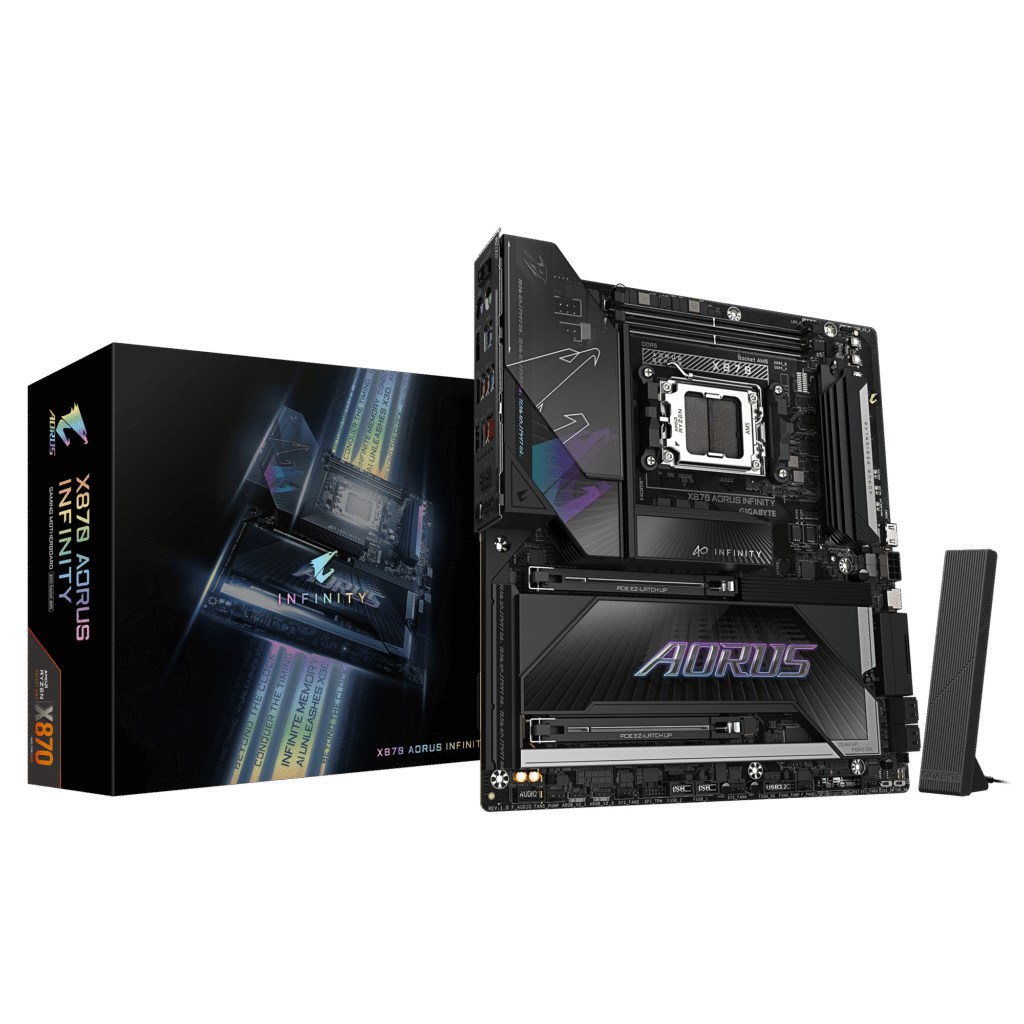
- Dedicated 2-DIMM memory layout optimized for extreme DDR5 overclocking up to 11400 MT/s
- PCIe 5.0 support across primary expansion and M.2 NVMe storage interfaces
- Broad Socket AM5 compatibility across AMD Ryzen 7000, 8000, and 9000 series processors
- Dual memory profile support accommodating both AMD EXPO and Intel XMP 3.0 standards
- Dual DIMM configuration caps overall memory capacity to two modules (128 GB maximum)
- Populating the secondary PCIe slot bifurcates the primary PCIe 5.0 x16 slot to x8 mode
- Specialized layout prioritizes competitive overclocking over general-purpose workstation expansion
Overview
Direct, shortened memory trace routing between the AM5 socket and dual DIMM slots establishes signal integrity capable of reaching DDR5 11400 MT/s, deliberately stripping away secondary memory channels to minimize electrical crosstalk. Operating on AMD’s X870 chipset, the board pairs native Socket AM5 support across Ryzen 7000, 8000, and 9000 series processors with dedicated PCIe 5.0 signal paths. Bandwidth allocation prioritizes full PCIe 5.0 x16 throughput to the primary graphics slot alongside a dedicated PCIe 5.0 x4 M.2 NVMe storage interface capable of hosting drives up to Type 25110. However, routing flexibility reflects clear tuning compromises: populating the secondary physical PCIe 5.0 slot bifurcates the primary graphics link down to an x8 electrical configuration, reserving peak throughput strictly for single-card setups.
Structural integrity across the Extended ATX footprint accommodates heavy sub-ambient cooling hardware and substantial graphics cards through reinforced slot anchors and a dense multi-layer PCB. Thermal dissipation relies entirely on expansive passive aluminum heatsinks covering the chipset and high-bandwidth M.2 drive, managing heat buildup through direct surface contact rather than mechanical fan assemblies. On the firmware side, the platform delivers unified tuning integration by supporting both AMD EXPO and Intel XMP 3.0 memory profiles, ensuring fine-grained voltage adjustments and timing control essential for stabilizing extreme DDR5 overclocks.
In practical deployment, the platform represents an uncompromising niche instrument rather than a balanced foundation for general-purpose desktop computing. Capping memory capacity at two modules (up to 128 GB) and offering just four SATA 6Gb/s ports alongside limited expansion slots, it trades everyday peripheral connectivity for peak signaling purity. For competitive overclockers and enthusiasts chasing frequency benchmarks on Socket AM5, the architecture delivers uncompromising signal discipline, while everyday builders will find the expansion constraints overly restrictive.
Technical Specifications
| Brand | GIGABYTE |
| Model | X870 AORUS Infinity |
| Socket | Socket AM5 |
| Chipset | AMD X870 |
| Form Factor | Extended ATX (E-ATX) |
| Supported Processors | AMD Ryzen 7000 / 8000 / 9000 Series |
| Memory Slots | 2 x DDR5 DIMM |
| Memory Channel Architecture | Dual Channel |
| Maximum Memory Capacity | 128 GB |
| Maximum Memory Frequency | DDR5 11400 MT/s (OC) |
| Overclocking Profiles | AMD EXPO, Intel XMP 3.0 |
| PCIe Expansion Slots | 1 x PCIe 5.0 x16 (PCIEX16), 1 x PCIe 5.0 x16 (PCIEX8 mode, bandwidth shared with PCIEX16) |
| M.2 Storage Slots | 1 x M.2 (M2A_CPU, PCIe 5.0 x4/x2, Type 25110/22110/2580/2280) |
| SATA Storage Ports | 4 x SATA 6Gb/s |
Primary Sources & Audited Citations
Recommended Alternatives in Motherboards
At a Glance
How reliable is the GIGABYTE X870 AORUS Infinity Review: High-Frequency AM5 Memory Architecture according to Mizex audits?
Target this board strictly if pursuing extreme DDR5 frequency benchmarks, as the dual-DIMM layout and PCIe lane sharing limit versatility for general-purpose workstations.
What are the known quirks or drawbacks of the GIGABYTE X870 AORUS Infinity Review: High-Frequency AM5 Memory Architecture?
Our reliability audit identified the following documented caveats:
- Dual DIMM configuration caps overall memory capacity to two modules (128 GB maximum)
- Populating the secondary PCIe slot bifurcates the primary PCIe 5.0 x16 slot to x8 mode
- Specialized layout prioritizes competitive overclocking over general-purpose workstation expansion
What are the key engineering highlights of the GIGABYTE X870 AORUS Infinity Review: High-Frequency AM5 Memory Architecture?
The top strengths recorded in our evaluation include:
- Dedicated 2-DIMM memory layout optimized for extreme DDR5 overclocking up to 11400 MT/s
- PCIe 5.0 support across primary expansion and M.2 NVMe storage interfaces
- Broad Socket AM5 compatibility across AMD Ryzen 7000, 8000, and 9000 series processors
- Dual memory profile support accommodating both AMD EXPO and Intel XMP 3.0 standards