
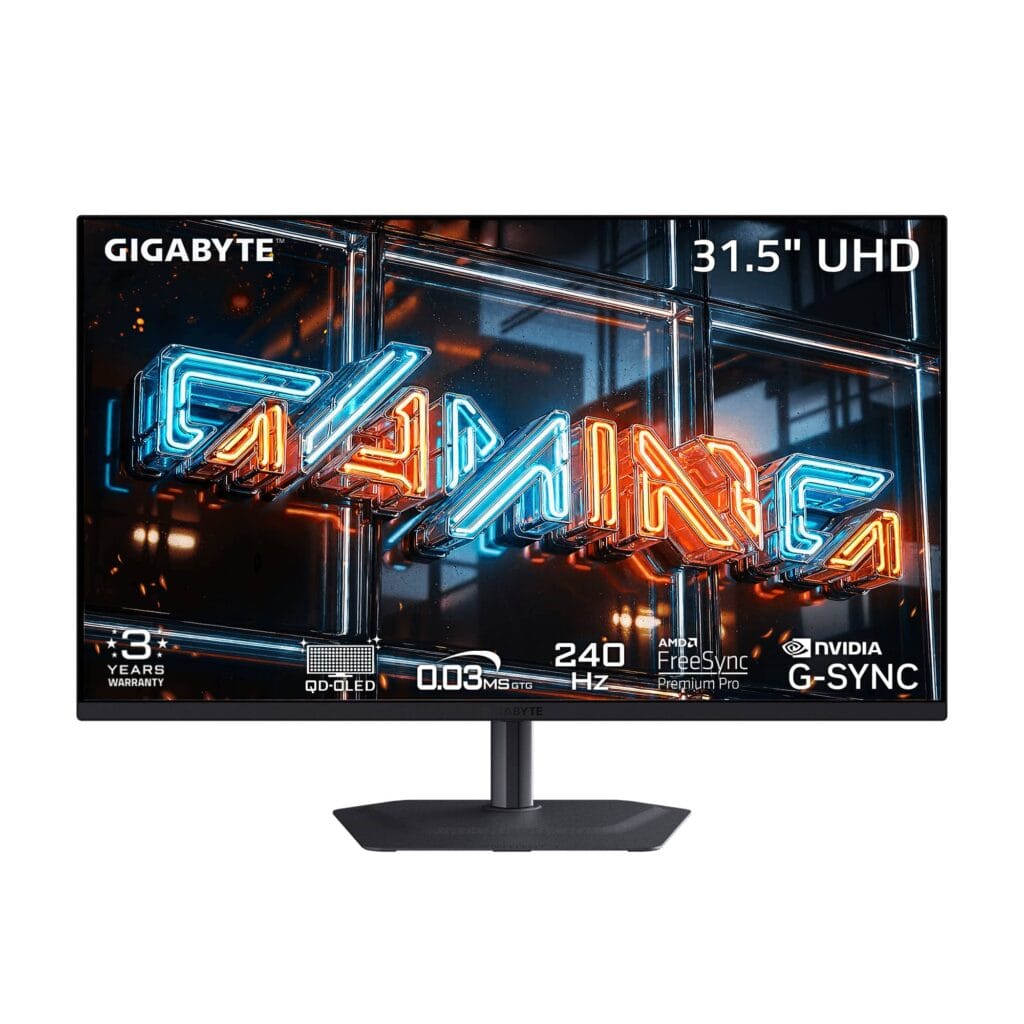
- Five-layer Samsung Penta Tandem EL 3.0 QD-OLED panel hits ~300 cd/m² full-screen SDR brightness and 1,000 cd/m² HDR peaks (3% APL)
- 240 Hz refresh rate with 0.03 ms GTG response time, VESA ClearMR 13000, and VESA DisplayHDR True Black 500 certification
- Fanless graphene thermal dissipation paired with AI OLED Care burn-in safeguards and OLED VRR Anti-Flicker
- ObsidianShield optical coating provides 3H scratch resistance and reduced surface glare
- Omits a circular polarizer, allowing black levels to lift slightly under strong ambient lighting
- Triangular subpixel layout can introduce mild color fringing along high-contrast text edges
Overview
Samsung’s five-layer Penta Tandem EL 3.0 QD-OLED panel gives this 31.5-inch 4K monitor a noticeable jump in sustained luminance over earlier OLED generations, hitting roughly 300 cd/m² across a full 100% white window in SDR while pushing up to 1,000 cd/m² at a 3% APL—and higher via HyperNits Peak 1300 mode—for DisplayHDR True Black 500 content. Paired with a 240 Hz refresh rate, 0.03 ms gray-to-gray response time, and VESA ClearMR 13000 certification, fast-paced motion stays clean and free of blur alongside 99% DCI-P3 color coverage.
Instead of relying on an active internal cooling fan to manage the extra emissive layers, Gigabyte pairs the panel with a passive graphene thermal film to pull heat away during long gaming sessions. Up front, the Advanced ObsidianShield optical coating adds 3H surface hardness to better resist micro-scratches and cut down on glare compared to bare glossy OLED glass. Because the surface omits a traditional circular polarizer, however, heavy ambient light from nearby windows or overhead fixtures can slightly lift black levels, and the triangular subpixel layout leaves faint color fringing along high-contrast text edges compared to standard RGB-stripe LCDs.
Daily usability leans heavily on panel-protection and motion-tuning features. AI OLED Care handles background burn-in mitigation, while OLED VRR Anti-Flicker helps smooth out brightness fluctuations when frame rates swing under variable refresh rate. Tools like Tactical Switch 2.0, Ultra Clear, and AI Black Equalizer round out the firmware suite alongside TÜV Rheinland Low Blue Light and Flicker-Free certifications, making this a focused desktop display for light-controlled gaming setups rather than sunlit spreadsheets.
Technical Specifications
| Model | Gigabyte MO32U24 |
| Panel Type | Samsung Penta Tandem EL 3.0 QD-OLED (5-layer tandem stack) |
| Screen Size | 31.5 in (80.0 cm) |
| Resolution | 4K UHD |
| Refresh Rate | 240 Hz |
| Response Time | 0.03 ms (GTG) |
| Subpixel Layout | Triangular |
| Surface Coating | ObsidianShield optical film (3H hardness, no circular polarizer) |
| Color Gamut | 99% DCI-P3 |
| SDR Brightness | ~300 cd/m² (100% full-field white) |
| HDR Peak Brightness | 1,000 cd/m² (3% APL); HyperNits Peak 1300 mode |
| HDR Certification | VESA DisplayHDR True Black 500 |
| Motion Certification | VESA ClearMR 13000 |
| Thermal Design | Fanless graphene thermal film |
| Eye Care Certifications | TÜV Rheinland Low Blue Light, Flicker-Free |
| Display Features | AI OLED Care, OLED VRR Anti-Flicker, HyperNits, AI Picture Mode, Tactical Switch 2.0, Ultra Clear, AI Black Equalizer |
Primary Sources & Audited Citations
Recommended Alternatives in Monitors & Displays
At a Glance
How reliable is the Gigabyte MO32U24 according to Mizex audits?
Buy if high-refresh 4K HDR gaming in a controlled-light setup is your priority; look at an RGB-stripe IPS monitor if all-day text clarity in bright ambient light matters more.
What are the known quirks or drawbacks of the Gigabyte MO32U24?
Our reliability audit identified the following documented caveats:
- Omits a circular polarizer, allowing black levels to lift slightly under strong ambient lighting
- Triangular subpixel layout can introduce mild color fringing along high-contrast text edges
What are the key engineering highlights of the Gigabyte MO32U24?
The top strengths recorded in our evaluation include:
- Five-layer Samsung Penta Tandem EL 3.0 QD-OLED panel hits ~300 cd/m² full-screen SDR brightness and 1,000 cd/m² HDR peaks (3% APL)
- 240 Hz refresh rate with 0.03 ms GTG response time, VESA ClearMR 13000, and VESA DisplayHDR True Black 500 certification
- Fanless graphene thermal dissipation paired with AI OLED Care burn-in safeguards and OLED VRR Anti-Flicker
- ObsidianShield optical coating provides 3H scratch resistance and reduced surface glare