
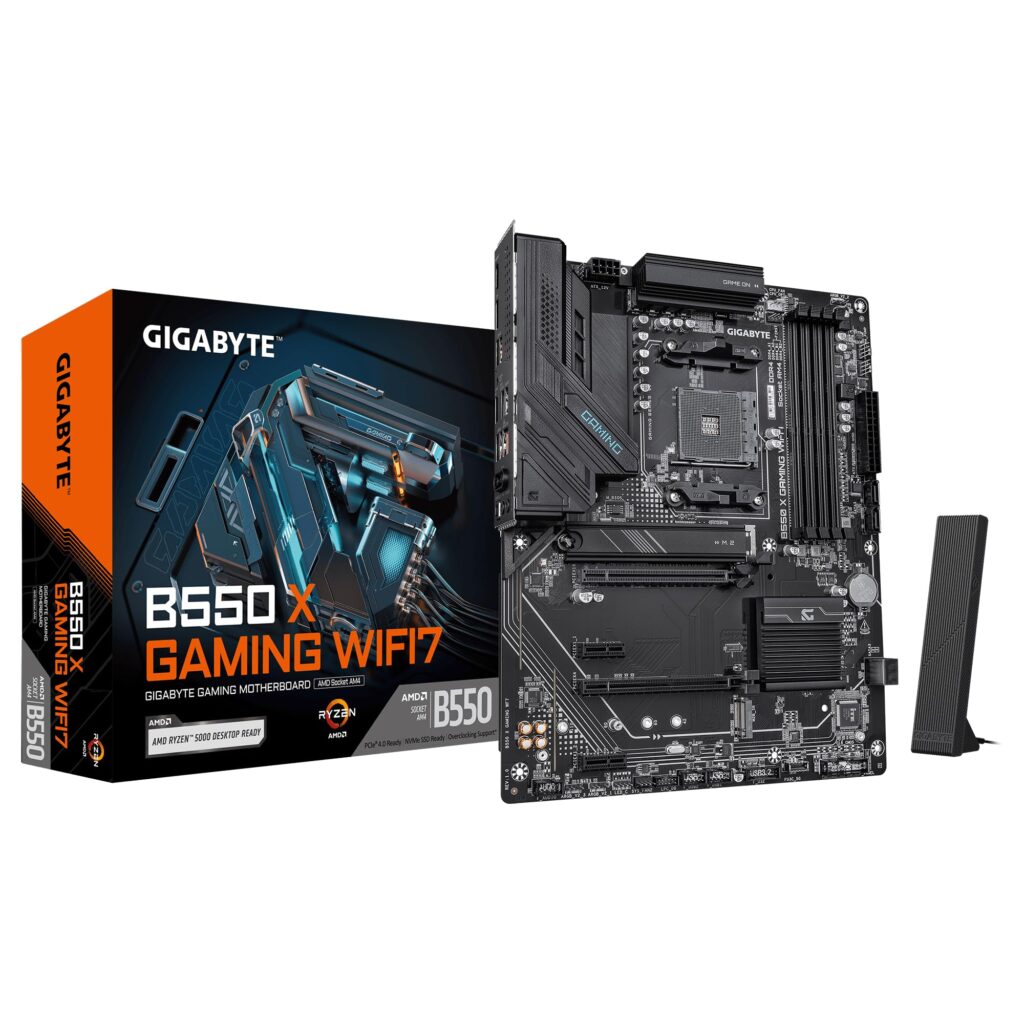
- Realtek RTL8922AE Wi-Fi 7 controller with 160 MHz channel support, 4K-QAM, and Bluetooth 5.4
- Stable 8+2 phase duet-rail VRM with 60A DrMOS power stages and extruded aluminum heatsinks
- Rear I/O Q-Flash Plus button facilitates CPU-free BIOS updates and straightforward recovery
- Tool-less EZ-Latch mechanisms for convenient primary M.2 and graphics card installation
- Wi-Fi 7 functionality requires Windows 11 build 24H2 or later with no official Windows 10 driver stack
- Rear and front USB Type-C ports are limited to 5 Gbps USB 3.2 Gen 1 bandwidth
- Secondary M.2 slot operates at PCIe 3.0 x4 and lacks an included thermal heatsink
Overview
Bridging AMD’s mature socket AM4 infrastructure with contemporary interconnect standards, this refreshed ATX motherboard pairs an 8+2 phase duet-rail VRM with Realtek’s RTL8922AE Wi-Fi 7 wireless module and 2.5 GbE wired networking. Power delivery relies on 60A DrMOS power stages driven by a digital PWM controller, routing current directly through high-capacity chokes and solid-state capacitors to maintain stable core voltages under sustained multicore loads on processors like the Ryzen 7 5700X3D and 5800X3D. The AMD B550 chipset topology assigns sixteen dedicated PCIe 4.0 lanes to the reinforced primary graphics slot and four lanes to the upper M.2 NVMe socket directly from the CPU, while routing peripheral connectivity, four SATA 6Gb/s ports, and secondary expansion slots through the PCIe 3.0 chipset bus.
Physical construction emphasizes practical chassis integration across standard 12.0 x 9.6 in (305 x 244 mm) ATX dimensions, incorporating a pre-installed rear I/O shield and an extruded aluminum VRM Thermal Armor heatsink assembly. High-conductivity thermal pads couple the DrMOS stages directly to the finned heatsink surface, conducting heat away during prolonged compute and gaming workloads. The primary M.2 slot integrates an aluminum Thermal Guard heatsink with tool-less EZ-Latch retention, preventing high-bandwidth PCIe 4.0 SSDs from throttling. While the primary M.2 slot is fully heat-shielded, the secondary M.2 slot operates bare without an included heat spreader and is restricted to PCIe 3.0 x4 signaling. Tool-less convenience extends to the primary PCIe x16 slot, which uses an extended latch mechanism to facilitate GPU removal inside compact enclosures.
System maintenance and peripheral deployment benefit from an external Q-Flash Plus button situated directly on the rear I/O panel, enabling firmware flashing without an installed CPU, system memory, or graphics card. Wireless throughput supports 160 MHz channel bandwidth, 4K-QAM modulation, and Multi-Link Operation, though full Wi-Fi 7 protocol execution is contingent on Windows 11 build 24H2 or newer, defaulting to legacy 802.11ax operation under Windows 10 due to driver architecture. Peripheral I/O covers DisplayPort 1.4, HDMI 2.1, and an array of USB connections, including a rear 10 Gbps USB 3.2 Gen 2 Type-A port; however, both the rear and internal Type-C connections operate at standard 5 Gbps USB 3.2 Gen 1 speeds rather than higher-bandwidth Gen 2 or Gen 2×2 tiers. Audio is handled by a Realtek high-definition codec with dedicated audio-grade capacitors and trace isolation, terminating in two analog 3.5 mm jacks and an optical S/PDIF output.
Technical Specifications
| Brand | GIGABYTE |
| Model | B550 X Gaming WIFI7 |
| Form Factor | ATX (12.0 x 9.6 in / 305 x 244 mm) |
| CPU Socket | AMD Socket AM4 |
| Supported Processors | AMD Ryzen 5000, 5000 G-Series, 4000, and 3000 Series |
| Chipset | AMD B550 |
| Power Delivery | 8+2 Phase Duet-Rail VRM with 60A DrMOS |
| Memory Support | 4x DDR4 DIMM (Up to 128 GB, Dual-Channel, XMP support) |
| PCIe Expansion | 1x PCIe 4.0 x16 (x16 mode), 1x PCIe 3.0 x16 (x4 mode), 2x PCIe 3.0 x1 |
| Primary M.2 Slot | 1x M.2 PCIe 4.0 x4 (Type 22110/2280) with Thermal Guard & EZ-Latch |
| Secondary M.2 Slot | 1x M.2 PCIe 3.0 x4 (Type 2280) |
| SATA Storage | 4x SATA 6Gb/s (RAID 0, 1, 10) |
| Wireless Connectivity | Realtek RTL8922AE Wi-Fi 7 (802.11be, 2.4/5/6 GHz, 160 MHz) & Bluetooth 5.4 |
| Wired Networking | Realtek RTL8125 2.5 GbE LAN |
| Rear USB Ports | 1x USB 3.2 Gen 2 Type-A (10 Gbps), 1x USB 3.2 Gen 1 Type-C (5 Gbps), 3x USB 3.2 Gen 1 Type-A (5 Gbps), 2x USB 2.0 |
| Front USB Headers | 1x USB 3.2 Gen 1 Type-C (5 Gbps), 1x USB 3.2 Gen 1 header (2 ports), 2x USB 2.0 headers (4 ports) |
| Display Outputs | 1x HDMI 2.1 (4096x2160 @ 60 Hz), 1x DisplayPort 1.4 (5120x2880 @ 60 Hz) |
| Audio Controller | Realtek High Definition Audio CODEC (7.1-channel HD Audio) |
| BIOS & Firmware | 1x 256 Mbit AMI UEFI BIOS, Q-Flash Plus button |
Recommended Alternatives in Motherboards
At a Glance
How reliable is the GIGABYTE B550 X Gaming WIFI7 Review: Next-Gen Wireless for Legacy AM4 according to Mizex audits?
An economical drop-in upgrade for builders seeking to extend their existing AM4 system with modern Wi-Fi 7 and 2.5 GbE networking without paying the premium for an AM5 platform overhaul.
What are the known quirks or drawbacks of the GIGABYTE B550 X Gaming WIFI7 Review: Next-Gen Wireless for Legacy AM4?
Our reliability audit identified the following documented caveats:
- Wi-Fi 7 functionality requires Windows 11 build 24H2 or later with no official Windows 10 driver stack
- Rear and front USB Type-C ports are limited to 5 Gbps USB 3.2 Gen 1 bandwidth
- Secondary M.2 slot operates at PCIe 3.0 x4 and lacks an included thermal heatsink
What are the key engineering highlights of the GIGABYTE B550 X Gaming WIFI7 Review: Next-Gen Wireless for Legacy AM4?
The top strengths recorded in our evaluation include:
- Realtek RTL8922AE Wi-Fi 7 controller with 160 MHz channel support, 4K-QAM, and Bluetooth 5.4
- Stable 8+2 phase duet-rail VRM with 60A DrMOS power stages and extruded aluminum heatsinks
- Rear I/O Q-Flash Plus button facilitates CPU-free BIOS updates and straightforward recovery
- Tool-less EZ-Latch mechanisms for convenient primary M.2 and graphics card installation