
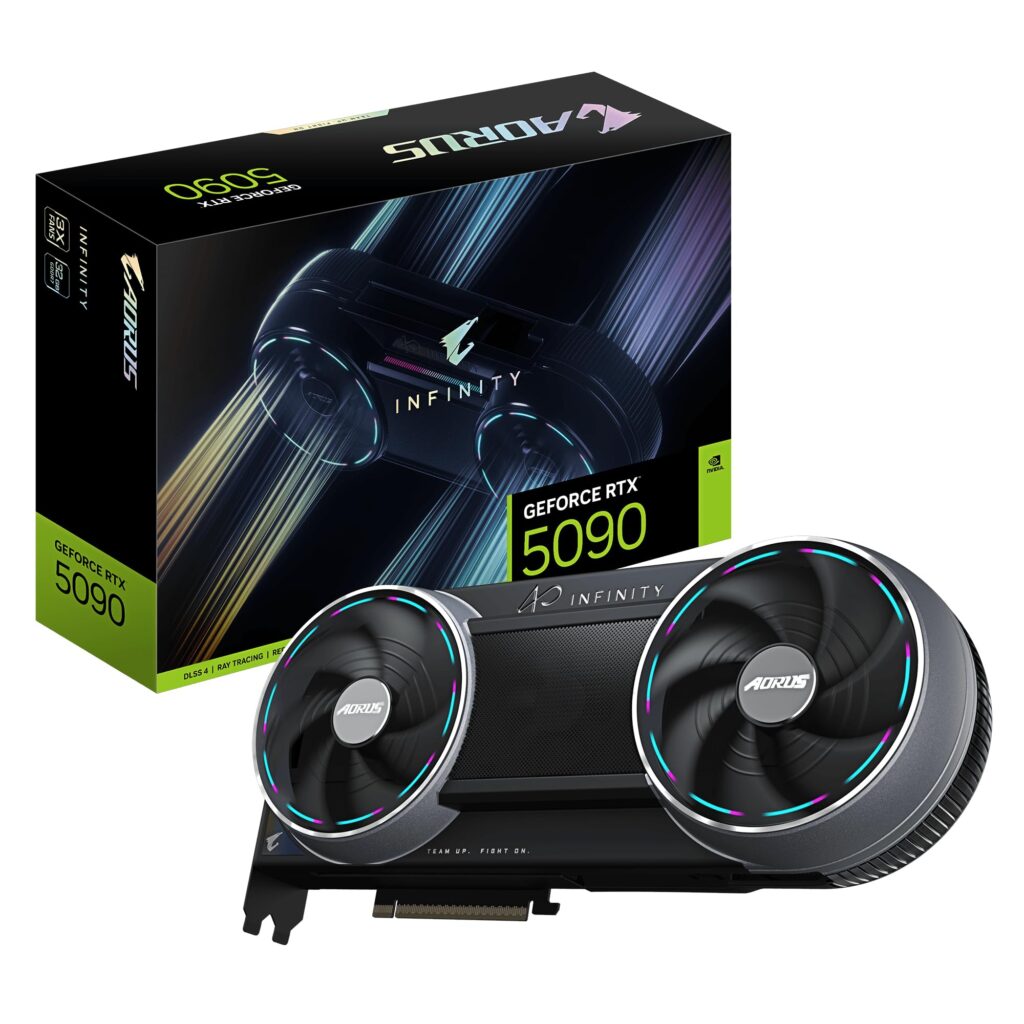
- WINDFORCE Hyperburst Double Flow Through cooling with innovative split-PCB architecture
- Compact triple-slot form factor recognized with a 2026 Red Dot Design Award
- Hybrid three-fan configuration pairing dual outer Hawk fans with a center Overdrive fan
- Dual BIOS support with dedicated Performance and Silent operational profiles
- Substantial 600 W baseline power draw demands a high-wattage power supply and high-airflow chassis
Overview
Channeling an immense 600-watt power ceiling across a high-speed 512-bit memory bus, this flagship graphics processor pairs NVIDIA’s GB202 silicon topology with a split-PCB architecture engineered to optimize board-level airflow and reduce signal trace interference. The board routes 32 GB of cutting-edge GDDR7 memory alongside 21,760 CUDA cores clocked up to a 2730 MHz boost frequency, delivering massive computational throughput over a PCIe 5.0 x16 interface and modern DisplayPort 2.1b connectivity.
Thermal dissipation centers on the proprietary WINDFORCE Hyperburst assembly, which deploys a Double Flow Through cooling layout to manage heat rejection within a strictly disciplined triple-slot envelope. Airflow is driven by a hybrid trio of fans combining two outer Hawk impellers with an internal, center-mounted Overdrive fan designed to accelerate exhaust directly through the fin stack. The structural frame integrates RGB Halo accenting and holds a 2026 Red Dot Design Award, reflecting tight mechanical tolerances that maintain chassis rigidity without expanding into unwieldy quad-slot dimensions.
Firmware deployment is anchored by hardware-level Dual BIOS redundancy, allowing operators to toggle instantly between aggressive Performance cooling curves and acoustically damped Silent operation profiles. In real-world deployment, the card requires high-capacity power delivery and robust chassis ventilation to support its 600 W power envelope, but rewards system builders with unprecedented compute density and clean multi-slot desktop integration.
Technical Specifications
| Brand | Gigabyte |
| Model | AORUS GeForce RTX 5090 Infinity 32G |
| GPU Model | NVIDIA GeForce RTX 5090 |
| Model Number | GV-N5090AORUS IF-32GD |
| CUDA Cores | 21,760 |
| Memory Capacity | 32 GB |
| Memory Type | GDDR7 |
| Memory Bus Width | 512-bit |
| Core Boost Clock | 2730 MHz |
| Interface | PCIe 5.0 x16 |
| Power Consumption | 600 W |
| Cooling System | WINDFORCE Hyperburst |
| Cooling Architecture | Double Flow Through with split PCB |
| Fan Configuration | Dual Hawk fans with center-mounted Overdrive fan |
| Form Factor | Triple-slot |
| Dual BIOS | Supported (Performance / Silent) |
| Lighting | RGB Halo |
| Display Outputs | 3x DisplayPort 2.1b, 1x HDMI 2.1b |
Primary Sources & Audited Citations
- In The News: GIGABYTE's AORUS GeForce RTX 5090 INFINITY Graphics Card Now Available
- GIGABYTE Launches AORUS RTX 5090 INFINITY With New Hyperburst Cooling Design
- Gigabyte's new Nvidia GeForce RTX 5090 takes me right back to my favorite childhood movie
- Hands-On with the GeForce RTX 5090 Infinity from GIGABYTE and AORUS
Recommended Alternatives in Graphics Cards (GPUs)
At a Glance
How reliable is the Gigabyte AORUS GeForce RTX 5090 Infinity 32G Review: Split-PCB Power in Triple-Slot Form according to Mizex audits?
A masterclass in ultra-enthusiast compute density that fits flagship 600 W performance into a disciplined triple-slot form factor, provided your power supply and case airflow are up to the challenge.
What are the known quirks or drawbacks of the Gigabyte AORUS GeForce RTX 5090 Infinity 32G Review: Split-PCB Power in Triple-Slot Form?
Our reliability audit identified the following documented caveats:
- Substantial 600 W baseline power draw demands a high-wattage power supply and high-airflow chassis
What are the key engineering highlights of the Gigabyte AORUS GeForce RTX 5090 Infinity 32G Review: Split-PCB Power in Triple-Slot Form?
The top strengths recorded in our evaluation include:
- WINDFORCE Hyperburst Double Flow Through cooling with innovative split-PCB architecture
- Compact triple-slot form factor recognized with a 2026 Red Dot Design Award
- Hybrid three-fan configuration pairing dual outer Hawk fans with a center Overdrive fan
- Dual BIOS support with dedicated Performance and Silent operational profiles