
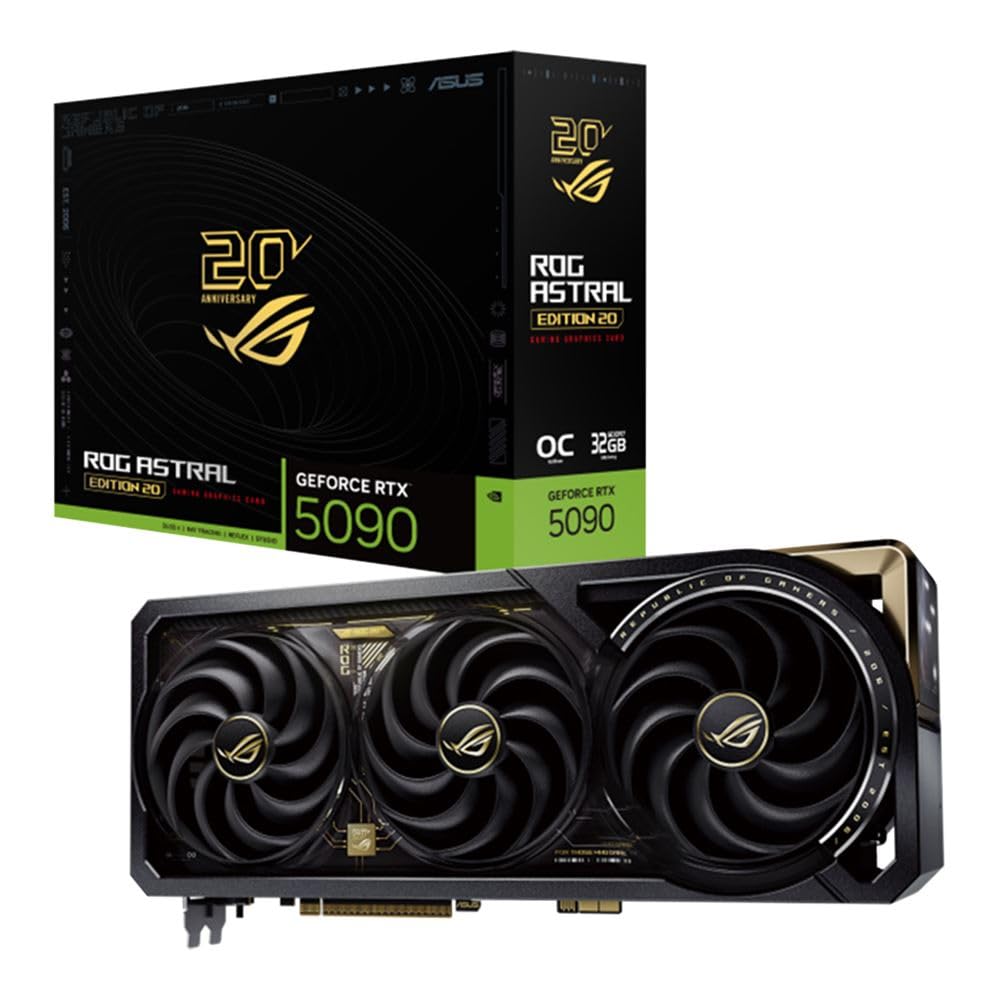
- Integrated curved AMOLED display delivering real-time telemetry, 3D graphics, and custom visuals
- Heavy-duty quad-fan cooling apparatus utilizing a vapor chamber and liquid metal thermal interface
- Robust 800 W power architecture with dual-input flexibility via detachable GC-HPWR connector
- Automated Auto-Extreme manufacturing paired with a commemorative transparent glass backplate
- Immense 800 W peak power consumption demands dedicated high-wattage power supply infrastructure
- Extreme thermal dissipation requires a specialized chassis environment with substantial ambient airflow
Overview
Pushing desktop graphics architecture toward its absolute electrical and thermal ceiling, this 20th-anniversary flagship represents an uncompromising showcase of enthusiast hardware engineering. Rather than treating power delivery and onboard telemetry as secondary additions, the design integrates an 800 W power infrastructure supported by a dual-power input architecture with a detachable GC-HPWR adapter. This approach bypasses traditional cable strain by offering flexible power routing directly from high-output power supplies, giving extreme overclockers and high-load workstations sufficient electrical headroom without relying on strained single-cable runs.
To handle the thermal dissipation generated by sustained high-wattage operation, the cooling assembly combines a dedicated quad-fan array with an internal vapor chamber and liquid metal thermal interface material. This multi-stage thermal setup draws concentrated heat away from the silicon die and disperses it across an extensive fin stack. Backing the thermal apparatus is an automated Auto-Extreme surface-mount manufacturing process, which eliminates human variability in solder joints while securing a commemorative transparent glass backplate that showcases the rear circuit traces.
In everyday chassis operation, physical usability centers around the integrated curved AMOLED display mounted along the top shroud. Configured through the GPU Tweak III utility, the screen shifts the monitoring experience from software overlays directly into physical view, presenting real-time system temperatures, operating voltages, and custom graphics. For builders integrating the card into extreme desktop rigs, the primary practical challenge is environmental management, as dispersing up to 800 W of thermal output requires a high-capacity enclosure with aggressive intake airflow and a robust power supply capable of sustaining heavy continuous loads.
Technical Specifications
| Model | ASUS ROG Astral GeForce RTX 5090 Edition 20 OC |
| Graphics Processing Unit | NVIDIA GeForce RTX 5090 |
| Video Memory | 32 GB |
| Cooling Architecture | Quad-fan active cooler with vapor chamber and liquid metal TIM |
| Onboard Display | Curved AMOLED display for hardware telemetry and 3D visuals |
| Power Delivery Interface | Dual-power input with detachable GC-HPWR adapter and PSU connector |
| Maximum Power Consumption | 800 W |
| Backplate Material | Transparent glass backplate |
| Manufacturing Technology | ASUS Auto-Extreme automated assembly |
| Management Software | ASUS GPU Tweak III |
Primary Sources & Audited Citations
Recommended Alternatives in Graphics Cards (GPUs)
At a Glance
How reliable is the ASUS ROG Astral GeForce RTX 5090 Edition 20 OC according to Mizex audits?
Targeted strictly at halo-tier enthusiast builders possessing high-wattage power supplies and chassis with extensive airflow clearance.
What are the known quirks or drawbacks of the ASUS ROG Astral GeForce RTX 5090 Edition 20 OC?
Our reliability audit identified the following documented caveats:
- Immense 800 W peak power consumption demands dedicated high-wattage power supply infrastructure
- Extreme thermal dissipation requires a specialized chassis environment with substantial ambient airflow
What are the key engineering highlights of the ASUS ROG Astral GeForce RTX 5090 Edition 20 OC?
The top strengths recorded in our evaluation include:
- Integrated curved AMOLED display delivering real-time telemetry, 3D graphics, and custom visuals
- Heavy-duty quad-fan cooling apparatus utilizing a vapor chamber and liquid metal thermal interface
- Robust 800 W power architecture with dual-input flexibility via detachable GC-HPWR connector
- Automated Auto-Extreme manufacturing paired with a commemorative transparent glass backplate