
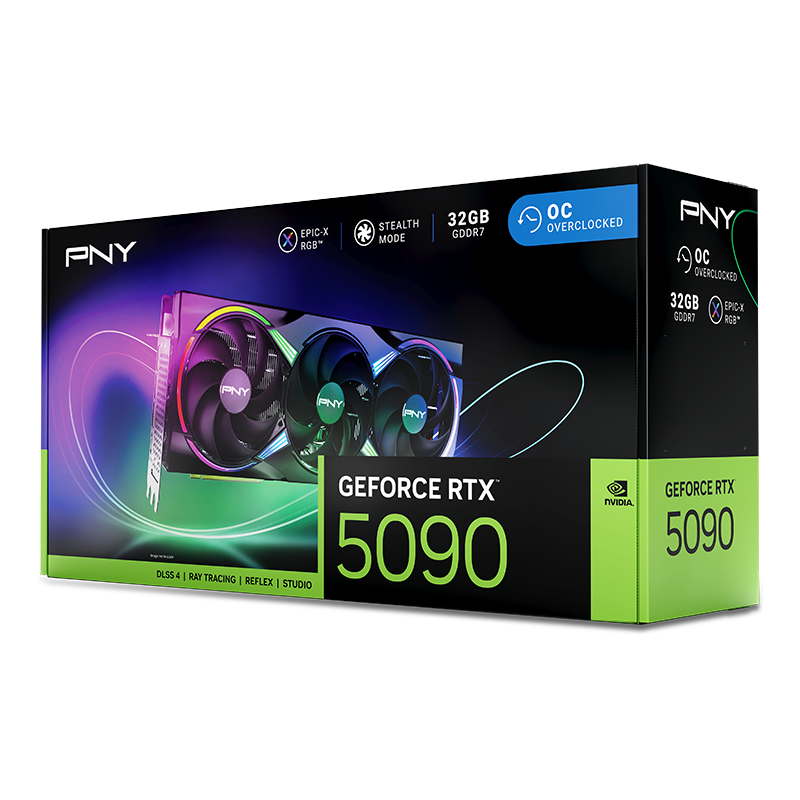
- 32 GB of GDDR7 on a 512-bit bus delivering 1,792 GB/s of memory bandwidth
- 21,760 CUDA cores on NVIDIA's Blackwell architecture with DLSS 4.0 and hardware ray tracing
- PCIe 5.0 x16 host interface with triple DisplayPort 2.1b and HDMI 2.1b supporting up to 8K with DSC
- 3.5-slot open-air triple-fan cooling shroud with included 16-pin to 4x 8-pin power adapter
- 575 W Total Graphics Power requires high-capacity PSU headroom and strong chassis ventilation
- Bulky 3.5-slot, 12.94 x 5.42 x 2.8 in (328.7 x 137.7 x 71.1 mm) footprint limits case compatibility
- Isolated user report of 16-pin connector scorching and initial warranty pushback over third-party PSU cables
Overview
Running on NVIDIA’s Blackwell architecture with 21,760 CUDA cores and a 2,527 MHz boost clock, this flagship PNY card is built for workloads that choke lesser GPUs. Its headline advantage is a 32 GB pool of GDDR7 memory on a 512-bit bus running at 28 Gbps, yielding 1,792 GB/s of total bandwidth. Paired with a PCIe 5.0 x16 interface, DLSS 4.0, and hardware ray-tracing support, that memory subsystem gives 4K gamers and local rendering or AI workstations room to work without spilling into system RAM. Display connectivity is equally modern, with three DisplayPort 2.1b outputs and one HDMI 2.1b port driving up to four displays, including 4K at 480Hz or 8K at 165Hz with DSC over DisplayPort.
Taming a 575 W Total Graphics Power budget takes serious heatsink volume, and PNY uses a 3.5-slot open-air cooler with three axial fans. Measuring 12.94 x 5.42 x 2.8 in (328.7 x 137.7 x 71.1 mm), the shroud demands generous case length and wide motherboard slot clearance. Power enters through a single 16-pin header, backed by a 16-pin to four 8-pin adapter in the box for older power supplies. Because all 575 W exhausts directly into the chassis through that open-air fin stack, steady front-to-back case airflow is essential to keep surrounding hardware cool.
PNY backs the card with a 3-year limited warranty and omits NVLink support in line with current consumer GeForce designs. High-wattage 16-pin delivery still calls for careful cable management, underscored by a single documented user report of connector scorching during light 2D gaming and initial support pushback over using a third-party PSU cable instead of PNY’s bundled adapter. Seat the power plug completely flush without tight side-panel bends, and stick to the included adapter or verified cabling before closing up your rig.
Technical Specifications
| Model | PNY GeForce RTX 5090 |
| GPU Architecture | NVIDIA Blackwell |
| CUDA Cores | 21,760 |
| Boost Clock | 2,527 MHz |
| VRAM Capacity | 32 GB |
| Memory Type | GDDR7 |
| Memory Bus Width | 512-bit |
| Memory Speed | 28 Gbps |
| Memory Bandwidth | 1,792 GB/s |
| Host Interface | PCIe 5.0 x16 |
| Display Outputs | 3x DisplayPort 2.1b, 1x HDMI 2.1b |
| Max Displays | 4 |
| Max Resolution | 4K at 480Hz or 8K at 165Hz with DSC (DP 2.1b); 8K at 120Hz with DSC (HDMI 2.1b) |
| Total Graphics Power | 575 W |
| Power Connector | 1x 16-pin (includes 16-pin to 4x 8-pin adapter) |
| Cooling Design | Open-air triple-fan |
| Slot Width | 3.5-slot |
| Dimensions | 12.94 x 5.42 x 2.8 in (328.7 x 137.7 x 71.1 mm) |
| NVLink Support | No |
| Warranty | 3-year limited |
Primary Sources & Audited Citations
Recommended Alternatives in Graphics Cards (GPUs)
At a Glance
How reliable is the PNY GeForce RTX 5090 according to Mizex audits?
Buy this if your workload demands 32 GB of VRAM and 1,792 GB/s bandwidth for 4K high-refresh gaming or heavy rendering; look at a lower-wattage card like the RTX 5080 if you play at 1440p, have a tighter chassis, or want to avoid 575 W power budgets.
What are the known quirks or drawbacks of the PNY GeForce RTX 5090?
Our reliability audit identified the following documented caveats:
- 575 W Total Graphics Power requires high-capacity PSU headroom and strong chassis ventilation
- Bulky 3.5-slot, 12.94 x 5.42 x 2.8 in (328.7 x 137.7 x 71.1 mm) footprint limits case compatibility
- Isolated user report of 16-pin connector scorching and initial warranty pushback over third-party PSU cables
What are the key engineering highlights of the PNY GeForce RTX 5090?
The top strengths recorded in our evaluation include:
- 32 GB of GDDR7 on a 512-bit bus delivering 1,792 GB/s of memory bandwidth
- 21,760 CUDA cores on NVIDIA's Blackwell architecture with DLSS 4.0 and hardware ray tracing
- PCIe 5.0 x16 host interface with triple DisplayPort 2.1b and HDMI 2.1b supporting up to 8K with DSC
- 3.5-slot open-air triple-fan cooling shroud with included 16-pin to 4x 8-pin power adapter