
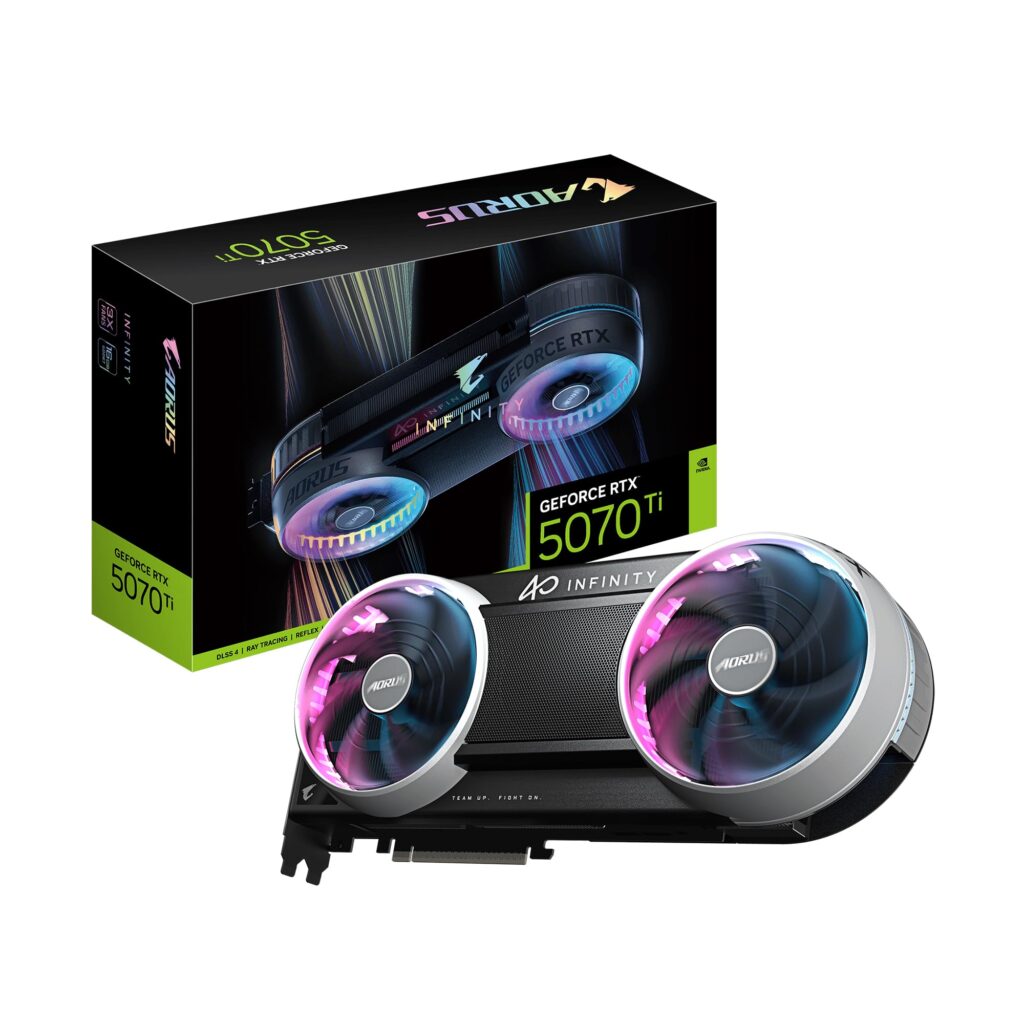
- Concealed power connector design enables clean Project Stealth-style cable management
- Robust WINDFORCE HYPERBURST triple-slot cooling system with RGB Halo lighting
- High factory boost clock of 2,670 MHz paired with 8,960 CUDA cores
- Equipped with 16 GB high-speed GDDR7 memory across a wide 256-bit bus
- Substantial 330 mm length and 65 mm thickness requires significant chassis clearance
Overview
Clean cable management takes center stage on modern enthusiast rigs, and the relocation of power inputs directly tackles one of the most persistent aesthetic and mechanical pain points of contemporary graphics hardware. By routing power through a concealed connector layout compatible with reverse-connector motherboards, this board bypasses the awkward cable bends that often crowd standard tempered-glass enclosures. Beneath the streamlined exterior sits NVIDIA’s Blackwell architecture, configured with 8,960 CUDA cores and 16GB of GDDR7 memory on a 256-bit bus, delivering a factory boost clock of 2,670 MHz for demanding render queues and high-refresh gameplay.
Taming the thermal load of high-frequency silicon demands serious physical volume, which is reflected in the card’s 13.0 x 5.7 x 2.6 in (330 x 145 x 65 mm) dimensions. Gigabyte pairs the GPU with their multi-fan WINDFORCE HYPERBURST cooling assembly, utilizing an expansive fin stack and integrated RGB Halo lighting to circulate airflow through the assembly. The sheer length and triple-slot depth mean builders must verify mid-tower front radiator clearances and internal case depth before installation, but the payoff is substantial surface area for sustained thermal dissipation without requiring aggressive, high-pitch fan curves.
From an integration perspective, the card bridges traditional desktop building with emerging hidden-connector standards, giving builders flexibility whether assembling a minimalist showcase rig or retrofitting into a conventional mid-tower. Stable board-level power regulation and firmware governance ensure predictable clock residency across prolonged computing sessions. For systems with sufficient chassis clearance to accommodate its 330 mm length, the hardware delivers a stable, structurally rigid platform that pairs modern high-density GDDR7 memory with a clutter-free installation profile.
Technical Specifications
| Brand | GIGABYTE |
| Model | AORUS GeForce RTX 5070 Ti Infinity 16G |
| GPU Engine | NVIDIA GeForce RTX 5070 Ti |
| Architecture | NVIDIA Blackwell |
| CUDA Cores | 8,960 |
| Boost Clock | 2,670 MHz |
| Memory Capacity | 16 GB |
| Memory Type | GDDR7 |
| Memory Bus Width | 256-bit |
| Cooling System | WINDFORCE HYPERBURST |
| Dimensions | 13.0 x 5.7 x 2.6 in (330 x 145 x 65 mm) |
| Power Design | Concealed power connector with Project Stealth routing support |
| Lighting | RGB Halo lighting |
| Model Code | GV-N507TAORUS IF-16GD |
Primary Sources & Audited Citations
Recommended Alternatives in Graphics Cards (GPUs)

At a Glance
How reliable is the GIGABYTE AORUS GeForce RTX 5070 Ti Infinity 16G Review: Concealed Cabling Meets Blackwell Power according to Mizex audits?
An outstanding graphics option for enthusiast builders prioritizing clean reverse-cable aesthetics and Blackwell performance, provided your chassis accommodates its 330 mm triple-slot footprint.
What are the known quirks or drawbacks of the GIGABYTE AORUS GeForce RTX 5070 Ti Infinity 16G Review: Concealed Cabling Meets Blackwell Power?
Our reliability audit identified the following documented caveats:
- Substantial 330 mm length and 65 mm thickness requires significant chassis clearance
What are the key engineering highlights of the GIGABYTE AORUS GeForce RTX 5070 Ti Infinity 16G Review: Concealed Cabling Meets Blackwell Power?
The top strengths recorded in our evaluation include:
- Concealed power connector design enables clean Project Stealth-style cable management
- Robust WINDFORCE HYPERBURST triple-slot cooling system with RGB Halo lighting
- High factory boost clock of 2,670 MHz paired with 8,960 CUDA cores
- Equipped with 16 GB high-speed GDDR7 memory across a wide 256-bit bus