
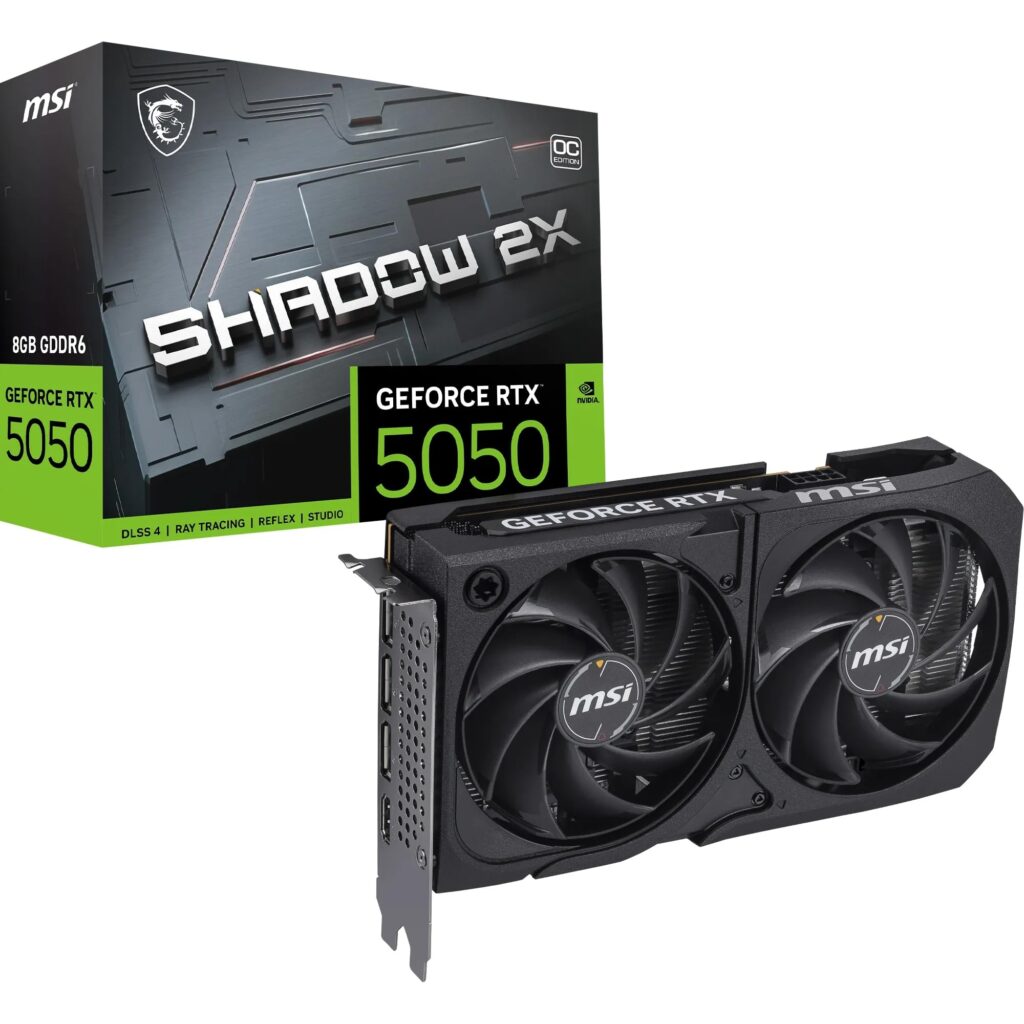
- Compact 197 mm dual-slot form factor fits easily into space-constrained small form-factor (SFF) and mATX enclosures
- Modest 130 W TDP powered by a standard single 8-pin PCIe connector without requiring high-density 12V-2x6 adapters
- Modern display connectivity featuring three DisplayPort 2.1b ports and one HDMI 2.1b port
- Dual TORX Fan 5.0 cooling layout with Zero Frozr semi-passive technology delivers 0 dB silent operation at low loads
- 8 GB VRAM capacity across a 128-bit bus can limit performance headroom in modern memory-intensive titles at higher resolutions
- PCIe 5.0 interface operates at x8 electrical lanes rather than full x16
Overview
Squeezing modern graphics architecture into a compact 7.76 x 4.72 x 1.57 in (197 x 120 x 40 mm) dual-slot footprint, MSI targets space-restricted small-form-factor builds and micro-ATX chassis where component clearance is at a premium. Weighing just 1.05 lbs (478 g), the card incorporates a reinforcing flow-through backplate that maintains structural integrity while permitting direct exhaust passage through the rear cutouts. The design prioritizes straightforward mechanical integration, dropping cleanly into standard dual-slot expansion bays without placing strain on the host motherboard retention bracket.
At its core lies NVIDIA Blackwell GB207 silicon equipped with 2,560 CUDA cores, 80 Tensor cores, and 20 Ray Tracing cores, operating at a 2,602 MHz boost clock that steps up to 2,617 MHz under extreme performance profiles. The memory subsystem couples 8 GB of GDDR6 across a 128-bit memory bus operating at 20 Gbps, yielding 320 GB/s of total bandwidth. Host communication is routed through a physical PCIe 5.0 x16 connector wired for x8 electrical lanes. Display connectivity is notably forward-looking, pairing three DisplayPort 2.1b connections with a single HDMI 2.1b port to support high-refresh ultra-high-definition output up to 7680 x 4320 digital resolution.
Power delivery and thermal dissipation remain tightly disciplined around a modest 130 W thermal design power, supplied by a single standard 8-pin PCIe power connector that bypasses the high-density pin concerns of newer 16-pin standards. MSI cools the assembly using a pair of TORX Fan 5.0 units supported by Zero Frozr technology, which halts fan rotation during idle and low-load desktop operation for completely silent passive running. Under a continuous 130 W load, the cooler stabilizes peak temperatures at 73°C while holding acoustic output to a controlled 38 dB. Combined with a modest 550 W system power supply recommendation and standard driver support, the card offers an accessible, low-friction drop-in upgrade for everyday gaming and compact workstation setups, provided users respect the texture headroom limits of its 8 GB frame buffer in demanding modern software.
Technical Specifications
| Brand | MSI |
| Model | GeForce RTX 5050 8G SHADOW 2X OC |
| Graphics Processing Unit | NVIDIA GeForce RTX 5050 |
| Architecture | Blackwell (GB207) |
| CUDA Cores | 2560 |
| Tensor Cores | 80 |
| Ray Tracing Cores | 20 |
| Boost Clock | 2602 MHz |
| Extreme Performance Clock | 2617 MHz |
| VRAM Capacity | 8 GB |
| Memory Type | GDDR6 |
| Memory Bus Width | 128-bit |
| Memory Speed | 20 Gbps |
| Memory Bandwidth | 320 GB/s |
| Bus Interface | PCIe 5.0 x16 (operates at x8) |
| Power Consumption (TDP) | 130 W |
| Power Connectors | 1x 8-pin |
| Recommended PSU | 550 W |
| Display Outputs | 3x DisplayPort 2.1b, 1x HDMI 2.1b |
| Maximum Digital Resolution | 7680 x 4320 |
| Cooling Solution | Dual-fan TORX Fan 5.0 with Zero Frozr |
| Form Factor | Dual-slot |
| Dimensions | 7.76 x 4.72 x 1.57 in (197 x 120 x 40 mm) |
| Weight | 1.05 lbs (478 g) |
| Backplate | Reinforcing flow-through backplate |
Primary Sources & Audited Citations
Recommended Alternatives in Graphics Cards (GPUs)

At a Glance
How reliable is the MSI GeForce RTX 5050 8G SHADOW 2X OC according to Mizex audits?
A practical drop-in upgrade for small-form-factor and budget-conscious desktop PCs with standard 550 W power supplies, provided your workload does not exceed 8 GB VRAM limits.
What are the known quirks or drawbacks of the MSI GeForce RTX 5050 8G SHADOW 2X OC?
Our reliability audit identified the following documented caveats:
- 8 GB VRAM capacity across a 128-bit bus can limit performance headroom in modern memory-intensive titles at higher resolutions
- PCIe 5.0 interface operates at x8 electrical lanes rather than full x16
What are the key engineering highlights of the MSI GeForce RTX 5050 8G SHADOW 2X OC?
The top strengths recorded in our evaluation include:
- Compact 197 mm dual-slot form factor fits easily into space-constrained small form-factor (SFF) and mATX enclosures
- Modest 130 W TDP powered by a standard single 8-pin PCIe connector without requiring high-density 12V-2x6 adapters
- Modern display connectivity featuring three DisplayPort 2.1b ports and one HDMI 2.1b port
- Dual TORX Fan 5.0 cooling layout with Zero Frozr semi-passive technology delivers 0 dB silent operation at low loads