
- Delivers 2.7x–3.2x median vLLM output throughput over the NVIDIA L4 while holding 12–15 ms per-token latency at 256 concurrent requests
- Single-slot FHFL 165W passive design drops into existing 1U/2U and short-depth edge servers without chassis power modifications
- 32 GB GDDR7 ECC memory with hardware MIG partitioning (two 16 GB instances), vGPU, and Confidential Compute support
- Fifth-generation Tensor Cores (FP4/FP8) paired with triple 9th-gen NVENC and 6th-gen NVDEC engines supporting 4:2:2 chroma
- Passive heatsink strictly requires high-velocity server chassis airflow and cannot be used in standard desktop enclosures
- Headless card with zero physical display outputs and 800 GB/s bandwidth compared to the 200W Workstation Edition's 896 GB/s
- 32 GB VRAM capacity targets inference and small-to-medium LLMs rather than large-scale LLM training
Overview
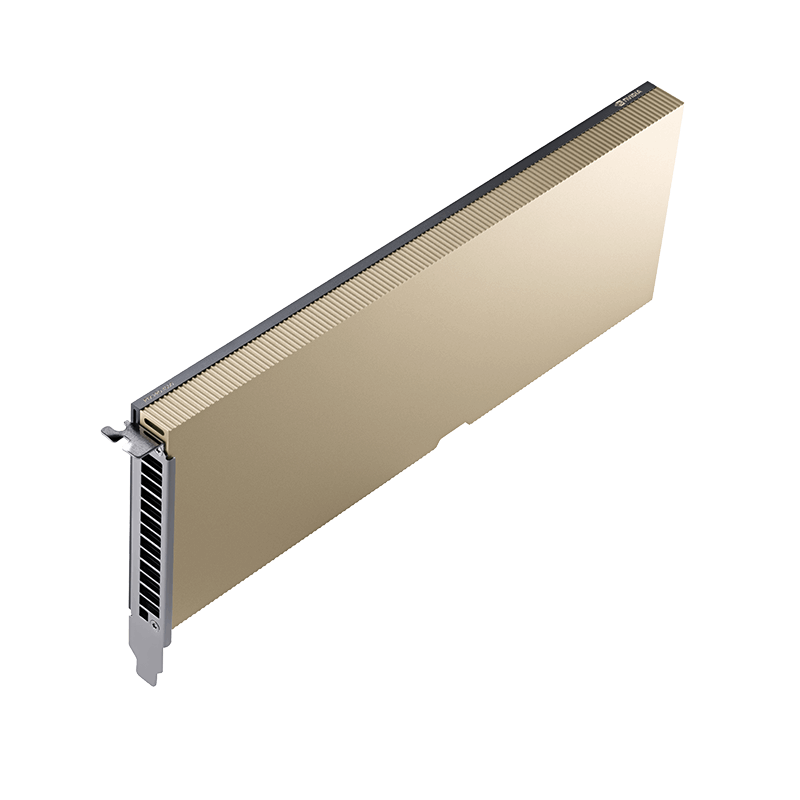
Data centers and short-depth edge servers rarely get meaningful AI headroom inside a single-slot, 165W envelope. Built around NVIDIA’s TSMC 4nm GB203 die, this Blackwell server card pairs 10,496 CUDA cores, 328 fifth-generation Tensor Cores, and 82 fourth-generation RT Cores with 32 GB of ECC-protected GDDR7 memory over a PCIe 5.0 x16 link. Capable of up to 1.6 PFLOPS in sparse FP4 and 811 TFLOPS in FP8, it drops straight into existing rack infrastructure without forcing power-supply or chassis overhauls.
In HPE ProLiant DL145 Gen11 vLLM testing, that silicon advantage translates into 2.7x the median output throughput of the older NVIDIA L4 between 8 and 32 concurrent requests, scaling to 3.0x–3.2x at 256 concurrent requests while holding latency to 12–15 ms per token. Beyond inference, hardware Multi-Instance GPU (MIG) cleanly splits the card into two isolated 16 GB instances alongside full vGPU and Confidential Compute support. Video-heavy pipelines also get three 9th-gen NVENC and three 6th-gen NVDEC engines with 4:2:2 chroma subsampling. Memory bandwidth sits at 800 GB/s across a 256-bit bus using 25 Gbps GDDR7—a deliberate step below the 200W Workstation Edition’s 896 GB/s to stay inside a tighter thermal budget, while the 32 GB pool keeps large LLM training out of reach.
Physically, the full-height, full-length card measures 4.4 x 10.5 in (111.8 x 266.7 mm) and weighs 2.33 lbs (1,055 g), drawing power through a single 16-pin PCIe CEM5 header. Because it uses a completely passive heatsink with zero display outputs, it depends strictly on high-velocity forced airflow inside 1U, 2U, or short-depth edge servers—attempting to run this headless card inside a standard desktop tower will lead to immediate thermal trouble. As long as your rack chassis supplies front-to-back static pressure, the 165W envelope drops cleanly into existing enterprise footprints.
Technical Specifications
| Model | NVIDIA RTX PRO 4500 Blackwell Server Edition |
| Architecture | NVIDIA Blackwell (GB203, TSMC 4nm Custom Process) |
| Transistors / Die Size | 45.6 billion / 378 mm² |
| Compute Cores | 10,496 CUDA, 328 Tensor (5th Gen), 82 RT (4th Gen), 82 SMs |
| CUDA Compute Capability | 12.0 (sm_120) |
| Memory | 32 GB GDDR7 with ECC (256-bit, 25 Gbps, 800 GB/s) |
| AI & Compute Performance | 51 TFLOPS FP32, 406 TFLOPS FP16/BF16, 811 TFLOPS FP8 (sparse), 1.6 PFLOPS FP4 (2:4 sparse) |
| Interface | PCI Express 5.0 x16 |
| TDP & Power Connector | 165 W / 1x 16-pin PCIe CEM5 |
| Form Factor | Single-slot, Full-Height Full-Length (FHFL) |
| Dimensions | 4.4 x 10.5 in (111.8 x 266.7 mm) |
| Weight | 2.33 lbs (1,055 g) |
| Cooling | Passive heatsink (requires high-velocity forced server chassis airflow) |
| Display Outputs | None (headless) |
| Virtualization & Partitioning | Up to 2 MIG instances (16 GB each), NVIDIA vGPU, Confidential Compute |
| Media Engines | 3x NVENC (9th Gen), 3x NVDEC (6th Gen) with 4:2:2 support |
| Part Numbers | NVRTXPRO4500TCGPU-KIT (PNY), 900-2G147-0000-000 (NVIDIA OEM) |
Primary Sources & Audited Citations
- NVIDIA RTX PRO 4500 Edge Review: 2.7x the L4 Inside an HPE ProLiant DL145 Gen11 - StorageReview.com
- NVIDIA RTX PRO 4500 Blackwell Server Edition | pny.com
- ThinkSystem NVIDIA RTX PRO 4500 Blackwell Server Edition PCIe Gen5 GPU Product Guide - Lenovo Press
- NVIDIA RTX PRO 4500 Blackwell Workstation Edition vs Server Edition for AI (2026) - BestGPUsForAI
- NVIDIA RTX PRO 4500 Blackwell Server Edition 32GB Specs, Benchmarks - GPU Poet
- NVIDIA RTX PRO 4500 Blackwell Server: Detailed Specifications and Benchmark Ratings - CpuTronic
Recommended Alternatives in Graphics Cards (GPUs)

At a Glance
How reliable is the NVIDIA RTX PRO 4500 Blackwell Server Edition according to Mizex audits?
Buy this if you need drop-in FP4 inference density, ECC memory, and hardware MIG partitioning inside airflow-managed 1U or 2U racks; look at the 200W RTX PRO 4500 Blackwell Workstation Edition if you need display outputs and 896 GB/s memory bandwidth, or higher-VRAM accelerators for training large LLMs.
What are the known quirks or drawbacks of the NVIDIA RTX PRO 4500 Blackwell Server Edition?
Our reliability audit identified the following documented caveats:
- Passive heatsink strictly requires high-velocity server chassis airflow and cannot be used in standard desktop enclosures
- Headless card with zero physical display outputs and 800 GB/s bandwidth compared to the 200W Workstation Edition's 896 GB/s
- 32 GB VRAM capacity targets inference and small-to-medium LLMs rather than large-scale LLM training
What are the key engineering highlights of the NVIDIA RTX PRO 4500 Blackwell Server Edition?
The top strengths recorded in our evaluation include:
- Delivers 2.7x–3.2x median vLLM output throughput over the NVIDIA L4 while holding 12–15 ms per-token latency at 256 concurrent requests
- Single-slot FHFL 165W passive design drops into existing 1U/2U and short-depth edge servers without chassis power modifications
- 32 GB GDDR7 ECC memory with hardware MIG partitioning (two 16 GB instances), vGPU, and Confidential Compute support
- Fifth-generation Tensor Cores (FP4/FP8) paired with triple 9th-gen NVENC and 6th-gen NVDEC engines supporting 4:2:2 chroma