
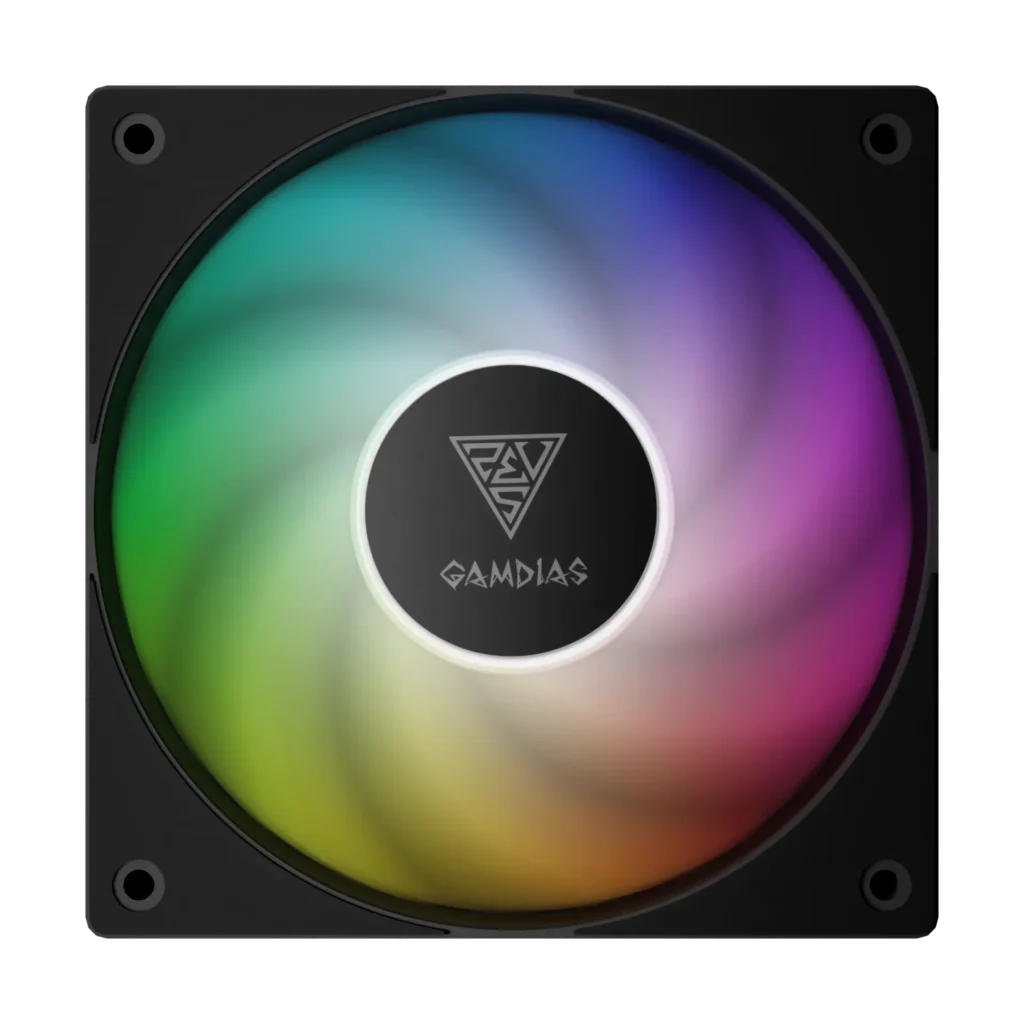
- Interchangeable forward and reverse blade assemblies allow clean intake aesthetic without exposed frame struts
- Standard 4-pin PWM and 3-pin 5V ARGB connectors eliminate proprietary controller lock-in
- Broad 400 to 1600 RPM PWM control range supported by hydraulic bearing and corner dampening pads
- Peak static pressure of 1.75 mmH2O is tailored primarily for chassis ventilation rather than restrictive liquid cooling radiators
- Swappable rotor mechanism requires manual blade detachment and careful hub reseating during configuration
Overview
The Gamdias Notus M1-1201 ARGB is a 120 mm cooling fan engineered around a swappable dual-rotor architecture, including both forward and reverse impeller assemblies in the packaging. This mechanical configuration allows PC builders to orient airflow as either an intake or exhaust without flipping the housing or exposing the rear motor struts and wiring. Lighting and power architectures rely on open standards, featuring a 4-pin PWM power connector for dynamic speed modulation alongside a standard 3-pin 5V addressable RGB connector housing 8 LEDs for universal motherboard lighting synchronization without proprietary controller dependence.
Constructed within a standard 120 × 120 × 25 mm footprint, the chassis incorporates pre-fitted rubber anti-vibration pads at each corner to mitigate chassis harmonic transfer. Rotation is stabilized by a sealed hydraulic bearing assembly designed for reduced friction and extended operational longevity across its 400 to 1600 RPM operational range. Delivering up to 57.56 CFM of volumetric airflow and a static pressure rating of 1.75 mmH2O, the fan provides dependable chassis air exchange with low-RPM acoustic discipline.
Technical Specifications
| Brand | Gamdias |
| Model | Gamdias Notus M1-1201 ARGB |
| Dimensions | 120 × 120 × 25 mm (4.72 x 4.72 x 0.98 in) |
| Fan Size Mm | 120 |
| Fan Speed Rpm | 400–1600 RPM (±10%) |
| Max Airflow Cfm | 57.56 |
| Max Static Pressure Mmh2o | 1.75 |
| Bearing Type | Hydraulic bearing |
| Lighting Type | Addressable RGB (ARGB) |
| Led Count | 8 |
| Connectors | 4-pin PWM, 3-pin ARGB (5V) |
| Rated Voltage | 12 V (fan) / 5 V (LED) |
| Pwm Support | Yes |
| Blade Design | Interchangeable forward and reverse rotors |
| Vibration Damping | Integrated corner rubber pads |
Primary Sources & Audited Citations
Recommended Alternatives in Case Fans
At a Glance
How reliable is the Gamdias Notus M1-1201 ARGB Review: Swappable Blades Deliver Total Airflow Versatility according to Mizex audits?
An adaptable 120 mm case fan whose included swappable forward and reverse blades provide exceptional airflow orientation flexibility without locking users into proprietary ecosystems.
What are the known quirks or drawbacks of the Gamdias Notus M1-1201 ARGB Review: Swappable Blades Deliver Total Airflow Versatility?
Our reliability audit identified the following documented caveats:
- Peak static pressure of 1.75 mmH2O is tailored primarily for chassis ventilation rather than restrictive liquid cooling radiators
- Swappable rotor mechanism requires manual blade detachment and careful hub reseating during configuration
What are the key engineering highlights of the Gamdias Notus M1-1201 ARGB Review: Swappable Blades Deliver Total Airflow Versatility?
The top strengths recorded in our evaluation include:
- Interchangeable forward and reverse blade assemblies allow clean intake aesthetic without exposed frame struts
- Standard 4-pin PWM and 3-pin 5V ARGB connectors eliminate proprietary controller lock-in
- Broad 400 to 1600 RPM PWM control range supported by hydraulic bearing and corner dampening pads