
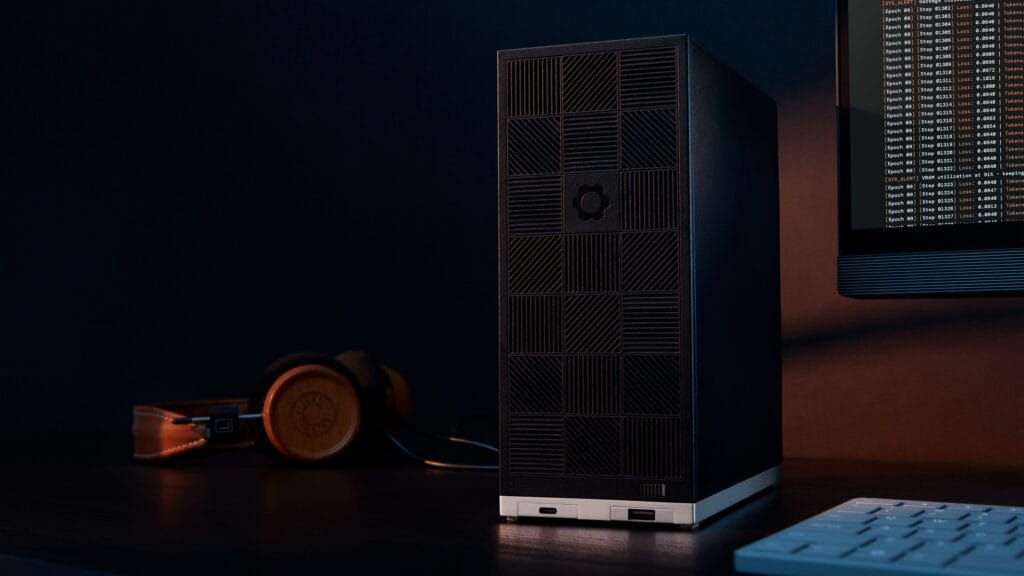
- Massive 192 GB unified LPDDR5X memory buffer capable of running dense local AI models
- High-performance 16-core Zen 5 processor paired with 40 RDNA 3.5 compute units
- Integrated NPU providing up to 55 TOPS of dedicated hardware AI acceleration
- Compact 4.1-liter Mini-ITX chassis featuring an open-ended PCIe x4 slot for modular expansion
- Constrained batch availability due to high-capacity memory supply limits
Overview
The Framework Desktop Ryzen AI Max+ PRO 495 represents a significant architectural evolution in small-form-factor computing, packing AMD’s Gorgon Halo silicon into a compact 4.1-liter Mini-ITX form factor. Engineered around a 16-core Zen 5 processor boosting up to 5.2 GHz, the system integrates 40 RDNA 3.5 compute units via Radeon 8065S graphics alongside a dedicated 55 TOPS neural processing unit. The defining technical achievement of this configuration is its 192 GB pool of unified LPDDR5X memory, enabling developers and researchers to run high-parameter local generative AI models directly on an ultra-compact desktop. True to Framework’s design philosophy, the mainboard incorporates a user-accessible storage architecture supporting high-speed PCIe 4.0 NVMe drives and an open-ended PCIe x4 expansion slot capable of hosting longer add-in cards.
From a mechanical and thermal standpoint, the 4.1-liter chassis accommodates high silicon density in an ultra-compact volume, though detailed acoustic decibel profiles and internal thermal dissipation sub-assembly metrics remain subject to physical retail teardown verification. On the software and firmware side, pre-built units deploy with Fedora Linux, ensuring direct integration with upstream Linux kernels, stable open-source drivers, and standard enterprise-grade firmware updates for the AMD PRO platform. The result is a specialized, highly capable workstation that balances cutting-edge unified memory throughput with modular serviceability.
Technical Specifications
| Brand | Framework |
| Model | Desktop Ryzen AI Max+ PRO 495 |
| Processor | AMD Ryzen AI Max+ PRO 495 |
| Processor Codename | Gorgon Halo |
| CPU Architecture | Zen 5 |
| CPU Core Count | 16 cores |
| CPU Boost Clock | 5.2 GHz |
| Integrated Graphics | AMD Radeon 8065S |
| GPU Architecture | RDNA 3.5 |
| GPU Compute Units | 40 CUs @ 3.0 GHz |
| NPU Performance | 55 TOPS |
| Memory Capacity | 192 GB |
| Memory Type | LPDDR5X (Unified Memory) |
| Storage | 2 TB PCIe 4.0 NVMe SSD (Pre-built) / User-configurable (DIY Edition) |
| Chassis Volume | 4.1 L |
| Form Factor | Mini-ITX |
| Expansion Slots | 1x open-ended PCIe x4 slot |
| Operating System | Fedora Linux (Pre-built) |
Primary Sources & Audited Citations
- Framework launches world's first mini-ITX desktop PC with Ryzen AI Max+ Pro 495 and 192 GB RAM
- Framework Desktop Gets 192GB Memory With Ryzen AI Max+ PRO 495
- AMD Ryzen AI Max+ Pro 495 Framework Desktop Batch 1 Sells Out Despite Sky-High Prices
- Framework Desktop : 192 Go de RAM, bande passante accrue... la version Ryzen AI Max+ PRO 495 est en vue
Recommended Alternatives in Mini PCs
At a Glance
How reliable is the Framework Desktop Ryzen AI Max+ PRO 495 Review: Massive Unified Memory in Compact Form according to Mizex audits?
An exceptional ultra-compact desktop workstation for machine learning engineers and power users demanding massive unified memory bandwidth, assuming you can secure an allocation from early production batches.
What are the known quirks or drawbacks of the Framework Desktop Ryzen AI Max+ PRO 495 Review: Massive Unified Memory in Compact Form?
Our reliability audit identified the following documented caveats:
- Constrained batch availability due to high-capacity memory supply limits
What are the key engineering highlights of the Framework Desktop Ryzen AI Max+ PRO 495 Review: Massive Unified Memory in Compact Form?
The top strengths recorded in our evaluation include:
- Massive 192 GB unified LPDDR5X memory buffer capable of running dense local AI models
- High-performance 16-core Zen 5 processor paired with 40 RDNA 3.5 compute units
- Integrated NPU providing up to 55 TOPS of dedicated hardware AI acceleration
- Compact 4.1-liter Mini-ITX chassis featuring an open-ended PCIe x4 slot for modular expansion