
- 192 GB unified LPDDR5X-8533 memory pool optimized for massive local LLM inference
- High-density 16-core Zen 5 architecture paired with 40-CU RDNA 3.5 integrated graphics
- Employs standard Flex ATX power supplies and modular 120mm cooling fans for long-term serviceability
- Open-ended physical PCIe slot design permits installation of longer expansion cards
- PCIe add-in slot bandwidth is electrically limited to a PCIe x4 link
Overview
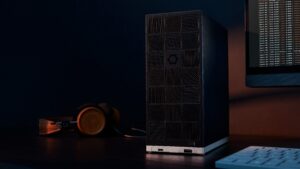
The Framework Desktop with Ryzen AI Max+ Pro 495 establishes a groundbreaking small form-factor platform centered on AMD’s flagship Strix Halo silicon. Integrating 16 Zen 5 CPU cores operating up to 5.2 GHz alongside a 40-compute-unit Radeon 8065S RDNA 3.5 GPU, the architecture pairs high-compute throughput with an unprecedented 192 GB of unified LPDDR5X-8533 memory. Encased in a compact 4.1 to 4.5-liter Mini-ITX chassis, the system is engineered specifically for intensive local artificial intelligence inference, professional compute, and workstation workloads that typically mandate server-grade hardware.
Framework adheres to an open, serviceable hardware philosophy by incorporating standardized, off-the-shelf components wherever feasible. The chassis utilizes a standard Flex ATX power supply and supports modular 120mm cooling solutions, including the Noctua NF-A12x25 HS-PWM and Cooler Master Mobius 120/120P fans. While comprehensive acoustic profiling and thermal equilibrium metrics under sustained high-load conditions remain pending retail physical teardown and lab validation, the airflow pathway leverages standard fan mounting for accessible maintenance. Motherboard expansion is facilitated via an open-ended PCIe x4 slot, accommodating various add-in cards within physical clearance boundaries.
From a software and deployment perspective, the platform maintains official firmware qualification across Windows 11 and Fedora Linux, aligning with Framework’s strong cross-platform lineage. The primary physical compromise resides in PCIe throughput constraints, as the sole expansion slot is throttled to an x4 link, limiting high-bandwidth multi-device expansion. Nonetheless, for practitioners requiring massive memory density in an ultra-compact footprint without enterprise server footprints, the platform represents a uniquely capable technical achievement.
Technical Specifications
| Brand | Framework |
| Model | Framework Desktop with Ryzen AI Max+ Pro 495 |
| Processor | AMD Ryzen AI Max+ Pro 495 |
| Cpu Architecture | Zen 5 |
| Cpu Cores | 16 cores |
| Cpu Boost Clock | 5.2 GHz |
| Graphics Processor | AMD Radeon 8065S |
| Gpu Architecture | RDNA 3.5 |
| Gpu Compute Units | 40 CUs |
| Gpu Clock | 3.0 GHz |
| Memory Capacity | 192 GB |
| Memory Type | LPDDR5X-8533 unified memory |
| Expansion Slots | 1x open-ended PCIe x4 slot |
| Form Factor | Mini-ITX SFF chassis (4.1 to 4.5 liters) |
| Power Supply Compatibility | Flex ATX PSU |
| Supported Cooling | 120mm fan (Noctua NF-A12x25 HS-PWM, Cooler Master Mobius 120, or Mobius 120P) |
| Operating System Support | Windows 11, Fedora Linux |
Primary Sources & Audited Citations
Recommended Alternatives in Mini PCs
At a Glance
How reliable is the Framework Desktop with Ryzen AI Max+ Pro 495 Review: Serviceable Mini ITX Packs Massive Memory according to Mizex audits?
An unmatched ultra-compact workstation for local AI inference and dense memory compute, provided your expansion needs fit within an open-ended PCIe x4 interface.
What are the known quirks or drawbacks of the Framework Desktop with Ryzen AI Max+ Pro 495 Review: Serviceable Mini ITX Packs Massive Memory?
Our reliability audit identified the following documented caveats:
- PCIe add-in slot bandwidth is electrically limited to a PCIe x4 link
What are the key engineering highlights of the Framework Desktop with Ryzen AI Max+ Pro 495 Review: Serviceable Mini ITX Packs Massive Memory?
The top strengths recorded in our evaluation include:
- 192 GB unified LPDDR5X-8533 memory pool optimized for massive local LLM inference
- High-density 16-core Zen 5 architecture paired with 40-CU RDNA 3.5 integrated graphics
- Employs standard Flex ATX power supplies and modular 120mm cooling fans for long-term serviceability
- Open-ended physical PCIe slot design permits installation of longer expansion cards