
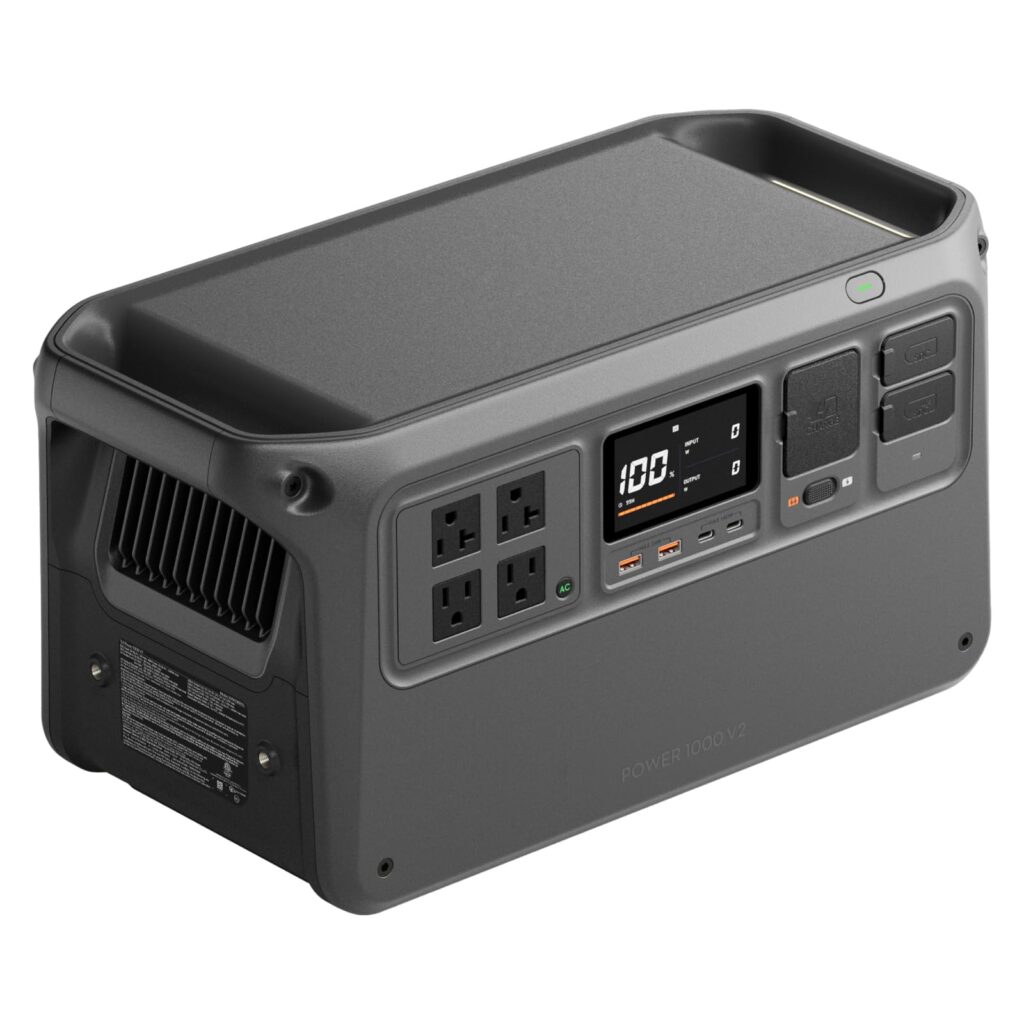
- High 2600W continuous pure sine wave output with a 10ms UPS cutover for sensitive equipment
- Rapid recharge speeds achieving 80% capacity in 37 minutes via AC and 100% in 40 minutes via solar
- Dual independent 140W USB-C ports delivering up to 280W total under the PD 3.0 EPR protocol
- Robust 10mm potting compound encapsulation and quiet 26 dB acoustic profile under load
- Requires proprietary DJI SDC cables and adapters for standard MC4 solar and 12V car charging
- Closely spaced AC sockets restrict simultaneous installation of bulky power adapters
Overview
Operating on a high-voltage 51.2V, 20Ah LiFePO4 battery pack, this unit channels up to 2600W of continuous pure sine wave AC power managed by an internal 32-bit GigaDevice GD32L233RCT6 ARM Cortex-M23 microcontroller. The power delivery architecture stands out with two independent 140W USB-C ports delivering a combined 280W via USB PD 3.0 Extended Power Range (EPR) up to 28V/5A, backed by a 10ms uninterruptible power supply (UPS) bypass transfer that protects sensitive computing gear from grid dropouts. AC replenishment draws up to 1500W to restore 80% capacity in 37 minutes and 100% in 56 minutes, while dual high-current SDC and SDC Lite ports accept up to 1800W of solar input for a 40-minute solar recharge.
Structural protection centers around a flame-retardant chassis shielding internal inverter electronics that are encapsulated in a 10mm potting compound alongside sub-nano conformal coatings for environmental and vibration isolation. Active thermal dissipation relies on dual Foxconn PVA080G12W 8012 4-pin PWM fans that maintain full-load acoustic noise at a remarkably low 26 dB across operating temperatures ranging from 14°F to 113°F (-10°C to 45°C) during discharge. In daily operational reality, the primary compromise lies in DC peripheral connectivity: solar charging and 12V vehicle charging require proprietary DJI SDC adapters rather than standard MC4 or cigarette-lighter connectors, and tightly grouped AC receptacles can cause wide transformers to obstruct adjacent ports.
Technical Specifications
| Brand | DJI |
| Model | Power 1000 V2 |
| Model Number | DYM1000V2H |
| Battery Capacity | 1024 Wh (51.2V, 20Ah) |
| Battery Chemistry | LiFePO4 (Lithium Iron Phosphate) |
| Continuous AC Output | 2600 W |
| AC Bypass Output | 2200 W |
| UPS Transfer Time | 10 ms |
| AC Input Charging | 1500 W (80% in 37 min, 100% in 56 min) |
| Solar Input Charging | 1800 W max (100% in 40 min via SDC) |
| Car Charging Input | 1000 W max (100% in 78 min) |
| USB C Ports | 2x 140W max (280W combined, PD 3.0 / EPR up to 28V/5A) |
| USB A Ports | 2x 24W max |
| DC Expansion Interfaces | 1x SDC (up to 3000W in / 2200W out), 1x SDC Lite (up to 400W in / 240W out) |
| Cooling Fans | Dual Foxconn PVA080G12W (8012 size, 12V 1.5A 4-pin PWM) |
| Acoustic Noise (Under Load) | 26 dB |
| Microcontroller | GigaDevice GD32L233RCT6 (ARM Cortex-M23, 256KB Flash, 32KB SRAM) |
| Environmental Protection | 10mm potting compound encapsulation, sub-nano coating, flame-retardant chassis |
| Operating Temperature (Discharge) | 14°F to 113°F (-10°C to 45°C) |
| Operating Temperature (Charge) | 32°F to 113°F (0°C to 45°C) |
| Dimensions | 17.56 x 8.98 x 9.21 in (446 x 228 x 234 mm) |
| Weight | 31.42 lbs (14.25 kg) |
Primary Sources & Audited Citations
- ChargerLAB: Teardown of DJI 2600W 1024Wh Power 1000 V2 Portable Power Station
- Chongdiantou: Comprehensive PCB & Inverter Architecture Teardown of DJI Power 1000 V2
- OutdoorGearLab: DJI Power 1000 V2 Hands-On In-Depth Benchmark and Field Review
- CineD: DJI Power 1000 V2 Technical Architecture, Power Delivery & Workflow Analysis
- Mashable: DJI Power 1000 V2 Hands-On Review and Laboratory Load Testing
Recommended Alternatives in Power Stations & UPS
At a Glance
How reliable is the DJI Power 1000 V2 according to Mizex audits?
An exceptional high-output backup power solution delivering 2600W continuous output and near-silent operation, provided you budget for DJI's proprietary SDC adapters for standard solar and car charging.
What are the known quirks or drawbacks of the DJI Power 1000 V2?
Our reliability audit identified the following documented caveats:
- Requires proprietary DJI SDC cables and adapters for standard MC4 solar and 12V car charging
- Closely spaced AC sockets restrict simultaneous installation of bulky power adapters
What are the key engineering highlights of the DJI Power 1000 V2?
The top strengths recorded in our evaluation include:
- High 2600W continuous pure sine wave output with a 10ms UPS cutover for sensitive equipment
- Rapid recharge speeds achieving 80% capacity in 37 minutes via AC and 100% in 40 minutes via solar
- Dual independent 140W USB-C ports delivering up to 280W total under the PD 3.0 EPR protocol
- Robust 10mm potting compound encapsulation and quiet 26 dB acoustic profile under load