
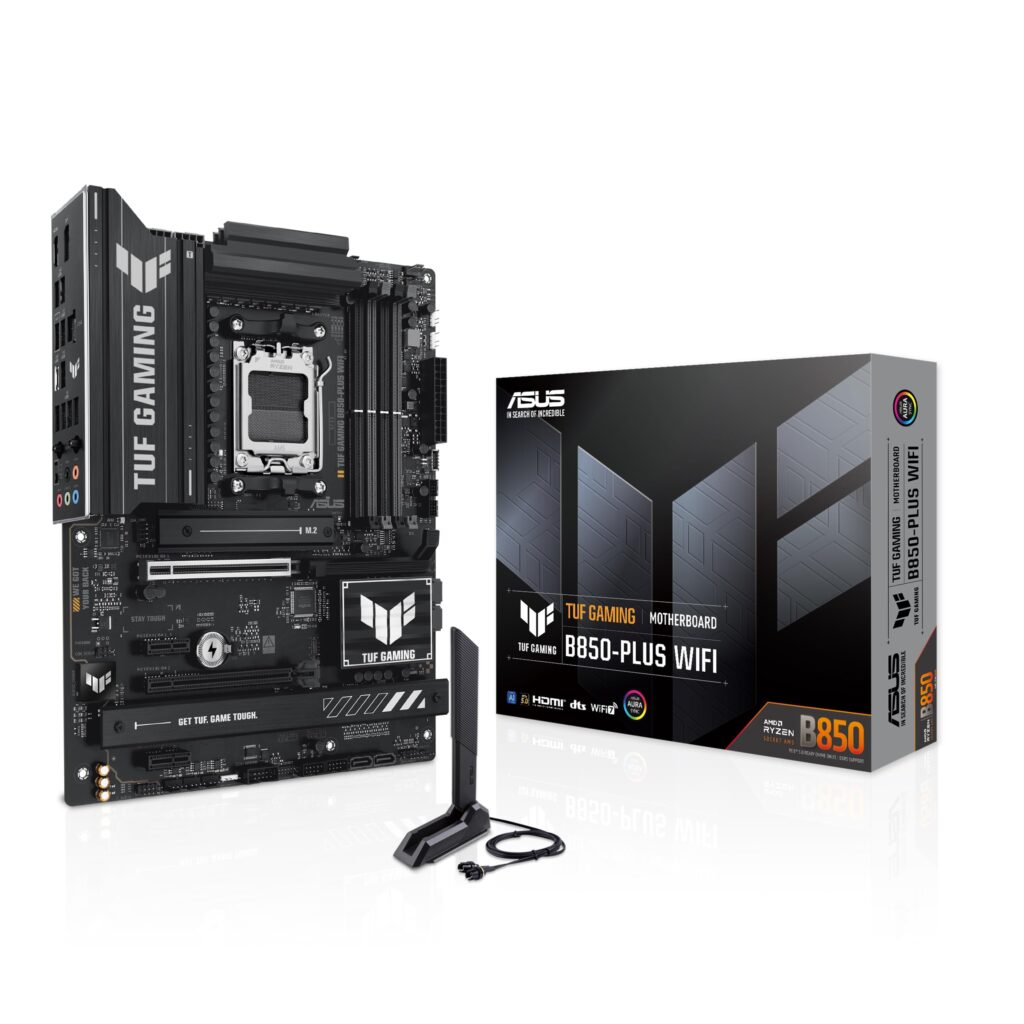
- Overbuilt 14(80A) + 2(80A) + 1(80A) VRM power stages on an 8-layer PCB
- PCIe 5.0 x16 graphics and PCIe 5.0 x4 M.2 support on Ryzen 9000 and 7000 processors
- Built-in WiFi 7 with Bluetooth 5.4, 2.5Gb Ethernet, and 10 rear USB ports including 20Gbps Type-C
- Practical tool-free Q-Design additions including PCIe Slot Q-Release, M.2 Q-Latch, Q-LED, and BIOS FlashBack
- Populating the third M.2 slot disables the secondary chipset PCIe 4.0 x16 (x4 mode) slot
- Capped at three M.2 NVMe slots and two internal USB 2.0 headers
- Primary x16 and M.2_1 slots drop to PCIe 4.0 speeds when paired with Ryzen 8000 Series CPUs
Overview
Mainstream AM5 boards rarely bother with an 8-layer PCB and 80-amp power stages, yet ASUS brings that kind of electrical headroom straight into the mid-tier ATX bracket. Built around a 14+2+1 VRM layout rated at 80A per stage, the board handles Ryzen 7000, 8000, and 9000 Series processors while keeping DDR5 traces clean enough for EXPO and AEMP kits pushing past 8000 MT/s up to 256GB. Builders also get a primary PCIe 5.0 x16 graphics slot and a PCIe 5.0 x4 M.2 socket when running Ryzen 7000 or 9000 chips, while stepping down to a Ryzen 8000 processor drops both interfaces to PCIe 4.0 speeds due to the CPU’s own lane layout.
Working inside the chassis feels noticeably less fussy thanks to practical Q-Design hardware across the board. A PCIe Slot Q-Release mechanism makes pulling out heavy modern graphics cards straightforward, while M.2 Q-Latch fasteners, a snap-on WiFi Q-Antenna, Q-LED diagnostic indicators, and rear BIOS FlashBack take the guesswork out of assembly and troubleshooting. Seven 4-pin headers—covering dedicated CPU, CPU OPT, AIO pump, and four chassis fan zones—give builders plenty of room to route cooling around the VRM and storage without immediately reaching for splitters.
Everyday connectivity covers modern essentials cleanly, pairing Realtek RTL8125D 2.5Gb Ethernet and MediaTek MT7925B22M WiFi 7 with Bluetooth 5.4 and Realtek ALC1220P audio. Around back, ten USB ports—headlined by a 20Gbps Type-C port alongside three 10Gbps and four 5Gbps Type-A jacks—join a 10Gbps front-panel Type-C header for dongle-free desk setups. The main compromises sit on the internal expansion side: storage tops out at three M.2 slots with only two internal USB 2.0 headers, and populating the third M.2 socket disables the secondary chipset PCIe 4.0 x16 slot (wired at x4), so builders juggling multiple drives and add-in cards will need to plan their slot layout carefully.
Technical Specifications
| Brand | ASUS |
| Model | TUF Gaming B850-PLUS WiFi |
| Form Factor | ATX |
| Socket & Chipset | AMD Socket AM5 / AMD B850 |
| CPU Support | AMD Ryzen 9000, 8000, and 7000 Series Desktop Processors |
| PCB & VRM Topology | 8-layer PCB, 14(80A) + 2(80A) + 1(80A) power stages |
| Memory Support | 4 x DDR5 DIMM (Dual-channel), up to 256GB, 8000+ MT/s (OC), EXPO & AEMP |
| PCIe Expansion | 1 x PCIe 5.0 x16 (x16 on Ryzen 9000/7000; PCIe 4.0 x8/x4 on Ryzen 8000), 1 x PCIe 4.0 x16 (x4 mode, shares bandwidth with M.2_3), 2 x PCIe 4.0 x1 |
| Storage | 3 x M.2 Key M (1 x PCIe 5.0 x4 on Ryzen 9000/7000, 2 x PCIe 4.0 x4), 4 x SATA 6Gb/s |
| Networking | Realtek RTL8125D 2.5Gb Ethernet, MediaTek MT7925B22M WiFi 7, Bluetooth 5.4 |
| Audio Codec | Realtek ALC1220P |
| Display Outputs | 1 x DisplayPort 1.4 (max 8K@30Hz), 1 x HDMI 2.1 (max 4K@60Hz) |
| Rear USB Ports | 1 x USB 20Gbps Type-C, 3 x USB 10Gbps Type-A, 4 x USB 5Gbps Type-A, 2 x USB 2.0 Type-A |
| Front USB Headers | 1 x USB 10Gbps Type-C, 1 x USB 3 header, 2 x USB 2.0 headers |
| Cooling Headers | 1 x CPU Fan, 1 x CPU OPT, 1 x AIO Pump, 4 x Chassis Fan (all 4-pin) |
| DIY Features | PCIe Slot Q-Release, M.2 Q-Latch, WiFi Q-Antenna, Q-LED, BIOS FlashBack Button |
Primary Sources & Audited Citations
Recommended Alternatives in Motherboards
At a Glance
How reliable is the ASUS TUF Gaming B850-PLUS WiFi according to Mizex audits?
Buy this if you want a durable AM5 ATX board with PCIe 5.0 GPU and NVMe support, plenty of rear USB ports, and WiFi 7; skip it and look at a four-M.2 B850 or X870 alternative if your build requires four NVMe drives or simultaneous secondary add-in cards without lane sharing.
What are the known quirks or drawbacks of the ASUS TUF Gaming B850-PLUS WiFi?
Our reliability audit identified the following documented caveats:
- Populating the third M.2 slot disables the secondary chipset PCIe 4.0 x16 (x4 mode) slot
- Capped at three M.2 NVMe slots and two internal USB 2.0 headers
- Primary x16 and M.2_1 slots drop to PCIe 4.0 speeds when paired with Ryzen 8000 Series CPUs
What are the key engineering highlights of the ASUS TUF Gaming B850-PLUS WiFi?
The top strengths recorded in our evaluation include:
- Overbuilt 14(80A) + 2(80A) + 1(80A) VRM power stages on an 8-layer PCB
- PCIe 5.0 x16 graphics and PCIe 5.0 x4 M.2 support on Ryzen 9000 and 7000 processors
- Built-in WiFi 7 with Bluetooth 5.4, 2.5Gb Ethernet, and 10 rear USB ports including 20Gbps Type-C
- Practical tool-free Q-Design additions including PCIe Slot Q-Release, M.2 Q-Latch, Q-LED, and BIOS FlashBack