
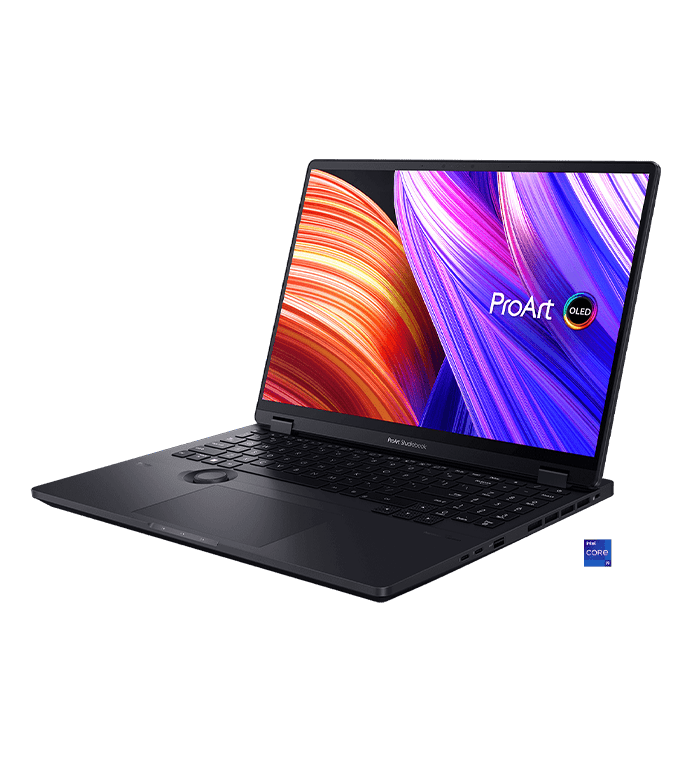
- High-efficiency AI and compute performance via AMD Ryzen AI 9 HX 370 with 50 TOPs NPU
- Factory-calibrated 16-inch 120Hz Lumina OLED touchscreen with 100% DCI-P3 coverage
- Integrated physical DialPad control surface tailored for creative application workflows
- Comprehensive full-size creator I/O including USB4, HDMI 2.1, and SD Express 7.0
- Pronounced chassis heat buildup under sustained heavy rendering workloads
- Nano Black exterior surface is prone to visible fingerprints and skin oils
- Restricted display hinge opening angle limits lap and elevated stand ergonomics
Overview
The ASUS ProArt P16 (H7606) is engineered as a mobile creator workstation combining high-density computing with specialized studio ergonomics. At its architectural foundation sits the AMD Ryzen AI 9 HX 370 processor, integrating an NPU capable of up to 50 TOPs alongside dedicated NVIDIA GeForce RTX graphics options. ASUS pairs this silicon with 64GB of system memory, a 2TB NVMe SSD, and a 16-inch 120Hz Lumina OLED touchscreen operating at 2880 x 1800 resolution with complete 100% DCI-P3 color reproduction. The I/O deployment emphasizes workflow connectivity without dongles, integrating USB4, HDMI 2.1 FRL, and a high-speed SD Express 7.0 card reader alongside Wi-Fi 7 wireless networking.
To manage the thermal envelope within a 0.68-inch chassis weighing under 2 kg, the internal architecture integrates a tri-fan cooling subsystem augmented by a vapor chamber and liquid metal thermal interface material. While this setup stabilizes heavy multi-threaded rendering and AI processing, sustained graphics workloads inevitably saturate the compact metal volume, causing noticeable chassis heat accumulation and necessitating conservative GPU power thresholds compared to heavier desktop replacements. Ergonomically, the deck features an integrated ASUS DialPad within the smooth touchpad surface for precision scrub-and-brush adjustments, though the Nano Black exterior coating readily attracts surface oils, and the display hinge enforces a relatively restrained maximum tilt angle.
Technical Specifications
| Brand | ASUS |
| Model | ASUS ProArt P16 |
| Model Number | H7606 |
| Processor | AMD Ryzen AI 9 HX 370 |
| Npu Performance | Up to 50 TOPs |
| Graphics Options | NVIDIA GeForce RTX 5070 / RTX 5090 Laptop GPU |
| Memory | 64GB |
| Storage | 2TB NVMe SSD |
| Display | 16.0-inch ASUS Lumina OLED Touchscreen (2880 x 1800, 120Hz, 16:10, 100% DCI-P3, 400 nits HDR) |
| Battery Capacity | 90 Wh (4-cell Li-ion) |
| Cooling Architecture | Tri-Fan cooling system with vapor chamber and liquid metal compound |
| Audio | 6-speaker stereo array certified by Harman Kardon with Dolby Atmos |
| Camera | FHD camera with IR sensor for Windows Hello |
| Input Hardware | Backlit chiclet keyboard, large touchpad with integrated ASUS DialPad |
| Networking | Wi-Fi 7, Bluetooth |
| Ports | 1x USB4 Gen 3 Type-C, 1x USB 3.2 Gen 2 Type-C, 2x USB 3.2 Gen 2 Type-A, 1x HDMI 2.1 FRL, 1x SD Express 7.0, 1x 3.5mm combo audio |
| Dimensions | 0.68 x 14.0 x 9.7 inches |
| Weight | Sub-2 kg (4.41 lbs) |
Primary Sources & Audited Citations
- ProArt P16 (H7606)|Laptops For Creators|ASUS USA
- Buy ASUS ProArt P16 (H7606); Copilot+ PC, 16” 4K OLED Touchscreen, AMD Ryzen AI 9 HX 370, RTX 5070, 64GB RAM, 2TB SSD, H7606WP-PB99T | For-Creators | Laptops | ASUS eShop USA
- Asus ProArt P16 (2026) Review: A Dream Laptop for Creative Pros
- ASUS ProArt P16, P14 & GR1X RTX Spark at IFA 2026
- ASUS USA
- Asus ProArt P16 review (Tandem OLED 4K 120Hz, RTX 5090)
- Asus ProArt P16 H7606WP-RJ192WS Laptop ,AMD Ryzen AI 9 HX 370 16 Inch ,2 Terabyte SSD ,64 GB ,NVIDIA GeForce RTX 5070 ,Windows 11 - Nano Black
- Armani Sale Dates (2026) | Year-Round Sales Calendar
Recommended Alternatives in Laptops
At a Glance
How reliable is the ASUS ProArt P16 Review: Stunning OLED Meets Dense Compact Chassis according to Mizex audits?
An exceptionally capable creative platform for mobile visual professionals who prioritize display accuracy and local AI acceleration over desktop-class sustained thermal limits.
What are the known quirks or drawbacks of the ASUS ProArt P16 Review: Stunning OLED Meets Dense Compact Chassis?
Our reliability audit identified the following documented caveats:
- Pronounced chassis heat buildup under sustained heavy rendering workloads
- Nano Black exterior surface is prone to visible fingerprints and skin oils
- Restricted display hinge opening angle limits lap and elevated stand ergonomics
What are the key engineering highlights of the ASUS ProArt P16 Review: Stunning OLED Meets Dense Compact Chassis?
The top strengths recorded in our evaluation include:
- High-efficiency AI and compute performance via AMD Ryzen AI 9 HX 370 with 50 TOPs NPU
- Factory-calibrated 16-inch 120Hz Lumina OLED touchscreen with 100% DCI-P3 coverage
- Integrated physical DialPad control surface tailored for creative application workflows
- Comprehensive full-size creator I/O including USB4, HDMI 2.1, and SD Express 7.0