
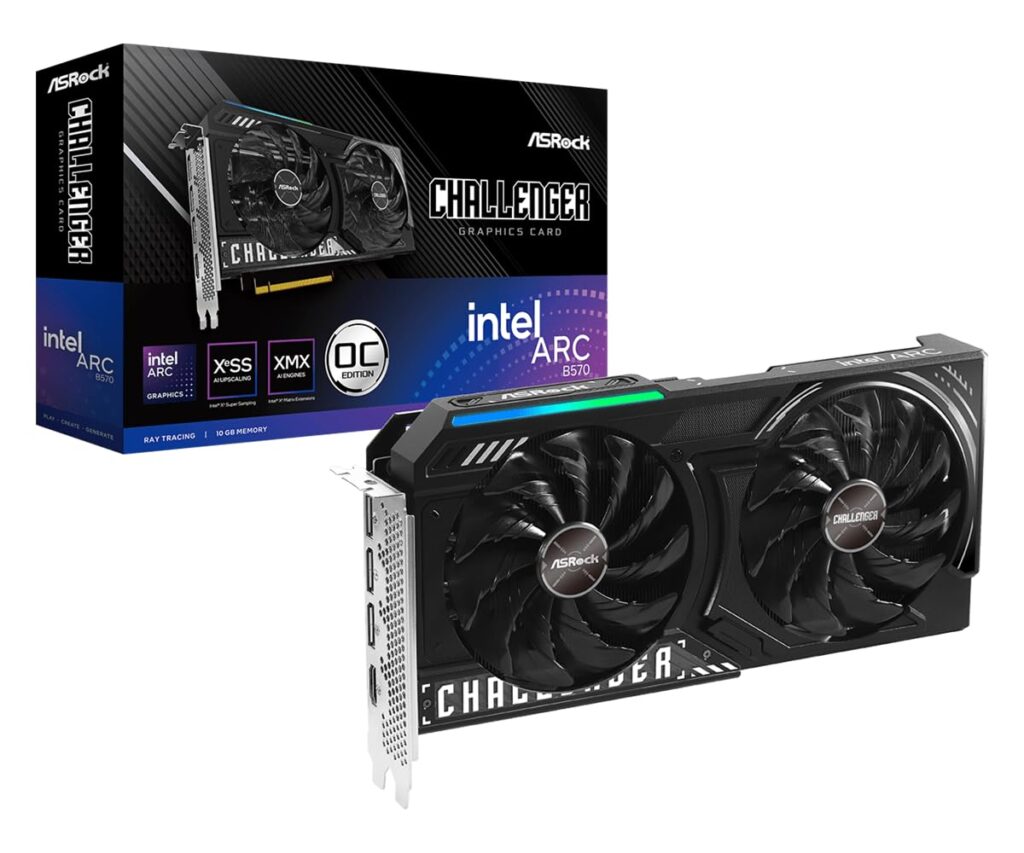
- 10 GB VRAM capacity provides extra headroom for 1080p and QHD gaming
- Cool and whisper-quiet operation under load
- Supports Intel XeSS 2 with Frame Generation, ray tracing hardware, and official overclocking
- Notable performance reduction compared to the Intel Arc B580
- Frame rate inconsistencies, CPU overhead, and higher-than-expected power consumption in testing
- Unnecessarily oversized cooler design and missing software functions
Overview
Intel’s Battlemage architecture arrives in the entry-level Challenger OC with a 10 GB memory buffer that immediately separates it from typical 8 GB budget cards. Built around the BMG-G21 silicon on TSMC’s N5 (5 nm EUV) process, the chip packs 19.6 billion transistors into a 272 mm² die with 18 Xe-cores, 5 render slices, 18 ray tracing units, and 144 XMX AI engines. Clocked at a 2,600 MHz base frequency for 12.7 TFLOPS of FP32 compute, it handles modern 1080p and QHD gaming gracefully while backing up frame rates with XeSS 2 upscaling, Frame Generation, and official overclocking support.
ASRock pairs this modest silicon with an unnecessarily oversized cooler, creating a physically bulky card for its tier that pays dividends in everyday acoustics. Under sustained load, the oversized heatsink keeps temperatures in check and maintains whisper-quiet fan behavior. However, Club386 testing uncovered higher-than-expected power draw alongside noticeable CPU overhead, meaning real-world efficiency trails what the core count implies.
In day-to-day play, the card lands a clear tier below the Arc B580, showing a notable performance drop when pushed harder. Frame rate inconsistencies and a few missing software functions also show that Intel’s ecosystem still has rough edges to sand down. For builders who prioritize quiet operation and a generous 10 GB buffer for 1080p or entry QHD workloads, it remains a capable if quirky budget contender.
Technical Specifications
| Brand | ASRock |
| Model | Intel Arc B570 Challenger 10GB OC |
| GPU Architecture | Intel Xe2 (Battlemage) |
| GPU Chip | BMG-G21 |
| Process Node | TSMC N5 (5 nm EUV) |
| Transistors | 19.6 billion |
| Die Size | 272 mm² |
| Xe Cores | 18 |
| Render Slices | 5 |
| Ray Tracing Units | 18 |
| XMX AI Engines | 144 |
| Base Clock | 2,600 MHz |
| FP32 Compute | 12.7 TFLOPS |
| VRAM Capacity | 10 GB |
| Upscaling Support | Intel XeSS 2 (with Frame Generation) |
| Release Date | January 2025 |
Primary Sources & Audited Citations
Recommended Alternatives in Graphics Cards (GPUs)
At a Glance
How reliable is the ASRock Intel Arc B570 Challenger 10GB OC according to Mizex audits?
Buy this if you want quiet 1080p and QHD gaming with a 10 GB buffer and XeSS 2 support; look at the Arc B580 instead if you have an older CPU sensitive to overhead or want sharper frame consistency.
What are the known quirks or drawbacks of the ASRock Intel Arc B570 Challenger 10GB OC?
Our reliability audit identified the following documented caveats:
- Notable performance reduction compared to the Intel Arc B580
- Frame rate inconsistencies, CPU overhead, and higher-than-expected power consumption in testing
- Unnecessarily oversized cooler design and missing software functions
What are the key engineering highlights of the ASRock Intel Arc B570 Challenger 10GB OC?
The top strengths recorded in our evaluation include:
- 10 GB VRAM capacity provides extra headroom for 1080p and QHD gaming
- Cool and whisper-quiet operation under load
- Supports Intel XeSS 2 with Frame Generation, ray tracing hardware, and official overclocking