
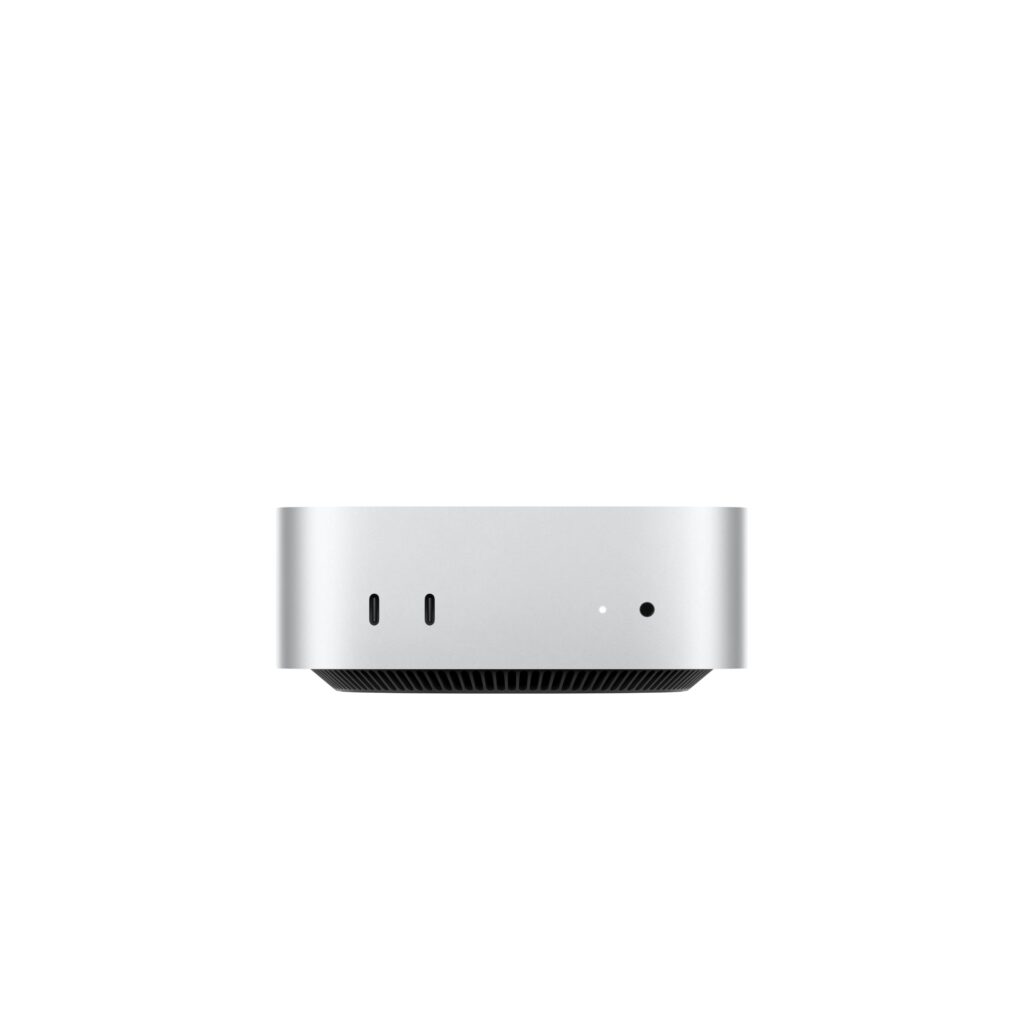
- Apple M6 silicon built on a 2nm process with 12 CPU cores, 12 GPU cores, and dual 16-core Neural Engines delivering up to 4x faster AI performance
- Robust external display controller supporting up to three displays, including dual daisy-chained monitors over a single Thunderbolt 4 port
- Upgraded baseline networking featuring native Wi-Fi 7, Bluetooth 6, and a 2.5Gb Ethernet controller configurable to 10Gb
- Convenient front-facing interface equipped with two USB-C ports and a 3.5mm high-impedance headphone jack
- Base configuration starts at a restrictive 256GB of non-upgradeable internal storage
- Physical power button remains positioned awkwardly on the bottom edge of the chassis
Overview
Fabricated on a 2-nanometer process node, Apple M6 silicon introduces an asymmetric 12-core computing topology combining two dedicated super cores, four performance cores, and six efficiency cores to anchor the compact desktop platform. A unified memory architecture delivers throughput ranging from 153 GB/s on base 16GB allocations up to 170 GB/s on 24GB and 32GB configurations, eliminating memory latency between the central processor and the integrated 12-core graphics engine. Hardware-accelerated ray tracing and Neural Accelerators on the GPU work in parallel with a dual 16-core Neural Engine to drive artificial intelligence tasks, while dedicated fixed-function media engines offload hardware encoding and decoding across ProRes, ProRes RAW, HEVC, H.264, and AV1 bitstreams.
Physical construction centers around a precision silver aluminum alloy unibody enclosure featuring a circular bottom ventilation grille elevated by a perimeter rubber anti-slip ring for quiet intake airflow. External connectivity emphasizes accessibility through front-facing I/O comprising two USB-C ports alongside a 3.5mm headphone jack engineered with impedance sensing for high-impedance studio monitors. The rear plane expands connectivity with three Thunderbolt 4 ports, an HDMI video connector, and a 2.5Gb Ethernet interface configurable up to 10Gb speeds, complemented wirelessly by native Wi-Fi 7 and Bluetooth 6 transceivers. The internal display engine drives up to three simultaneous external monitors, including daisy-chained dual displays over a single Thunderbolt 4 port and display output up to 6K at 60Hz or 4K at 165Hz.
Running macOS 27, operational stability is backed by unified system firmware, robust wake-sleep state transitions, and a spotless hardware reliability track record with zero documented community failure quirks. Everyday usability, however, involves clear trade-offs: the physical power button remains inconveniently placed on the bottom edge of the enclosure, requiring users to reach beneath or tilt the chassis to power on. Furthermore, zero modular repairability or internal expandability locks owners into their purchase configuration, making the base 256GB storage tier an aggressive bottleneck that compels reliance on external storage arrays for high-volume local workflows.
Technical Specifications
| Brand | Apple |
| Model | Mac mini M6 |
| Processor | Apple M6 (2nm process) |
| CPU Architecture | 12-core CPU (2 super cores, 4 performance cores, 6 efficiency cores) |
| GPU Architecture | 12-core GPU with hardware-accelerated ray tracing and Neural Accelerators |
| Neural Engine | Dual 16-core Neural Engine |
| Unified Memory | 16GB (configurable to 24GB or 32GB) |
| Memory Bandwidth | 153GB/s (base 16GB) to 170GB/s (24GB/32GB configurations) |
| Storage | 256GB SSD (configurable to 512GB, 1TB, or 2TB) |
| Media Engine | Hardware-accelerated H.264, HEVC, ProRes, ProRes RAW, video decode/encode engines, AV1 decode |
| Display Support | Up to 3 external displays (2 displays up to 6K @ 60Hz or 4K @ 165Hz via Thunderbolt, plus 1 display up to 5K @ 60Hz via Thunderbolt or 4K @ 60Hz via HDMI); supports dual external displays over a single Thunderbolt port; DisplayPort 1.4 |
| Front I/O | 2x USB-C ports, 1x 3.5mm headphone jack with high-impedance headphone support, 1x power indicator LED |
| Rear I/O | 3x Thunderbolt 4 (USB-C) ports, 1x HDMI port, 1x 2.5Gb Ethernet port (configurable to 10Gb), 1x AC power input |
| Wireless Networking | Wi-Fi 7, Bluetooth 6 |
| Wired Networking | 2.5Gb Ethernet (configurable to 10Gb) |
| Audio | Built-in speaker, 3.5mm headphone jack with advanced support for high-impedance headphones |
| Power Input | 100–240V AC, 50–60Hz, 2.5A |
| Chassis Construction | Silver aluminum alloy chassis with circular bottom ventilation grille and rubber anti-slip ring |
| Model Number | A3534 (MHQK4CH/A) |
| Operating System | macOS 27 |
Primary Sources & Audited Citations
Recommended Alternatives in Mini PCs
At a Glance
How reliable is the Apple Mac mini M6 Review: Compact 2nm Desktop Powerhouse according to Mizex audits?
The Apple Mac mini M6 is an exceptional compact desktop for creators and multi-display setups demanding class-leading 2nm processing and high-speed I/O, though buyers should opt for higher internal storage at purchase to offset the non-upgradeable 256GB base capacity.
What are the known quirks or drawbacks of the Apple Mac mini M6 Review: Compact 2nm Desktop Powerhouse?
Our reliability audit identified the following documented caveats:
- Base configuration starts at a restrictive 256GB of non-upgradeable internal storage
- Physical power button remains positioned awkwardly on the bottom edge of the chassis
What are the key engineering highlights of the Apple Mac mini M6 Review: Compact 2nm Desktop Powerhouse?
The top strengths recorded in our evaluation include:
- Apple M6 silicon built on a 2nm process with 12 CPU cores, 12 GPU cores, and dual 16-core Neural Engines delivering up to 4x faster AI performance
- Robust external display controller supporting up to three displays, including dual daisy-chained monitors over a single Thunderbolt 4 port
- Upgraded baseline networking featuring native Wi-Fi 7, Bluetooth 6, and a 2.5Gb Ethernet controller configurable to 10Gb
- Convenient front-facing interface equipped with two USB-C ports and a 3.5mm high-impedance headphone jack