
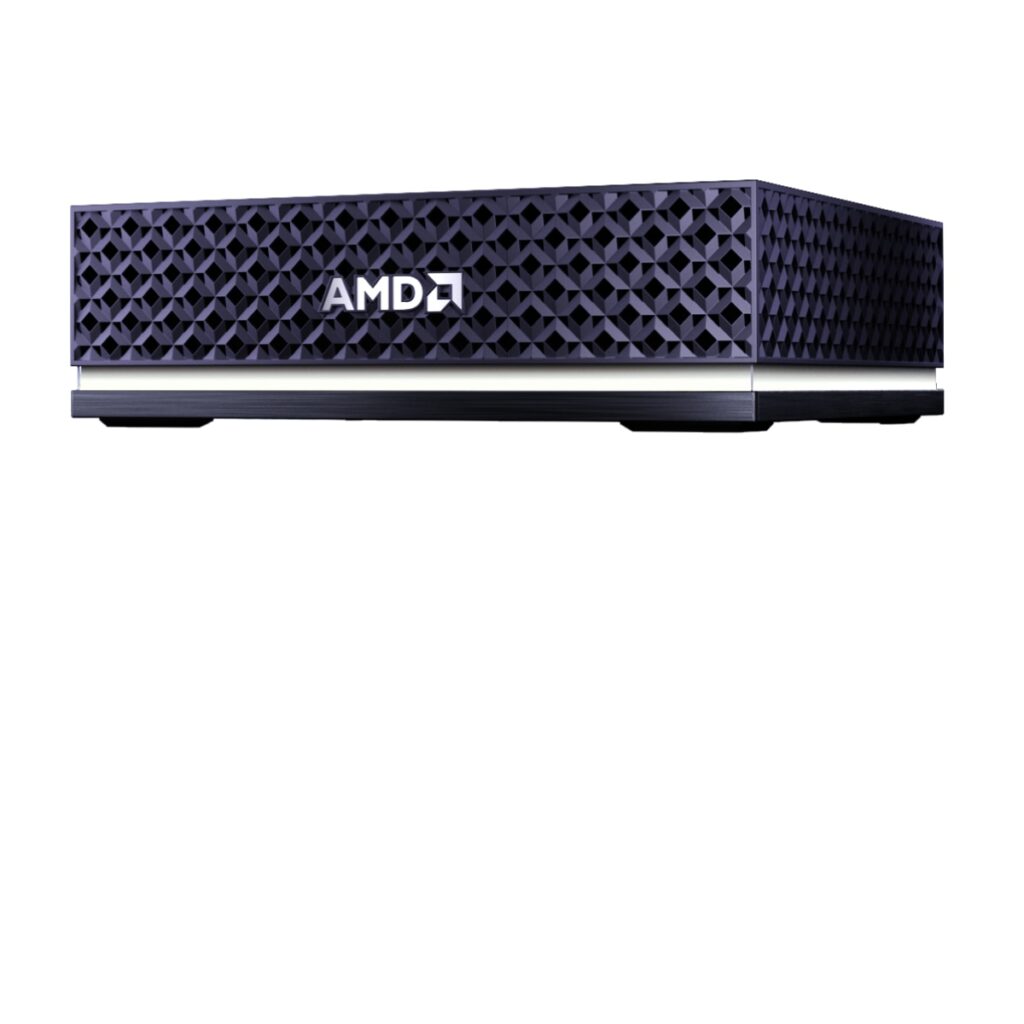
- Massive 128 GB unified LPDDR5x-8000 memory delivering 256 GB/s bandwidth for local LLM and AI execution
- 16-core, 32-thread Zen 5 processor paired with 40 RDNA 3.5 GPU compute units
- Dedicated AMD XDNA 2 NPU for offloaded neural compute tasks
- Removable 2 TB M.2 SSD for modular storage maintenance and upgrades
- Offered strictly in a single fixed hardware configuration
- Soldered unified memory prevents post-purchase RAM capacity upgrades
Overview
High-bandwidth memory architecture defines the operational profile of the AMD Ryzen AI Halo, routing 256 GB/s of unified bandwidth across a 128 GB LPDDR5x-8000 interface. Built around the 16-core, 32-thread Zen 5 AMD Ryzen AI Max+ 395 processor, the platform integrates an AMD Radeon 8060S graphics engine with 40 RDNA 3.5 Compute Units alongside an AMD XDNA 2 neural processing unit. This unified pool allows expansive local artificial intelligence models and parallel compute workloads to reside directly in shared high-speed memory, bypassing traditional discrete bus transit bottlenecks.
Within the mini-PC enclosure, the internal layout balances high-density silicon integration with practical storage serviceability. While the high-frequency LPDDR5x memory is soldered directly to the mainboard to preserve signal integrity across the wide bus, storage remains modular via a removable 2 TB M.2 SSD. Thermal dissipation relies on an active cooling assembly tasked with managing heat from the consolidated CPU, GPU, and NPU package under heavy compute loads, eliminating the multi-rail board complexity typically required by discrete GPU cards.
As a dedicated edge AI development workstation, driver and firmware coordination across Zen 5 x86 cores, RDNA 3.5 compute units, and the XDNA 2 neural processor governs runtime stability during sustained local inference tasks. While platform flexibility is bounded by its single fixed factory configuration, the architecture delivers a standardized, turnkey hardware foundation for developers executing demanding local models.
Technical Specifications
| Brand | AMD |
| Model | Ryzen AI Halo |
| Processor | AMD Ryzen AI Max+ 395 |
| CPU Architecture | Zen 5 |
| CPU Core Configuration | 16 Cores / 32 Threads |
| Integrated Graphics | AMD Radeon 8060S (40 RDNA 3.5 Compute Units) |
| Neural Processing Unit | AMD XDNA 2 |
| Memory Capacity | 128 GB |
| Memory Type | Unified LPDDR5x-8000 |
| Memory Bandwidth | 256 GB/s |
| Storage Capacity | 2 TB |
| Storage Interface | Removable M.2 SSD |
| Form Factor | Mini PC |
Primary Sources & Audited Citations
Recommended Alternatives in Mini PCs
At a Glance
How reliable is the AMD Ryzen AI Halo Review: Unified 128GB High-Bandwidth Mini Node according to Mizex audits?
An exceptional compact workstation for developers running local AI models that require massive unified memory bandwidth, provided a fixed single-configuration mini-PC meets your deployment requirements.
What are the known quirks or drawbacks of the AMD Ryzen AI Halo Review: Unified 128GB High-Bandwidth Mini Node?
Our reliability audit identified the following documented caveats:
- Offered strictly in a single fixed hardware configuration
- Soldered unified memory prevents post-purchase RAM capacity upgrades
What are the key engineering highlights of the AMD Ryzen AI Halo Review: Unified 128GB High-Bandwidth Mini Node?
The top strengths recorded in our evaluation include:
- Massive 128 GB unified LPDDR5x-8000 memory delivering 256 GB/s bandwidth for local LLM and AI execution
- 16-core, 32-thread Zen 5 processor paired with 40 RDNA 3.5 GPU compute units
- Dedicated AMD XDNA 2 NPU for offloaded neural compute tasks
- Removable 2 TB M.2 SSD for modular storage maintenance and upgrades