
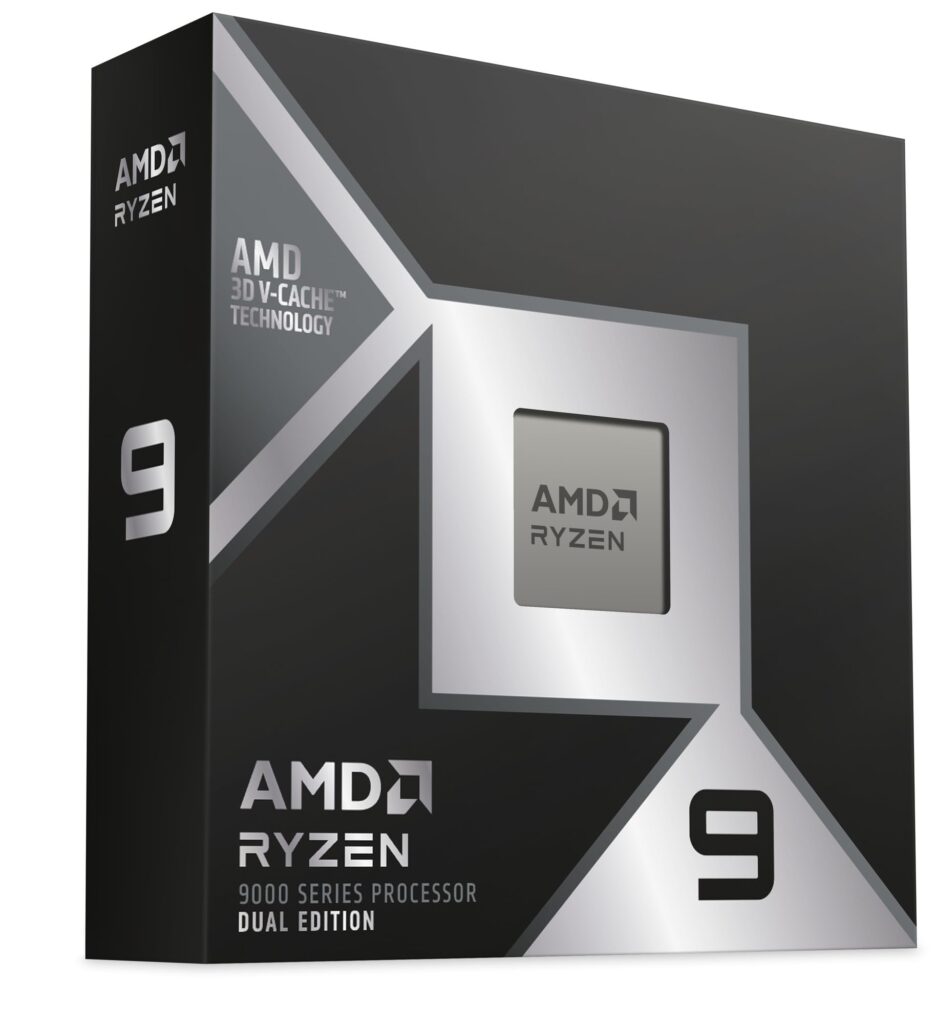
- Symmetrical 192 MB L3 cache across both 8-core CCDs eliminates cross-die cache asymmetry and scheduling latency spikes
- 2nd Gen under-die 3D V-Cache places compute cores closer to the cooler for better heat transfer
- Strong 21% to 71% gaming lead over the non-3D 9950X and standout scientific gains in workloads like OpenFOAM
- Retains drop-in compatibility with existing Socket AM5 motherboards
- Marginal 0% to 6% uplift over the single-X3D Ryzen 9 9950X3D across gaming and most tested workloads
- Higher 200W TDP (up from 170W on the 9950X3D) drives significantly higher power consumption
- Steep price premium relative to existing Ryzen 9000 X3D processors
Overview
Symmetrical 3D V-Cache across both compute dies finally eliminates the split-personality compromise of dual-CCD Ryzen processors. Across its 16 cores and 32 threads, this Ryzen 9000 Series chip splits processing evenly between two 8-core CCDs, giving each die 32 MB of 2D L3 cache plus 64 MB of stacked 3D V-Cache for 192 MB of L3 and 208 MB of combined on-chip cache. Because both dies share identical cache capacity, workloads no longer suffer from cross-die cache asymmetry or scheduling latency spikes when threads move between CCDs. Compared to the standard non-3D Ryzen 9 9950X, that expanded cache pool delivers 21% to 71% higher gaming frame rates alongside 20% to 30% leads over Intel’s Core Ultra 270K Plus in GamersNexus testing.
Under the hood, AMD’s 2nd Gen 3D V-Cache layout places the cache silicon below the compute cores rather than on top of them, keeping the primary heat-generating logic closer to the cooler coldplate. Even with that cleaner thermal path, running symmetrical stacked cache across both dies pushes the TDP to 200W, up from 170W on the single-X3D Ryzen 9 9950X3D, bringing significantly higher power consumption under load. Retaining drop-in Socket AM5 compatibility keeps upgrades straightforward on existing motherboards, as long as your cooling setup and board power delivery can handle the extra wattage.
In everyday practice, the dual-cache advantage hits a ceiling for most buyers. Aside from cache-hungry scientific simulations like OpenFOAM that benefit from 192 MB of L3 across every core, typical gaming and productivity workloads yield only a 0% to 6% uplift over the Ryzen 9 9950X3D. Paying a steep price premium and pulling noticeably more power for single-digit gains leaves this flagship as a narrow specialist option rather than a meaningful step up from AMD’s existing Ryzen 9000 X3D lineup.
Technical Specifications
| Brand | AMD |
| Model | Ryzen 9 9950X3D2 Dual Edition |
| Product Series | AMD Ryzen 9000 Series |
| Socket | AM5 |
| Cores / Threads | 16 / 32 |
| CCD Configuration | Dual CCD (8 cores per CCD) |
| L3 Cache | 192 MB (96 MB per CCD: 32 MB 2D L3 + 64 MB 3D V-Cache each) |
| Total On Chip Cache | 208 MB (L2 + L3) |
| Cache Architecture | 2nd Gen 3D V-Cache (under-die placement on both CCDs) |
| TDP | 200W |
Primary Sources & Audited Citations
- AMD Ryzen 9 9950X3D2 Dual Edition Review: 3D V-Cache on Both CCDs - StorageReview.com
- AMD Ryzen 9 9950X3D2 Dual Edition Review: Ultimate No-Compromise CPU - HotHardware
- DO NOT BUY: AMD Ryzen 9 9950X3D2 CPU Review & Benchmarks | 24 Charts in 24 Hours - GamersNexus
- AMD Ryzen 9 9950X3D2 Review: Twice the 3D V-Cache - TechSpot
- AMD Ryzen 9 9950X3D2 Dual Edition Review: Rising A Bit Higher - ServeTheHome
Recommended Alternatives in CPUs / Processors
At a Glance
How reliable is the AMD Ryzen 9 9950X3D2 Dual Edition according to Mizex audits?
Buy this only if you run cache-sensitive scientific workloads like OpenFOAM across all 16 cores; look at the Ryzen 9 9950X3D for nearly identical gaming and creator performance at lower power and cost.
What are the known quirks or drawbacks of the AMD Ryzen 9 9950X3D2 Dual Edition?
Our reliability audit identified the following documented caveats:
- Marginal 0% to 6% uplift over the single-X3D Ryzen 9 9950X3D across gaming and most tested workloads
- Higher 200W TDP (up from 170W on the 9950X3D) drives significantly higher power consumption
- Steep price premium relative to existing Ryzen 9000 X3D processors
What are the key engineering highlights of the AMD Ryzen 9 9950X3D2 Dual Edition?
The top strengths recorded in our evaluation include:
- Symmetrical 192 MB L3 cache across both 8-core CCDs eliminates cross-die cache asymmetry and scheduling latency spikes
- 2nd Gen under-die 3D V-Cache places compute cores closer to the cooler for better heat transfer
- Strong 21% to 71% gaming lead over the non-3D 9950X and standout scientific gains in workloads like OpenFOAM
- Retains drop-in compatibility with existing Socket AM5 motherboards