
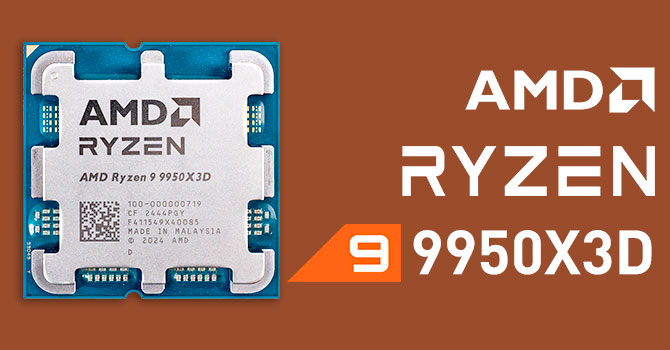
- Matches Ryzen 7 9800X3D gaming performance (+18% over 9950X, +10% over Core i9-14900K in CPU-heavy titles)
- Maintains full 16-core/32-thread productivity parity with the standard Ryzen 9 9950X
- Under-CCD 2nd-gen 3D V-Cache improves heat transfer, enabling 5.7 GHz boost clocks and unlocked overclocking
- Drop-in upgrade for existing AM5 motherboards with integrated graphics and AVX-512 support
- 170 W default TDP generates substantial heat under full 16-core loads, demanding high-end cooling
- Requires updated AM5 BIOS and chipset drivers (or Linux kernel 6.13+) to keep games on the V-Cache CCD
- Long DDR5 memory-training boot times on AM5 unless Memory Context Restore is enabled
Overview
AMD finally solved the classic X3D compromise by moving its second-generation 3D V-Cache underneath one of the two 8-core Zen 5 compute chiplets. Putting the stacked cache below the silicon instead of on top gets the heat-generating cores directly against the heatspreader, unlocking a 5.7 GHz max boost clock and full overclocking support on Socket AM5. In real-world use, that architecture puts gaming performance neck-and-neck with the Ryzen 7 9800X3D—averaging an 18% lead over the standard 9950X and a 10% edge over Intel’s Core i9-14900K in CPU-bound games—without giving up a single drop of 16-core rendering, code compilation, or workstation speed.
Because only one of the two chiplets carries the extra 64 MB of stacked L3 cache (for 144 MB of total cache), keeping the system properly fed on the software side matters. On Windows, you will want an updated AM5 BIOS and current AMD Chipset Software so games land on the cache-equipped cores rather than wandering onto the standard compute die; Linux users get the same routing behavior starting with kernel 6.13 and AMD’s 3D V-Cache Optimizer driver. Early AM5 owners should also keep an eye on BIOS settings and enable Memory Context Restore to avoid sluggish DDR5 memory-training delays on cold boots.
Even with improved gaming efficiency compared to both the standard 9950X and Intel’s Core Ultra 9 285K, pushing all 16 cores and 32 threads at a 170 W default TDP still moves serious heat. A capable liquid cooler or dual-tower air setup is a practical requirement if you plan to sustain peak clocks during long renders. That thermal demand aside, drop-in compatibility with existing AM5 boards—alongside AVX-512 support and integrated graphics—makes this a remarkably clean drop-in upgrade for heavy multi-purpose rigs.
Technical Specifications
| Model | AMD Ryzen 9 9950X3D |
| Architecture | Zen 5 (TSMC N4) |
| Socket | AM5 |
| Chiplet Topology | 2 x 8-core CCD, 1 x I/O die |
| Cores / Threads | 16 Cores / 32 Threads |
| Base / Max Boost Clock | 4.3 GHz / 5.7 GHz |
| Cache | 144 MB Total (16 MB L2 + 128 MB L3 with 2nd-gen 3D V-Cache) |
| Default TDP | 170 W |
| Memory Support | DDR5 |
| Overclocking | Unlocked |
| Integrated Graphics | Yes |
| Instruction Set Extensions | AVX-512 |
Primary Sources & Audited Citations
- AMD Ryzen 9 9950X3D Gaming and Content Creation Processor
- AMD Ryzen 9 9950X3D CPU Review & Benchmarks vs. 9800X3D, 285K, 9950X, & More | GamersNexus
- AMD Ryzen 9 9950X3D Delivers Excellent Performance For Linux Developers, Creators & Technical Computing Review - Phoronix
- AMD Ryzen 9 9950X3D Review: Ryzen 7 9800X3D levels of gaming performance and power efficiency - Notebookcheck
- AMD Ryzen 9 9950X3D Review – AMD's Brilliant All-Rounder | KitGuru
- AMD Ryzen 9 9950X3D Review: The Best High-End CPU - TechSpot
- AMD Ryzen 9 9950X3D review: one CPU to rule them all | Club386
- AMD Ryzen 9 9950X3D Review: High-Core Power Meets 3D V-Cache - StorageReview.com
- AMD Ryzen 9 9950X3D Review - IGN
- AMD Ryzen 9 9950X3D review: A no-compromise CPU for demanding gamers - Engadget
Recommended Alternatives in CPUs / Processors
At a Glance
How reliable is the AMD Ryzen 9 9950X3D according to Mizex audits?
Buy this if you want flagship gaming and heavy 16-core workstation performance in a single AM5 build; look at the Ryzen 7 9800X3D if you strictly game, or the standard Ryzen 9 9950X if gaming isn't a priority.
What are the known quirks or drawbacks of the AMD Ryzen 9 9950X3D?
Our reliability audit identified the following documented caveats:
- 170 W default TDP generates substantial heat under full 16-core loads, demanding high-end cooling
- Requires updated AM5 BIOS and chipset drivers (or Linux kernel 6.13+) to keep games on the V-Cache CCD
- Long DDR5 memory-training boot times on AM5 unless Memory Context Restore is enabled
What are the key engineering highlights of the AMD Ryzen 9 9950X3D?
The top strengths recorded in our evaluation include:
- Matches Ryzen 7 9800X3D gaming performance (+18% over 9950X, +10% over Core i9-14900K in CPU-heavy titles)
- Maintains full 16-core/32-thread productivity parity with the standard Ryzen 9 9950X
- Under-CCD 2nd-gen 3D V-Cache improves heat transfer, enabling 5.7 GHz boost clocks and unlocked overclocking
- Drop-in upgrade for existing AM5 motherboards with integrated graphics and AVX-512 support