Seeed Studio reSpeaker Flex XVF3800 Linear-4 USB Mic Array vs Seeed Studio reSpeaker Flex XVF3800 Circular-4 USB Mic Array
Standardized 5-pillar engineering audit, thermal telemetry, verified longevity metrics, and complete technical specification diff.
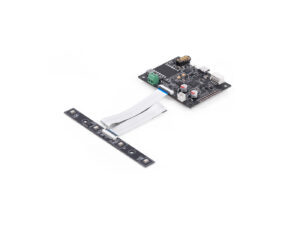
Modular far-field linear microphone array powered by an XMOS XVF3800 DSP and 10 W amplifier, pairing strong beamforming performance with notable firmware flashing and OS driver quirks.
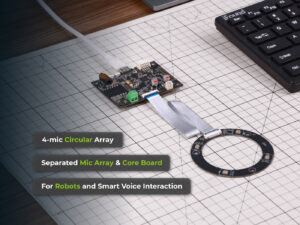
A modular far-field audio DSP array combining XMOS XVF3800 processing and a 10W speaker amp, offset only by rear-facing mic inlets and minor OS driver quirks.
Mizex Comparative Audit Verdict
5-Pillar Engineering Telemetry
Detailed comparison across standardized normalized 1.0 – 5.0 engineering pillars.
Seeed Studio reSpeaker Flex XVF3800 Linear-4 USB Mic Array: Strengths & Caveats
- Dedicated XMOS XVF3800 DSP offloads AEC, AGC, beamforming, and noise suppression in hardware
- Modular 24-pin FPC ribbon cable enables flexible satellite microphone placement in custom enclosures
- Dual USB UAC 2.0 and I2S host connectivity with onboard Seeed Studio XIAO ESP32S3 solder footprint
- Integrated 10 W at 4 Ω speaker amplifier backed by dedicated 12 V DC screw terminal power input
- Microphone sound inlets are positioned on the rear side of the PCB, requiring specific mounting orientation toward the audio source
- Windows firmware updating requires manual WinUSB driver assignment through Zadig before dfu-util functions
- I2S firmware operation requires switching to Safe Mode recovery partition to re-flash standard USB firmware
Seeed Studio reSpeaker Flex XVF3800 Circular-4 USB Mic Array: Strengths & Caveats
- Modular split-board design isolates the 44 mm circular mic array from the DSP core via a 24-pin locking FPC cable.
- Hardware-accelerated XMOS XVF3800 DSP provides onboard AEC, DoA tracking, beamforming, and noise cancellation.
- Built-in TI TPA3139D2 Class-D amplifier delivers up to 10W output into 4Ω external speakers via 12V auxiliary power.
- Dedicated surface-mount footprint enables direct solder integration of a Seeed Studio XIAO ESP32S3 module.
- Microphone acoustic ports are located on the rear face of the satellite PCB, demanding careful alignment and gasket sealing in custom enclosures.
- Outputting the full 10W speaker power requires auxiliary 12V terminal block wiring rather than standard 5V USB bus power.
- Post-DFU firmware updates on Windows can trigger device enumeration drops, while Linux defaults to low ALSA PCM output levels.
Technical Specification Comparison
Side-by-side spec alignment. Rows highlighted with subtle shading denote differing specifications.
| Specification | Seeed Studio reSpeaker Flex XVF3800 Linear-4 USB Mic Array | Seeed Studio reSpeaker Flex XVF3800 Circular-4 USB Mic Array |
|---|---|---|
| Brand | Seeed Studio | Seeed Studio |
| Model DIFF | reSpeaker Flex XVF3800 Linear-4 USB Mic Array | reSpeaker Flex XVF3800 Circular-4 USB Mic Array |
| Dsp Processor DIFF | XMOS XVF3800 (firmware v3.2.1) | — |
| Audio Codec | Texas Instruments TLV320AIC3104 | Texas Instruments TLV320AIC3104 |
| Microphone Count | 4 | 4 |
| Microphone Type | PDM MEMS | PDM MEMS |
| Microphone Layout DIFF | Linear array (1.30 in / 33 mm inter-mic spacing) | — |
| Polar Pattern DIFF | Directional front-facing (~180° pickup with rear suppression) | — |
| Voice Pickup Range DIFF | Up to 16.4 ft (5.0 m) far-field | Up to 5 m |
| Audio Processing Algorithms DIFF | Acoustic Echo Cancellation (AEC), Automatic Gain Control (AGC), Direction of Arrival (DoA), Multi-channel Beamforming, Voice Activity Detection (VAD), Noise Suppression, De-reverberation | — |
| Interconnect DIFF | 24-pin 0.5 mm pitch FPC ribbon cable (7.87 in / 20 cm included) | — |
| Host Interfaces DIFF | USB Type-C (UAC 2.0), PH2.0 locking connector (UAC 2.0), I2S | — |
| Supported Sample Rates DIFF | 16 kHz, 48 kHz | — |
| Audio Bit Depth DIFF | 16-bit, 32-bit | — |
| Audio Channels DIFF | 2-channel stereo, 6-channel USB output | — |
| Analog Audio Outputs DIFF | 3.5 mm AUX headphone jack, 2-pin JST speaker connector | — |
| Speaker Amplifier Power DIFF | 10 W into 4 Ω | — |
| External Power Input DIFF | 12 V DC terminal block | — |
| Microcontroller Expansion DIFF | Onboard footprint for Seeed Studio XIAO ESP32S3 (I2S, I2C, RST, GPIO) | — |
| Mounting Holes DIFF | 2 × M3 (linear mic array board), 4 × M3 (core processing board) | — |
| Onboard Controls DIFF | Hardware Reset (RST) button, SafeMode / Boot button | — |
| Onboard Indicators DIFF | Green power LED | — |
| Usb Identifiers DIFF | Vendor ID: 0x2886, Product ID: 0x001A | — |
| Audio Processor DIFF | — | XMOS XVF3800 |
| Speaker Amplifier DIFF | — | Texas Instruments TPA3139D2 Class-D (up to 10W at 4Ω) |
| Array Geometry DIFF | — | Circular 4-microphone array (44 mm spacing) |
| Pickup Pattern DIFF | — | 360° omnidirectional |
| Supported Sampling Rates DIFF | — | 16 kHz, 48 kHz |
| Dsp Algorithms DIFF | — | Acoustic Echo Cancellation (AEC), beamforming, Direction of Arrival (DoA), Automatic Gain Control (AGC), Voice Activity Detection (VAD), noise suppression, de-reverberation |
| Usb Interface DIFF | — | USB Type-C (UAC 2.0, DFU firmware upgrade, 5V power) and PH2.0 locking connector |
| Mic Array Interface DIFF | — | 24-pin 0.5 mm pitch FPC interface with locking latch |
| Audio Outputs DIFF | — | 3.5 mm AUX stereo headphone jack, 2-pin JST speaker connector |
| Expansion Interfaces DIFF | — | Seeed Studio XIAO ESP32S3 solder footprint, XMOS I2C/I2S/GPIO pin headers, XMOS XTAG4 debug footprint |
| Power Inputs DIFF | — | 5V DC (USB-C / PH2.0), 12V DC (external terminal block) |
| Mounting Provisions DIFF | — | Core board: 4 × M3 mounting holes; Circular array board: 3 × M3 mounting holes |
| Operation Modes DIFF | — | USB UAC 2.0 mode (2-channel / 6-channel) and I2S host mode |
Need to evaluate a different configuration?
🔍 Compare Other Hardware