
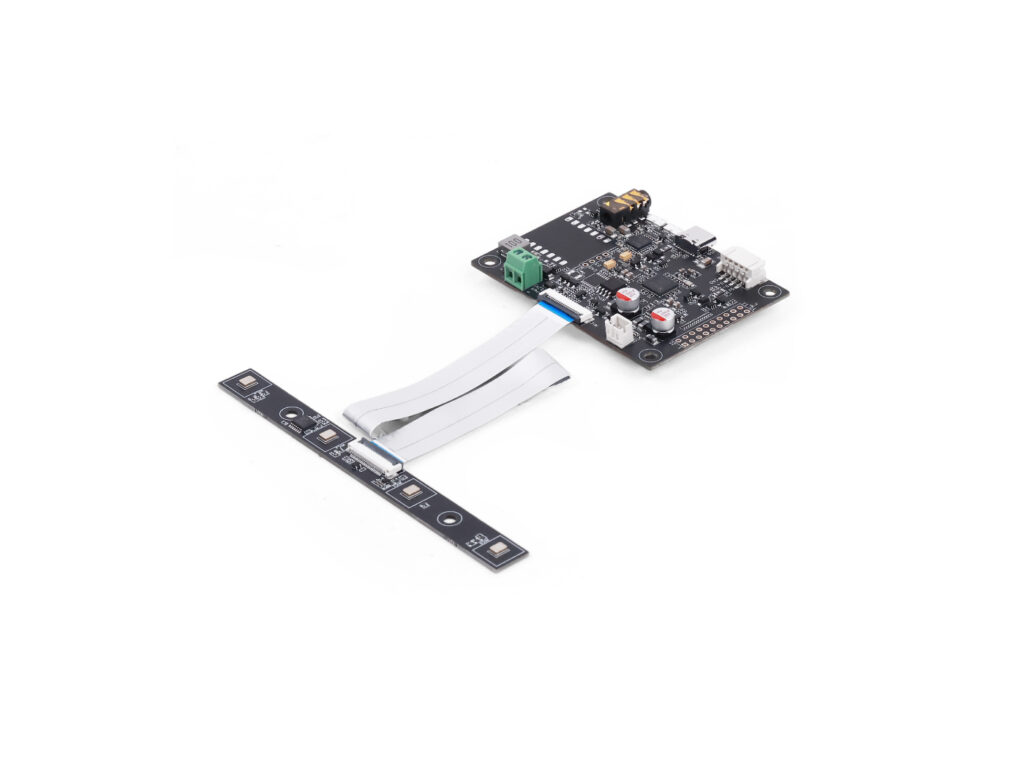
- Dedicated XMOS XVF3800 DSP offloads AEC, AGC, beamforming, and noise suppression in hardware
- Modular 24-pin FPC ribbon cable enables flexible satellite microphone placement in custom enclosures
- Dual USB UAC 2.0 and I2S host connectivity with onboard Seeed Studio XIAO ESP32S3 solder footprint
- Integrated 10 W at 4 Ω speaker amplifier backed by dedicated 12 V DC screw terminal power input
- Microphone sound inlets are positioned on the rear side of the PCB, requiring specific mounting orientation toward the audio source
- Windows firmware updating requires manual WinUSB driver assignment through Zadig before dfu-util functions
- I2S firmware operation requires switching to Safe Mode recovery partition to re-flash standard USB firmware
Overview
Decoupling acoustic sensor placement from central digital processing, the split two-board architecture relies on a 24-pin, 0.5 mm pitch flexible flat cable spanning 7.87 in (200 mm) to route raw PDM microphone streams into a dedicated baseboard. This separation allows the 4-element linear array to be integrated into chassis bezels, smart displays, or robotics enclosures while tucking the heavier XMOS XVF3800 DSP, TI TLV320AIC3104 codec, and 12 V terminal blocks into internal electronics bays. The linear microphone module spaces its four PDM MEMS sensors 1.30 in (33 mm) apart, creating an acoustic baseline tailored for 180° front-hemisphere directional pickup with substantial rear acoustic rejection over distances up to 16.4 ft (5.0 m). Integrators must note, however, that acoustic sound ports are routed through the rear face of the satellite PCB, demanding precise acoustic channel cutouts and gasket alignment during enclosure assembly.
Digital signal crunching is anchored by the XMOS XVF3800 processor running firmware v3.2.1, executing hardware-accelerated Acoustic Echo Cancellation (AEC), Automatic Gain Control (AGC), Voice Activity Detection (VAD), Direction of Arrival (DoA) tracking, and multichannel beamforming. Host communications leverage dual standards: a driverless USB Audio Class 2.0 (UAC 2.0) interface over USB Type-C or a locking PH2.0 header delivering 2-channel processed stereo or 6-channel raw audio at 16 kHz or 48 kHz (16-bit and 32-bit depth), alongside a direct digital I2S audio bus. For embedded autonomy, the baseboard integrates direct solder pads designed to seat a Seeed Studio XIAO ESP32S3 microcontroller, linking I2S, I2C, and GPIO lines directly to the DSP pipeline. Speaker output is driven by an onboard amplifier providing 10 W into 4 Ω, supported by a 3.5 mm auxiliary headphone jack and a dedicated 12 V DC screw terminal block to prevent high-current audio transients from browning out the host USB 5V rail.
In practical deployment, the platform requires navigating several documented firmware and driver constraints. Windows firmware flashing via dfu-util triggers USB driver errors unless manually assigned to WinUSB using Zadig, and post-update sound device re-enumeration occasionally stalls until the peripheral is manually uninstalled from Windows Device Manager. Furthermore, flashing I2S firmware closes off standard USB DFU pathways, requiring developers to hold the onboard Boot button during power-up to engage the hardware Safe Mode recovery partition. On Linux systems, default speaker output may register near silence until ALSA PCM mixer levels are manually driven to 100% and saved. Once configured, however, the combination of dedicated far-field DSP acceleration, robust M3 mechanical mounting points (2 on the array, 4 on the baseboard), and hybrid USB/I2S transport makes the array a flexible voice-capture building block for custom edge AI appliances.
Technical Specifications
| Brand | Seeed Studio |
| Model | reSpeaker Flex XVF3800 Linear-4 USB Mic Array |
| Dsp Processor | XMOS XVF3800 (firmware v3.2.1) |
| Audio Codec | Texas Instruments TLV320AIC3104 |
| Microphone Count | 4 |
| Microphone Type | PDM MEMS |
| Microphone Layout | Linear array (1.30 in / 33 mm inter-mic spacing) |
| Polar Pattern | Directional front-facing (~180° pickup with rear suppression) |
| Voice Pickup Range | Up to 16.4 ft (5.0 m) far-field |
| Audio Processing Algorithms | Acoustic Echo Cancellation (AEC), Automatic Gain Control (AGC), Direction of Arrival (DoA), Multi-channel Beamforming, Voice Activity Detection (VAD), Noise Suppression, De-reverberation |
| Interconnect | 24-pin 0.5 mm pitch FPC ribbon cable (7.87 in / 20 cm included) |
| Host Interfaces | USB Type-C (UAC 2.0), PH2.0 locking connector (UAC 2.0), I2S |
| Supported Sample Rates | 16 kHz, 48 kHz |
| Audio Bit Depth | 16-bit, 32-bit |
| Audio Channels | 2-channel stereo, 6-channel USB output |
| Analog Audio Outputs | 3.5 mm AUX headphone jack, 2-pin JST speaker connector |
| Speaker Amplifier Power | 10 W into 4 Ω |
| External Power Input | 12 V DC terminal block |
| Microcontroller Expansion | Onboard footprint for Seeed Studio XIAO ESP32S3 (I2S, I2C, RST, GPIO) |
| Mounting Holes | 2 × M3 (linear mic array board), 4 × M3 (core processing board) |
| Onboard Controls | Hardware Reset (RST) button, SafeMode / Boot button |
| Onboard Indicators | Green power LED |
| Usb Identifiers | Vendor ID: 0x2886, Product ID: 0x001A |
Primary Sources & Audited Citations
Recommended Alternatives in Audio & Acoustics

At a Glance
How reliable is the Seeed Studio reSpeaker Flex XVF3800 Linear-4 USB Mic Array Review: Split-Board Far-Field Voice DSP according to Mizex audits?
Ideal for embedded developers and robotics integrators needing professional far-field voice DSP and modular microphone placement, provided they are prepared for manual Windows DFU driver setup and ALSA mixer configuration.
What are the known quirks or drawbacks of the Seeed Studio reSpeaker Flex XVF3800 Linear-4 USB Mic Array Review: Split-Board Far-Field Voice DSP?
Our reliability audit identified the following documented caveats:
- Microphone sound inlets are positioned on the rear side of the PCB, requiring specific mounting orientation toward the audio source
- Windows firmware updating requires manual WinUSB driver assignment through Zadig before dfu-util functions
- I2S firmware operation requires switching to Safe Mode recovery partition to re-flash standard USB firmware
What are the key engineering highlights of the Seeed Studio reSpeaker Flex XVF3800 Linear-4 USB Mic Array Review: Split-Board Far-Field Voice DSP?
The top strengths recorded in our evaluation include:
- Dedicated XMOS XVF3800 DSP offloads AEC, AGC, beamforming, and noise suppression in hardware
- Modular 24-pin FPC ribbon cable enables flexible satellite microphone placement in custom enclosures
- Dual USB UAC 2.0 and I2S host connectivity with onboard Seeed Studio XIAO ESP32S3 solder footprint
- Integrated 10 W at 4 Ω speaker amplifier backed by dedicated 12 V DC screw terminal power input