
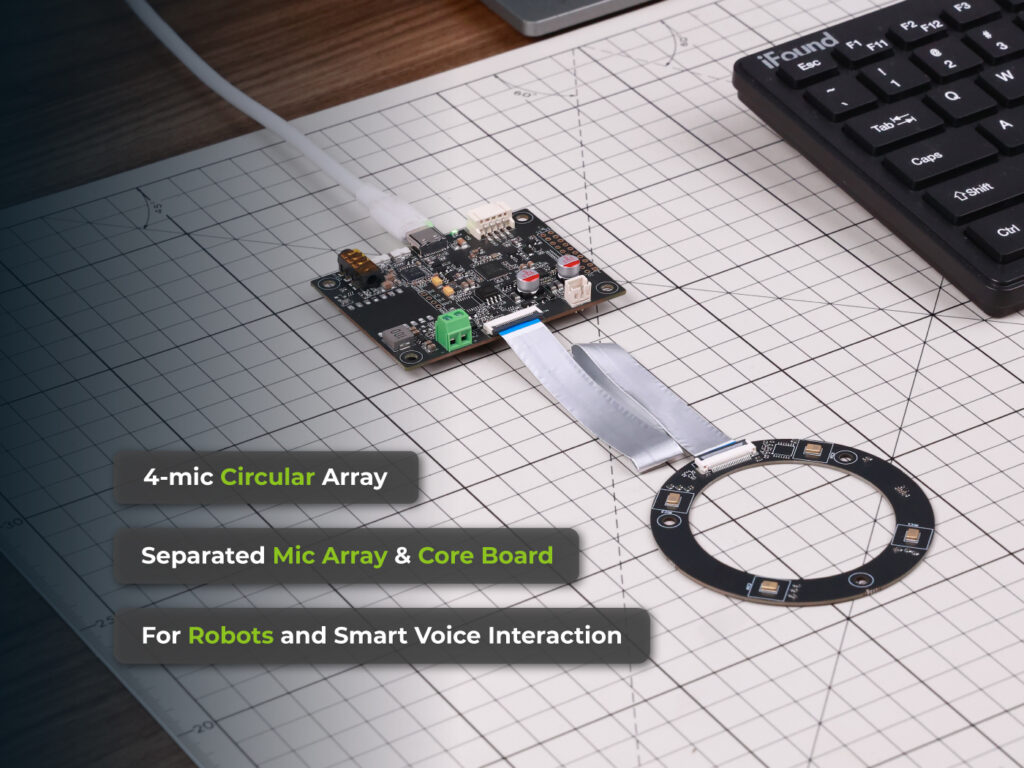
- Modular split-board design isolates the 44 mm circular mic array from the DSP core via a 24-pin locking FPC cable.
- Hardware-accelerated XMOS XVF3800 DSP provides onboard AEC, DoA tracking, beamforming, and noise cancellation.
- Built-in TI TPA3139D2 Class-D amplifier delivers up to 10W output into 4Ω external speakers via 12V auxiliary power.
- Dedicated surface-mount footprint enables direct solder integration of a Seeed Studio XIAO ESP32S3 module.
- Microphone acoustic ports are located on the rear face of the satellite PCB, demanding careful alignment and gasket sealing in custom enclosures.
- Outputting the full 10W speaker power requires auxiliary 12V terminal block wiring rather than standard 5V USB bus power.
- Post-DFU firmware updates on Windows can trigger device enumeration drops, while Linux defaults to low ALSA PCM output levels.
Overview
Dividing digital signal processing from acoustic capture, this two-piece modular array architecture bridges a dedicated XMOS XVF3800 voice processor to a 44 mm circular four-microphone satellite board via a 24-pin flexible printed circuit interface. The compute core pairs the XMOS DSP with a Texas Instruments TLV320AIC3104 codec and an integrated TPA3139D2 Class-D amplifier, routing multi-channel audio over standard USB Audio Class 2.0 or direct I2S bus lines. Board-level integration extends to a dedicated solder footprint for Seeed Studio’s XIAO ESP32S3 module, turning a wired peripheral into an untethered, network-capable voice endpoint without external breakout hardware.
Acoustic intake relies on four PDM MEMS microphones arranged in a 44 mm circular perimeter, delivering 360-degree omnidirectional voice capture rated up to 5 meters. Onboard hardware algorithms execute acoustic echo cancellation, direction of arrival tracking, beamforming, and de-reverberation at 16 kHz or 48 kHz sampling rates. Mechanically, the acoustic inlets penetrate the rear face of the satellite circuit board, necessitating deliberate acoustic gasket sealing and unobstructed cavity porting when mounting the circular board into custom enclosures. Passive thermal dissipation is maintained across open FR4 ground planes, though drawing the maximum 10 watts into 4-ohm speakers via the onboard amplifier requires tapping the secondary 12-volt DC terminal block rather than the 5-volt USB rail.
Host integration demonstrates strong hardware flexibility but reveals documented driver-level nuances across operating systems. Flashing custom firmware via USB DFU can cause Windows Device Manager enumeration stalls that require manually uninstalling the ghosted sound device and power-cycling the USB connection. Similarly, Linux ALSA configurations initialize speaker playback at near-zero default gain levels, demanding manual adjustment via ALSA mixer or PulseAudio controls to restore full amplitude. Once these software quirks are addressed, the hardware delivers dependable, low-latency audio processing for embedded voice recognition and far-field communication systems.
Technical Specifications
| Brand | Seeed Studio |
| Model | reSpeaker Flex XVF3800 Circular-4 USB Mic Array |
| Audio Processor | XMOS XVF3800 |
| Audio Codec | Texas Instruments TLV320AIC3104 |
| Speaker Amplifier | Texas Instruments TPA3139D2 Class-D (up to 10W at 4Ω) |
| Microphone Count | 4 |
| Microphone Type | PDM MEMS |
| Array Geometry | Circular 4-microphone array (44 mm spacing) |
| Pickup Pattern | 360° omnidirectional |
| Voice Pickup Range | Up to 5 m |
| Supported Sampling Rates | 16 kHz, 48 kHz |
| Dsp Algorithms | Acoustic Echo Cancellation (AEC), beamforming, Direction of Arrival (DoA), Automatic Gain Control (AGC), Voice Activity Detection (VAD), noise suppression, de-reverberation |
| Usb Interface | USB Type-C (UAC 2.0, DFU firmware upgrade, 5V power) and PH2.0 locking connector |
| Mic Array Interface | 24-pin 0.5 mm pitch FPC interface with locking latch |
| Audio Outputs | 3.5 mm AUX stereo headphone jack, 2-pin JST speaker connector |
| Expansion Interfaces | Seeed Studio XIAO ESP32S3 solder footprint, XMOS I2C/I2S/GPIO pin headers, XMOS XTAG4 debug footprint |
| Power Inputs | 5V DC (USB-C / PH2.0), 12V DC (external terminal block) |
| Mounting Provisions | Core board: 4 × M3 mounting holes; Circular array board: 3 × M3 mounting holes |
| Operation Modes | USB UAC 2.0 mode (2-channel / 6-channel) and I2S host mode |
Primary Sources & Audited Citations
Recommended Alternatives in Audio & Acoustics
At a Glance
How reliable is the Seeed Studio reSpeaker Flex XVF3800 Circular-4 USB Mic Array Review: Potent Audio DSP With Awkward Inlets according to Mizex audits?
Ideal for embedded voice interfaces and smart speaker prototypes requiring modular array placement, provided you account for rear-ported acoustic inlets and manual Linux audio mixer configuration.
What are the known quirks or drawbacks of the Seeed Studio reSpeaker Flex XVF3800 Circular-4 USB Mic Array Review: Potent Audio DSP With Awkward Inlets?
Our reliability audit identified the following documented caveats:
- Microphone acoustic ports are located on the rear face of the satellite PCB, demanding careful alignment and gasket sealing in custom enclosures.
- Outputting the full 10W speaker power requires auxiliary 12V terminal block wiring rather than standard 5V USB bus power.
- Post-DFU firmware updates on Windows can trigger device enumeration drops, while Linux defaults to low ALSA PCM output levels.
What are the key engineering highlights of the Seeed Studio reSpeaker Flex XVF3800 Circular-4 USB Mic Array Review: Potent Audio DSP With Awkward Inlets?
The top strengths recorded in our evaluation include:
- Modular split-board design isolates the 44 mm circular mic array from the DSP core via a 24-pin locking FPC cable.
- Hardware-accelerated XMOS XVF3800 DSP provides onboard AEC, DoA tracking, beamforming, and noise cancellation.
- Built-in TI TPA3139D2 Class-D amplifier delivers up to 10W output into 4Ω external speakers via 12V auxiliary power.
- Dedicated surface-mount footprint enables direct solder integration of a Seeed Studio XIAO ESP32S3 module.