Hearvo USB 3.0 HDMI KVM Switch S7232H vs JetKVM
Standardized 5-pillar engineering audit, thermal telemetry, verified longevity metrics, and complete technical specification diff.
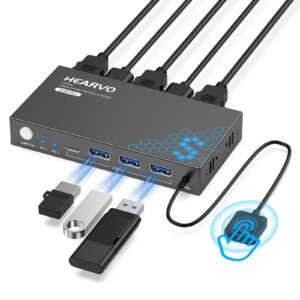
A capable 4K60 two-PC KVM switch featuring adaptive EDID emulation and a 5 Gbps USB hub tailored for single-monitor desk setups.
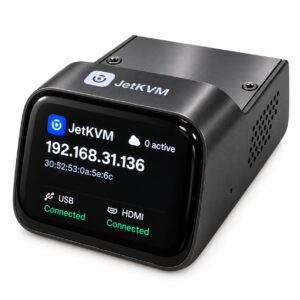
A highly capable open-source IP-KVM delivering 1080p60 encoding with sub-60ms latency in a rugged zinc chassis, offset by cramped I/O spacing and a persistent display backlight.
Mizex Comparative Audit Verdict
5-Pillar Engineering Telemetry
Detailed comparison across standardized normalized 1.0 – 5.0 engineering pillars.
Hearvo USB 3.0 HDMI KVM Switch S7232H: Strengths & Caveats
- Adaptive EDID emulation maintains display handshakes and prevents window repositioning during switching
- Integrated 4-port 5 Gbps USB hub supporting both USB-A and USB-C peripherals
- Dual switching controls via integrated push button and included wired desktop extension remote
- Bus-powered driverless architecture operating across Windows, macOS, and Linux without an external AC brick
- Single-monitor output only, lacking dual-display workstation support
- Lacks integrated USB-C Power Delivery (PD) pass-through charging for host laptops
JetKVM: Strengths & Caveats
- Hardware-accelerated 1080p @ 60 FPS capture with low 30–60 ms encoding latency
- Fully open-source Linux and Go-based software stack with public GitHub repository
- Rugged die-cast zinc alloy chassis with passive thermal dissipation
- RJ11 extension header enabling remote ATX power button and DC relay switching
- Less than 1 mm clearance between Mini-HDMI and RJ45 ports blocks bulky or booted Ethernet connectors
- Touchscreen backlight lacks a software sleep timer and remains permanently illuminated
- Unpowered host shutdowns drop connectivity unless paired with an external 5V power supply or USB standby port
Technical Specification Comparison
Side-by-side spec alignment. Rows highlighted with subtle shading denote differing specifications.
| Specification | Hearvo USB 3.0 HDMI KVM Switch S7232H | JetKVM |
|---|---|---|
| Brand DIFF | Hearvo | JetKVM |
| Model DIFF | USB 3.0 HDMI KVM Switch S7232H | JetKVM |
| Model Number DIFF | S7232H | — |
| Host Computer Capacity DIFF | 2 Systems | — |
| Display Output Channels DIFF | 1x HDMI | — |
| Video Input Channels DIFF | 2x HDMI | — |
| Maximum Resolution & Refresh DIFF | 4K (3840x2160) @ 60Hz | — |
| Supported Video Modes DIFF | 4K@60Hz, 4K@30Hz, 2K, 1080p, 3D | — |
| EDID Emulation DIFF | Adaptive EDID Handshake Support | — |
| USB Hub Configuration DIFF | 4x USB 3.0 (USB-A and USB-C) | — |
| USB Transfer Bandwidth DIFF | 5 Gbps | — |
| Switching Interface DIFF | Chassis Push Button, Wired Desktop Remote | — |
| Power Configuration DIFF | Host USB Bus-Powered | — |
| Driver Requirements DIFF | Driverless Plug-and-Play | — |
| Platform Support DIFF | Windows, macOS, Linux | — |
| Processor (SoC) DIFF | — | Rockchip RV1106G3 (ARM Cortex-A7 @ 1.0 GHz) |
| Hardware Video Encoder DIFF | — | Hardware H.264 and H.265 VPU |
| System Memory DIFF | — | 256 MB on-chip DDR3L |
| Onboard Storage DIFF | — | 16 GB eMMC flash |
| Integrated Display DIFF | — | 1.69-inch IPS capacitive touchscreen (280 x 240 resolution) |
| Video Input Interface DIFF | — | Mini-HDMI (up to 1080p @ 60 FPS) |
| Encoding Latency DIFF | — | 30–60 ms |
| Network Interface DIFF | — | 100 Mbps Ethernet (RJ45) |
| USB Interface DIFF | — | USB 2.0 Type-C (480 Mbps) for power and HID emulation |
| Expansion Interface DIFF | — | RJ11 extension port (supports ATX and DC power control boards) |
| Power Input DIFF | — | 5V via USB Type-C or 5V via RJ11 extension port |
| Chassis Material DIFF | — | Die-cast zinc alloy |
| Dimensions DIFF | — | 2.36 x 1.69 x 1.22 in (60 x 43 x 31 mm) |
| Firmware Stack DIFF | — | Open-source Linux and Go-based application stack |
Need to evaluate a different configuration?
🔍 Compare Other Hardware