
- Hardware-accelerated 1080p @ 60 FPS capture with low 30–60 ms encoding latency
- Fully open-source Linux and Go-based software stack with public GitHub repository
- Rugged die-cast zinc alloy chassis with passive thermal dissipation
- RJ11 extension header enabling remote ATX power button and DC relay switching
- Less than 1 mm clearance between Mini-HDMI and RJ45 ports blocks bulky or booted Ethernet connectors
- Touchscreen backlight lacks a software sleep timer and remains permanently illuminated
- Unpowered host shutdowns drop connectivity unless paired with an external 5V power supply or USB standby port
Overview
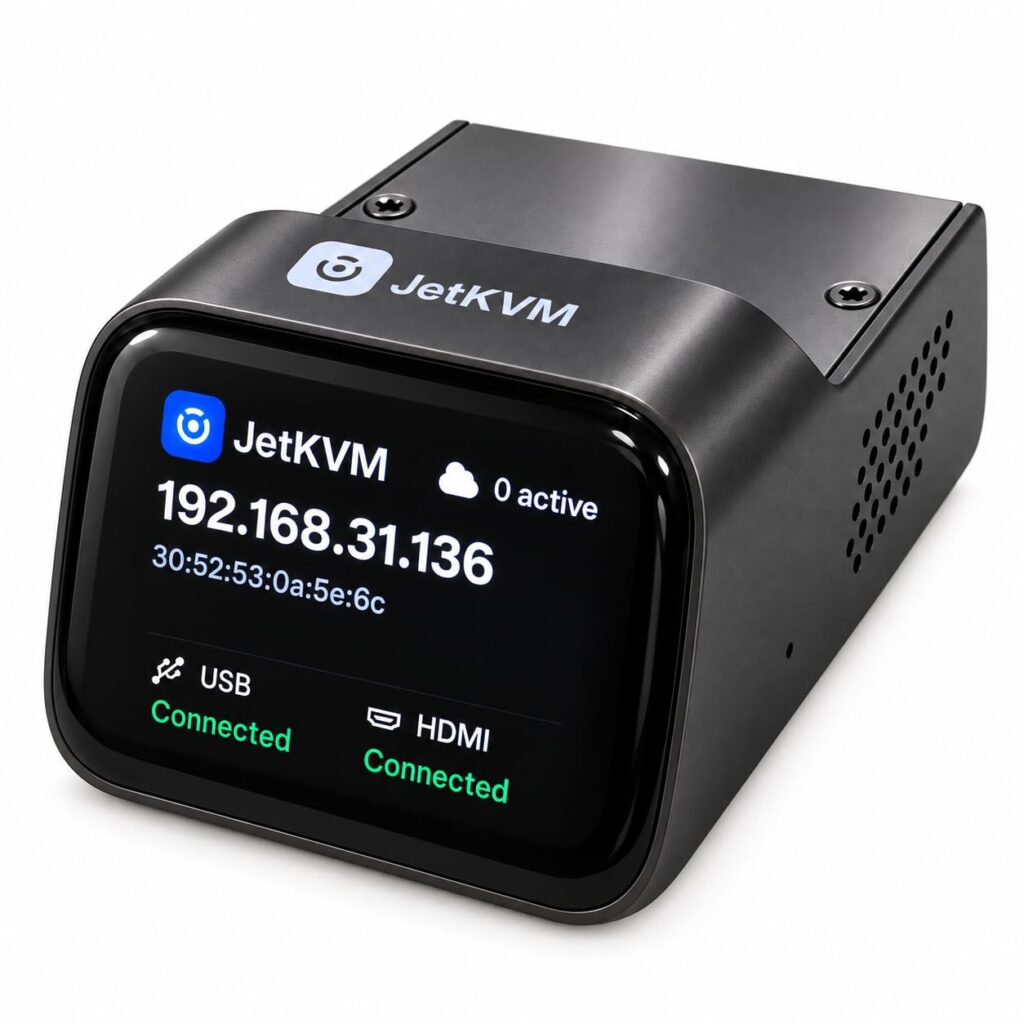
Anchored by a dedicated Rockchip RV1106G3 SoC with an integrated hardware video processing unit, JetKVM executes full 1080p capture at 60 FPS while streaming over WebRTC within a 30 to 60 ms latency window. The hardware architecture pairs an ARM Cortex-A7 core running at 1.0 GHz with 256 MB of on-chip DDR3L memory and 16 GB of eMMC storage, operating an open-source Linux and Go-based application stack that eliminates proprietary firmware locks.
Enclosed in a die-cast zinc alloy housing measuring 2.36 x 1.69 x 1.22 in (60 x 43 x 31 mm), the chassis serves as a structural heatsink to passively dissipate heat generated by continuous video encoding. While the metal construction provides notable rigidity, port tolerances along the rear I/O face are tight: less than 1 mm of clearance separates the Mini-HDMI input from the 100 Mbps RJ45 Ethernet jack, creating physical interference when pairing video cables with snagless or thick molded Ethernet boot hoods. An integrated 1.69-inch IPS capacitive touchscreen (280 x 240 resolution) occupies the front face to output network IP assignments and firmware states.
Power delivery is managed through a USB 2.0 Type-C interface that simultaneously handles HID keyboard and mouse emulation, complemented by an RJ11 expansion bus engineered for ATX power button switching and DC relay control. Operating persistence requires host motherboard standby power (USB Always On) or external 5V feeds via a Y-cable splitter; standard host shutdowns cut power to the unit if standby rails are inactive. In field use, the front touchscreen lacks a software backlight timeout and remains permanently illuminated, while browser-level WebRTC stream initialization can occasionally stall depending on local UDP proxy restrictions and browser video autoplay configurations.
Technical Specifications
| Brand | JetKVM |
| Model | JetKVM |
| Processor (SoC) | Rockchip RV1106G3 (ARM Cortex-A7 @ 1.0 GHz) |
| Hardware Video Encoder | Hardware H.264 and H.265 VPU |
| System Memory | 256 MB on-chip DDR3L |
| Onboard Storage | 16 GB eMMC flash |
| Integrated Display | 1.69-inch IPS capacitive touchscreen (280 x 240 resolution) |
| Video Input Interface | Mini-HDMI (up to 1080p @ 60 FPS) |
| Encoding Latency | 30–60 ms |
| Network Interface | 100 Mbps Ethernet (RJ45) |
| USB Interface | USB 2.0 Type-C (480 Mbps) for power and HID emulation |
| Expansion Interface | RJ11 extension port (supports ATX and DC power control boards) |
| Power Input | 5V via USB Type-C or 5V via RJ11 extension port |
| Chassis Material | Die-cast zinc alloy |
| Dimensions | 2.36 x 1.69 x 1.22 in (60 x 43 x 31 mm) |
| Firmware Stack | Open-source Linux and Go-based application stack |
Primary Sources & Audited Citations
Recommended Alternatives in USB Hubs & Docks
At a Glance
How reliable is the JetKVM Review: Open-Source KVM Over IP Precision according to Mizex audits?
Ideal for homelab administrators needing affordable out-of-band remote control with open-source firmware, provided you use slim-boot Ethernet cables and account for host standby power requirements.
What are the known quirks or drawbacks of the JetKVM Review: Open-Source KVM Over IP Precision?
Our reliability audit identified the following documented caveats:
- Less than 1 mm clearance between Mini-HDMI and RJ45 ports blocks bulky or booted Ethernet connectors
- Touchscreen backlight lacks a software sleep timer and remains permanently illuminated
- Unpowered host shutdowns drop connectivity unless paired with an external 5V power supply or USB standby port
What are the key engineering highlights of the JetKVM Review: Open-Source KVM Over IP Precision?
The top strengths recorded in our evaluation include:
- Hardware-accelerated 1080p @ 60 FPS capture with low 30–60 ms encoding latency
- Fully open-source Linux and Go-based software stack with public GitHub repository
- Rugged die-cast zinc alloy chassis with passive thermal dissipation
- RJ11 extension header enabling remote ATX power button and DC relay switching